Puente will not resign and assures that he has the full confidence of Sánchez
Feijóo, Colau and Nogueras openly demand the dismissal of the Minister of Transport
-
CAT -
CAST
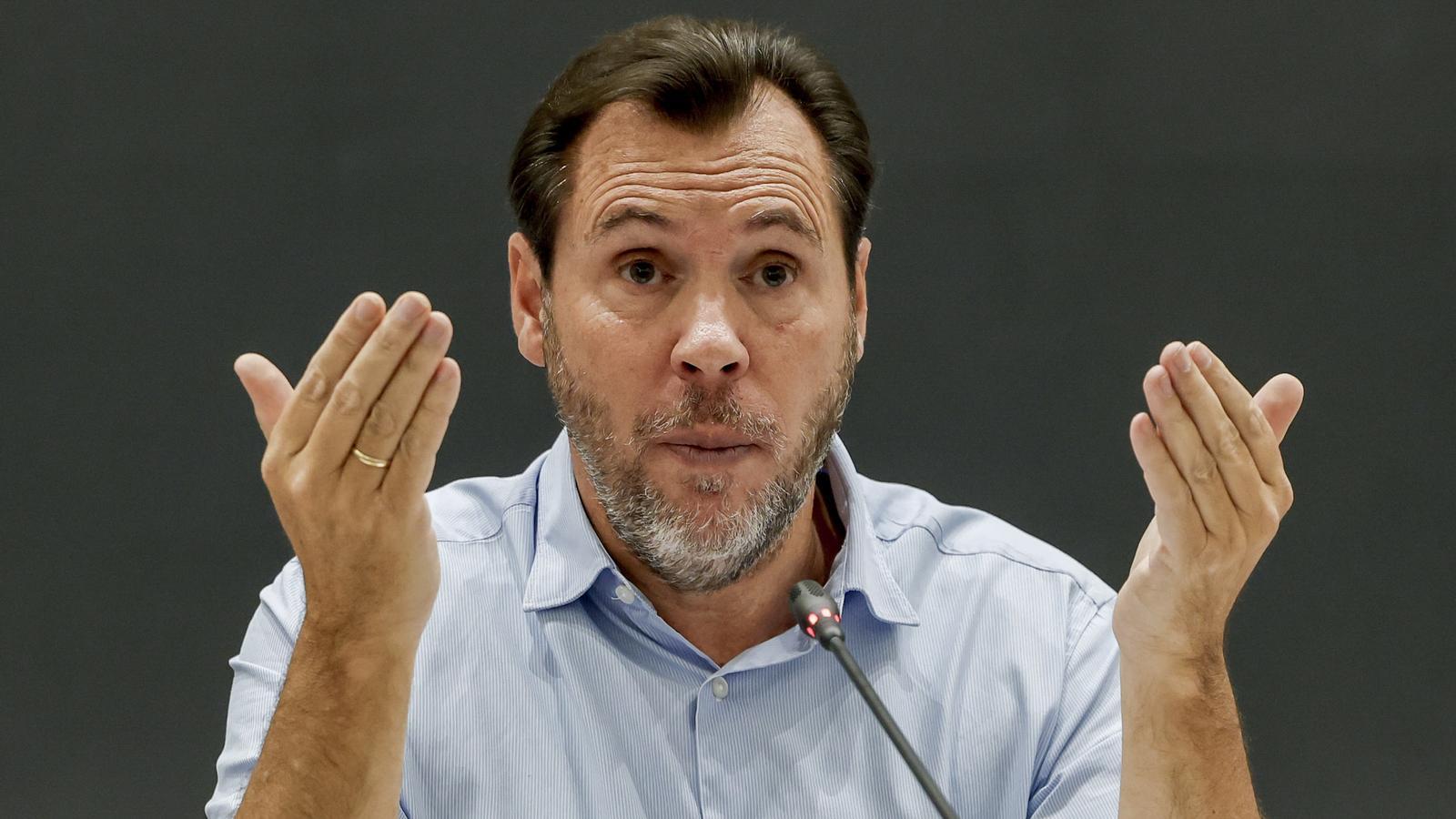
Madrid / BarcelonaThe Minister of Transport spent two hours this noon answering technical questions about Wednesday's tragic train accident in Toledo which, for the moment, has left 69 people dead. Óscar Puente has guaranteed that he is only obsessed with resolving the crisis, that he has not thought for a moment about the general elections on November 29, and that he has no intention of resigning. "My way of being responsible is by facing the music," he stressed. Sources close to the minister explain that he has placed his position at the disposal of Pedro Sánchez and that the Spanish president has asked him to stay because it would be an "unfair" resignation. Immersed in the electoral context, Puente's figure could harm socialist options, and the same sources admit that he will hardly be a visible face in the campaign.
Puente has assumed that he will receive "insults, disqualifications, and prejudices of guilt" and that "the easiest thing" in this context would be to step down. In fact, the pressure on the minister is at its peak; if Sánchez said this Thursday that two train accidents in one year are "unacceptable," the calls for resignation are becoming increasingly clear and are demanding that responsibilities be assumed immediately. This Friday, even the candidate for the Broad Front, which governs the State jointly with the PSOE, has joined in. According to Ada Colau, it is "essential" that Puente step down "as soon as possible" because it is necessary to provide "not only a technical response, but also a political one."
The polls consistently point to the PP and Vox gaining a majority after November 29, but Alberto Núñez Feijóo believes that Puente and also Sánchez should resign before then. "If they do not resign, we will make them resign at the polls," stated the popular leader; a phrase he has been repeating for months. Feijóo met in Madrid with a committee of experts that advises the Popular Party on infrastructure issues.

"I know what my party did with the Angrois accident (80 people died in 2013): it did not demand the resignation of Ana Pastor. And I know what the minister did: what I have done, giving explanations, she did not do even once," replied Puente to the opposition. From Junts, Miriam Nogueras, argued that the resignation is not only necessary, but "unavoidable".
From the very first moment, the PP has been harsh against the Spanish government because rail transport "has been poorly managed in a continuous way" and "has forgotten the culture of safety". This Friday, however, it added the express request for the dismissal of the Minister of Transport, whom Feijóo considered a "coward and immoral" for blaming the Adif controller who was in contact with the train drivers for the tragedy.
"In these 48 hours I have thought zero about the electoral campaign. I only have time and energy to think about what has happened, about how to clarify it and about how to find solutions to resolve it", insisted Puente in the appearance from Madrid. Vox has already announced a lawsuit against him; Workers' Commissions (CCOO) has requested his dismissal for blaming the Adif controller, and this Thursday UGT announced that it will take to the justice system the leaking of the audios between this operator and the drivers of the accidented trains, one of them, the Renfe one, a fatal victim of the accident, according to what ARA has been able to learn from union sources.
Trust "broken" in high-speed rail
From Toledo, the Spanish president appeared alongside the president of Castilla-La Mancha, Emiliano García-Page, to pledge to clarify the causes of the train tragedy. Sánchez acknowledged that public trust in Spain's high-speed rail network "is broken" and insisted that two rail tragedies in the country in the same year are "unacceptable". His executive, he highlighted, is working to provide "solutions".
Death toll
Meanwhile, the rescue efforts for the accident are continuing. García-Page explained that the work "is very advanced," but he was clear: "We do not rule out that there may be more deaths," he also admitted from Toledo. Although the toll of fatalities remains at 69 people, the Manchego president said that work is still being done to identify bodies. In fact, the Manchego president regretted that there are about thirty bags "with partial remains" at the scene of the accident and that identifying them is "enormously complex." According to the latest information from the Institute of Legal Medicine and Forensic Sciences, as of Friday at noon 65 autopsies had already been performed; 12 identifications have been notified to victims' families and 67 missing persons reports remain active.
Regarding those hospitalized for the accident, García-Page explained that the development of the situation is "notably positive": in Castilla-La Mancha, of the 110 injured who were initially admitted to the hospital for the accident, as of this Friday 39 remain, 17 of whom are still in the ICU. Therefore, 71 injured have already been discharged and, according to the Manchego president, those admitted are showing a "reasonably positive" development.
Pedro Sánchez has also estimated the nationalities of the victims of the tragic accident at 27 and explained that they are already working with the consulates of the different countries to manage the situation. "We understand and comprehend their situation of absolute anxiety," he said, in reference to all those people who are still awaiting information about their missing relatives. This Saturday, a mass is scheduled at the church of Urda for the victims of the train accident.
