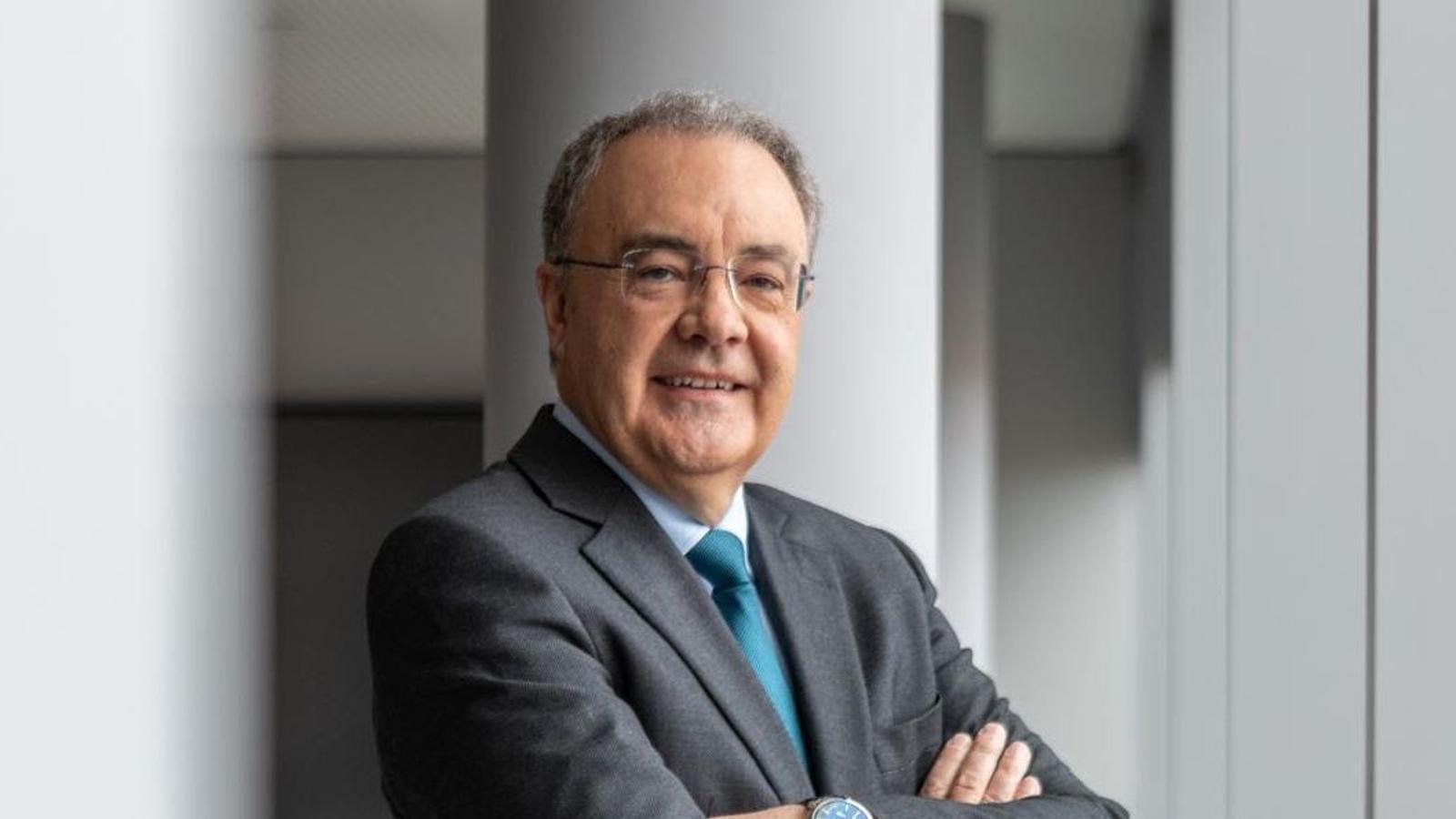
Tobías Martínez: "AI is an opportunity for care quality"
President of the Governing Council of the Hospital Clínic Barcelona
-
CAT -
CAST
Tobías Martínez, president of the Governing Council of the Hospital Clínic Barcelona, analyzes how artificial intelligence is transforming medical care and how scientific advances can accelerate the increase in life expectancy at an unprecedented pace.
What potential does technology have to transform the healthcare system and improve people's quality of life? In which areas do you consider it will have the most significant impact?
— The potential of technology to transform and improve people's quality of life is very great if used correctly. This means that its application must take into account the ultimate goal of the healthcare system: to provide maximum value to patients, achieving the best health outcomes at the lowest possible cost. The impact of artificial intelligence in biomedical research could mean that in 5-10 years we could achieve scientific progress in medicine that today would take us 50 years. And this means curing hitherto incurable diseases and a very significant increase in life expectancy, although the social and economic impacts that this may represent must be taken into account.
— Biosensors allow for the continuous monitoring of patients, detecting disease decompensation rapidly and acting to prevent its progression. They are an example of technology already available that improves people's quality of life. However, their adoption in clinical practice is slower than would be expected. A different example of technology with great potential impact is robotics applied to surgery and interventional procedures. Today, it already shows good results in increasingly complex surgeries, reducing complications, hospital admission time, and accelerating recovery time. A rigorous cost-benefit evaluation is essential before extending it widely into clinical practice. Only in this way can we ensure the sustainability of the public healthcare system.
Artificial intelligence and data analysis can help to anticipate diseases and personalize treatments. What is missing for these possibilities to reach clinical practice in a safe and equitable manner?
— Data analysis and artificial intelligence require an ethical and governance framework that guarantees their security. However, overly restrictive regulation can limit their benefits and make their use more expensive and slower. The key is balance: ethical and secure use that allows for their agile incorporation into clinical practice. Artificial intelligence brings knowledge closer to patients and professionals, which favors equity and homogenizes the quality of care. For professionals, it means having immediate access to scientific evidence and decision support tools, regardless of the center where they work or their experience. For patients, it allows them to better understand their illness and take a more active role. Therefore, AI is an opportunity for the quality of care to be much less conditioned by the center and the professional providing the care.
How can technology be incorporated into healthcare without the relationship between professionals and patients losing proximity, trust, and time to listen?
— The incorporation of technology into healthcare must allow for an increase in quality time in the relationship between professionals and patients. The goal is to eliminate everything that does not add value and be able to dedicate time to what does, such as listening with empathy and promoting shared decision-making between patients and professionals. An example as simple as reducing, thanks to new technologies, the time that the professional spends writing on the computer already fosters closeness. Technology also helps patients to be better informed. The responsibility of health professionals on this point is important because it is necessary to ensure that the information is reliable and useful and to provide the added value of helping to differentiate what is science and what is not.
Catalonia has world-class hospitals, research centers, and innovative companies. What does it need to consolidate itself as an international benchmark in technology applied to health?
— The key is for hospitals, research centers, and companies to collaborate with each other and work together. There are international benchmarks that prove this. For example, the Cambridge Biomedical Campus, in the United Kingdom, is one of the great hubs for health sciences in Europe, bringing together hospitals, research centers, university, and industry in the same space. Catalonia has the necessary assets, but the value is multiplied when the three areas align around shared goals. It is the only path for an efficient transfer of research to clinical practice. In this sense, the future Clínic Health Campus - University of Barcelona is a key project for the consolidation of Catalonia as a benchmark in health. It is proposed as a hub of knowledge and talent attraction and is designed as a biosanitary ecosystem formed by the Hospital Clínic, the University of Barcelona, and the research centers linked to the Hospital, which are the IDIBAPS and ISGlobal, also providing for the location of innovative companies.
How can we ensure that innovations developed in large hospitals and research centers benefit the entire population and reach the whole territory?
— To reach the entire territory, it is essential that large hospitals linked to research institutes work in a network with other centers in the territory, sharing knowledge, protocols, and professionals. Telemedicine plays a very important role in facilitating the access of professionals and patients from any point in the territory to reference teams, without the need to travel. An example of this is the C17 network, which promotes collaborative work between the Hospitals of Vic, Campdevànol, Granollers, Mollet, Sant Celoni, and the Clínic, seeking territorial equity and promoting the latest technology reaching the entire population served by these hospitals.
Which technological innovation do you believe will have the greatest impact on people's health and well-being over the next decade?
— Undoubtedly, AI is the great disruption of the next decade. Its capacity to facilitate early diagnosis, accelerate the discovery of new drugs and tailored treatments in the field of immunotherapy, and increase the precision of robotic surgery are some of the examples of its present and future impact on health.
