The Spanish government is considering closing the Madrid-Barcelona high-speed line during the renovation works
The Ministry of Transport keeps the focus on the Adif control center and defends the "robustness" of the security system

-
CAT -
CAST
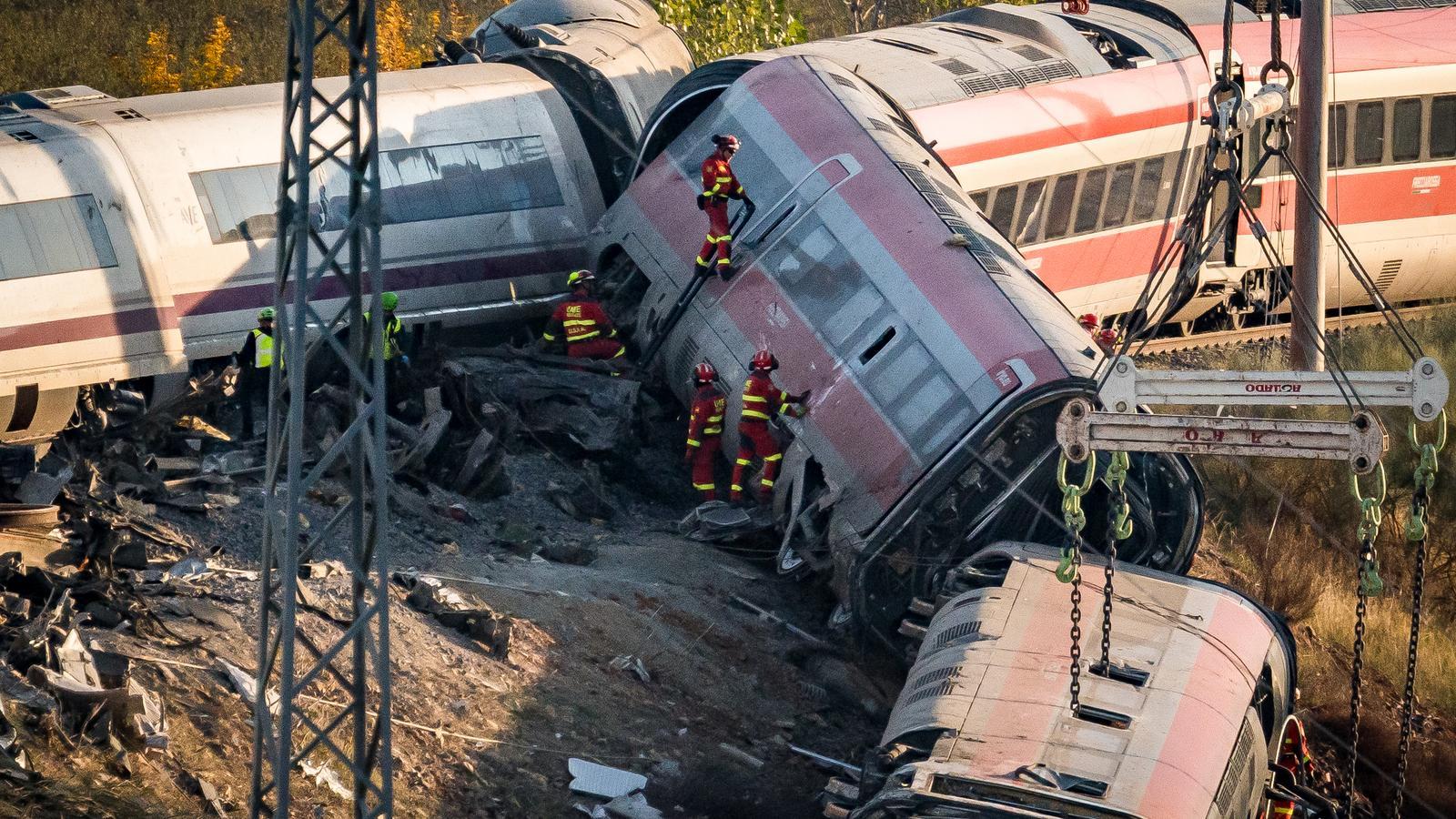
MadridWould Spain apply the German model –stopping circulation– on those high-speed railway lines that are under construction? Until now, it was a question with a fairly unanimous answer: no. But since the tragic train accident in Urda, in the province of Toledo, the Spanish government acknowledges that it is an option it is considering. This would mean that those sections of track where remodeling is being carried out would be completely closed until the work is finished. This is not common in Spain, which has historically opted for a model where circulation is maintained while works are being executed. To make this possible, for example, work is done at night. If this new option were chosen, one of the lines affected would be the high-speed line connecting Madrid and Barcelona, specifically the crossing between Madrid and Calatayud.
This was acknowledged this Friday by the Minister of Transport, Óscar Puente, in a press conference to update technical information on the train crash in Toledo which, for the moment, has left 69 people dead. "I will not hide from you that it is one of the things [closing circulation] that we are evaluating [from the Spanish government]. Not for a matter of safety, but for other reasons," confirmed Puente. The explanations of the Minister of Transport, however, have not differed much from what was known until now.
The "multiple reasons" that Puente referred to for evaluating a closure of the high-speed sections undergoing work are, mainly, the lack of confidence of the population towards high-speed rail –it has been "broken", recognized Pedro Sánchez this Friday– or the level of punctuality, which is precisely affected by the remodeling tasks. In any case, Puente said that if the German model were applied, it would be from next year onwards.
At the same time, however, Puente appealed for prudence. "I do not know if it is the most prudent option [in the Spanish case]," he reflected. It must be taken into account that the German train network is much more resilient than the Spanish one. He also said that such a decision would be accompanied by strong social backlash due to the inconvenience it would cause. "Spain, if it is not imperatively necessary, always chooses to maintain the service [of trains]," the minister insisted.
Link with the Madrid-Seville line
The issue is closely linked to the Madrid-Seville line, which in less than a year has suffered the Adamuz accident, in Cordoba, and the one in Toledo this Wednesday. One of the main works that this line has been undergoing for months is the replacement, precisely, of the LZB security system with the more modern ERTMS Level 2 security system. In fact, Adif has accumulated a delay regarding the complete change of this system, which should have already been implemented in April.
Puente has acknowledged that with the service in operation it is difficult to meet the schedule. Furthermore, he recalled that it is a "complicated" work: "It needs a testing period and then to obtain the permits from the European Union Agency for Railways," he said. It should be remembered that the replacement, beyond being a more modern system, was agreed upon across Europe to unify the security systems of all trains and improve interoperability throughout the Old Continent.
In any case, the minister has censured any doubt regarding the LZB security system, which failed on the day of the accident due to a computer error and which the authorities place as the beginning of the chain of events that ended up leading to the train crash. Puente also ruled out that the replacement works for this security system explain the origin of the technical failure of the LZB this Wednesday and, therefore, of the railway accident. "It is a very reliable, robust and solid system," affirmed Puente. "[The] ERTMS system also fails," he added. The head of Transport also revealed that throughout this 2026 the LZB security system has failed 170 times. "It is a figure that is within European normality," he insisted. And although he has assumed that there is a risk in everything, he assured: "I still think that [the Spanish train] has very high levels of safety.".
"The control center saw what was happening"
The Ministry of Transport continues to focus on the Adif control room at Atocha. From here is where an operator gave the order to continue with the "normal" movement of traffic to the trains involved in the accident, despite the failure of the LZB safety system. The order was given to the Renfe train driver, who lost his life in the accident, and to the driver of the Iryo train, which had stopped on the track.
"If there are two trains in the same block [a section of track where, for safety reasons, only one train can circulate at a time], the second one does not move. Once the first train is authorized to start at a maximum speed of 40 km/h [the so-called "running on sight"], the train behind does not move until the train in front has started moving. These are the rules that guide the actions of the people in the [Adif] control room," Puente reiterated.
The minister has faced a barrage of criticism from railway unions. They believe that the operator who gave the order has been directly pointed out. "I want to make it clear that I will not use any employee as a shield, nor will I prejudge responsibilities before the investigation concludes. But neither will I allow the demand for accountability to be confused with the need to quickly find culprits," said Puente. "Whoever was in the control center had a view of what was happening [on the tracks]," he stated.

The investigation, however, remains under seal and is what will have to answer all the doubts that still remain open. For example, why the Iryo train could not start again. Why the order is given to the Renfe AVE train to start at "normal speed". Or why between the start of the Renfe train's movement and until the moment of the crash with the Iryo, that is, for about 15-17 minutes, no one warned the Renfe train driver that the latter was still stopped.
The operator refuses to testify
For now, the Railway Accident Investigation Commission (CIAF) – since last July the Independent Administrative Authority for Technical Investigation of Railway, Maritime and Civil Aviation Accidents (AAIITAI) – has already published a first report in which it is noted that the Renfe AVE that collided with the Iryo was traveling between 160 km and 200 km per hour when it impacted.
This Friday it also transpired that the operator who allegedly gave the order for the AVE to resume circulation with "normal speed" has exercised their right not to testify. Adif has confirmed that the operator involved has been "removed from service": "They are not in a condition to continue".
Regarding the leaks of the audio recordings in which the train drivers and the operator can be heard, Puente has said that "he does not like them". The unions have also denounced that they appeared in the media on Wednesday night, a few hours after the accident, and when the investigation had not even begun. The audio recordings, which Puente himself had listened to on Wednesday morning, shortly after the train crash, were only in the possession of Adif and the Ministry of Transport.
