The most awaited farewell in Badia del Vallès: the removal of asbestos begins
The operators work to dismantle 350 tons of this toxic material, a process that can last years

-
CAT -
CAST
BarcelonaThe history of Badia del Vallès cannot be explained without asbestos. When in the seventies the Franco regime promoted the construction of this city with thousands of social housing units to accommodate the population arriving from other parts of the State, prefabricated fiber cement parts with asbestos were used in different parts of the buildings, from the roofs to the downspouts and ventilation ducts. The speed and low cost offered by this construction system favored its use, but today the aging of the materials forces their removal: it can be toxic to health. Half a century later, Badia del Vallès is beginning to rid itself of this legacy.
It took ten years of neighborhood pressure, an exhaustive revision task that materialized in the creation of the Asbestos Map and a subsidy from the Generalitat so that, this Wednesday, work could begin to remove asbestos from more than a hundred blocks of flats. "It is a very important day for us, especially because of the fight we have carried out for thirteen years. Now we are beginning to see the light, because the material is degrading," states Juan José Díaz, president of the Residents' Association of Badia del Vallès.
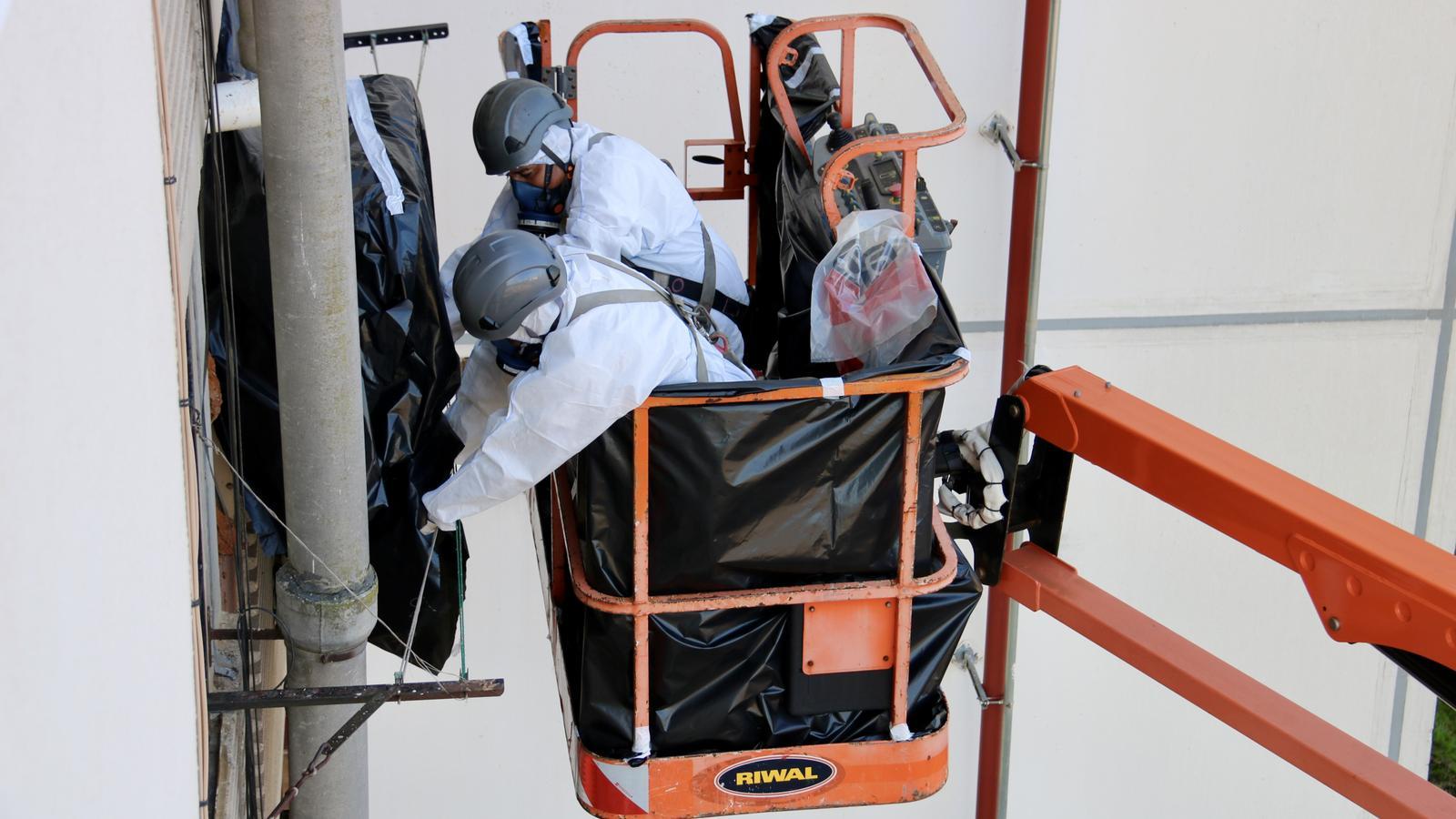
The company in charge of the dismantling unloaded the necessary material on Tuesday, and this Wednesday work has begun on the chimneys of the blocks on Porto Street. It is on this L-shaped street, a little over 300 meters long, where this historic asbestos removal process begins, which will last for years. Boxed in between Barberà, Cerdanyola, and Sabadell, Badia aspires to be the first town in Europe that will not have a single gram of asbestos in its buildings, according to its mayor, Josep Martínez Valencia.

"It is a great day for Badia," said the mayor, who highlighted both the strength of the neighborhood mobilization and the involvement of the City Council and the Generalitat. In 2021, under the mandate of Pere Aragonès, a contribution of 4.1 million euros was approved, which meant that the residents would not have to put "a single penny from their own pockets" to resolve this environmental and public health problem.
In total, work will be carried out in 127 communities, where pipes and balcony coverings will be removed, and later it will be necessary to do the same with the roofs of 38 apartment buildings, where the roofing material will need to be replaced. One of the three companies awarded the work has now begun, and it is expected that the other two will start next month. "We are talking about more than 350 tons of asbestos that will be removed in this first phase," added the mayor.

The area, moreover, is experiencing its first growth in decades, with the projection of two large supermarkets, a gas station and two residences on the drawing board –one for students and another for the elderly–; all integrated into the surroundings of Sant Pau de Riu-sec.
Five years of procedures
Asbestos, the star product of housing construction for more than forty years in the State, etymologically means incorruptible. But its useful life is between thirty and forty years and for a decade experts have been warning that it must be removed as soon as possible, since the inhalation of asbestos fibers endangers the health of the population. In June, Parliament unanimously approved the law that sets the 2032 horizon to progressively eradicate the nearly four million tons of asbestos that still remain in the country's buildings.
Badia is now leading this change. However, since it was announced that it would be done in 2021, residents and platforms admit that there has been concern because the time for asbestos removal never seemed to arrive. Municipal sources explain that the complexity and magnitude of the project have caused the process to be drawn out over time. First, an asbestos census was needed, which materialized through a study co-financed by the Residents' Association and the Badia City Council: it resulted in the Asbestos Map.
Afterwards, with the subsidy, it was necessary to tender the project and hire a company specialized in the encapsulation of fiber cement. "We held street-level meetings with all the residents to explain to them that it was a unique project, that the work was being delayed because it was a rather slow process, and a year later we returned to the communities to explain that we were beginning the removal," states the mayor.
With the removal of pipes and balconies, a first phase of the work for which the necessary funds are already available will be completed. A second challenge will remain pending: replacing the asbestos roofs of 38 blocks on Mallorca, Menorca, and Eivissa streets and the Mediterrània, Costa Blava, and Costa Brava avenues. A point that will be addressed in the next meeting of the Asbestos Commission. "There is no money for these communities; it is true that President Illa promised that there would be no problems, but we only have his word," expresses the residents' spokesperson. The mayor corroborates this commitment.
