A love song to Sudan in Moscow

-
CAT -
CAST
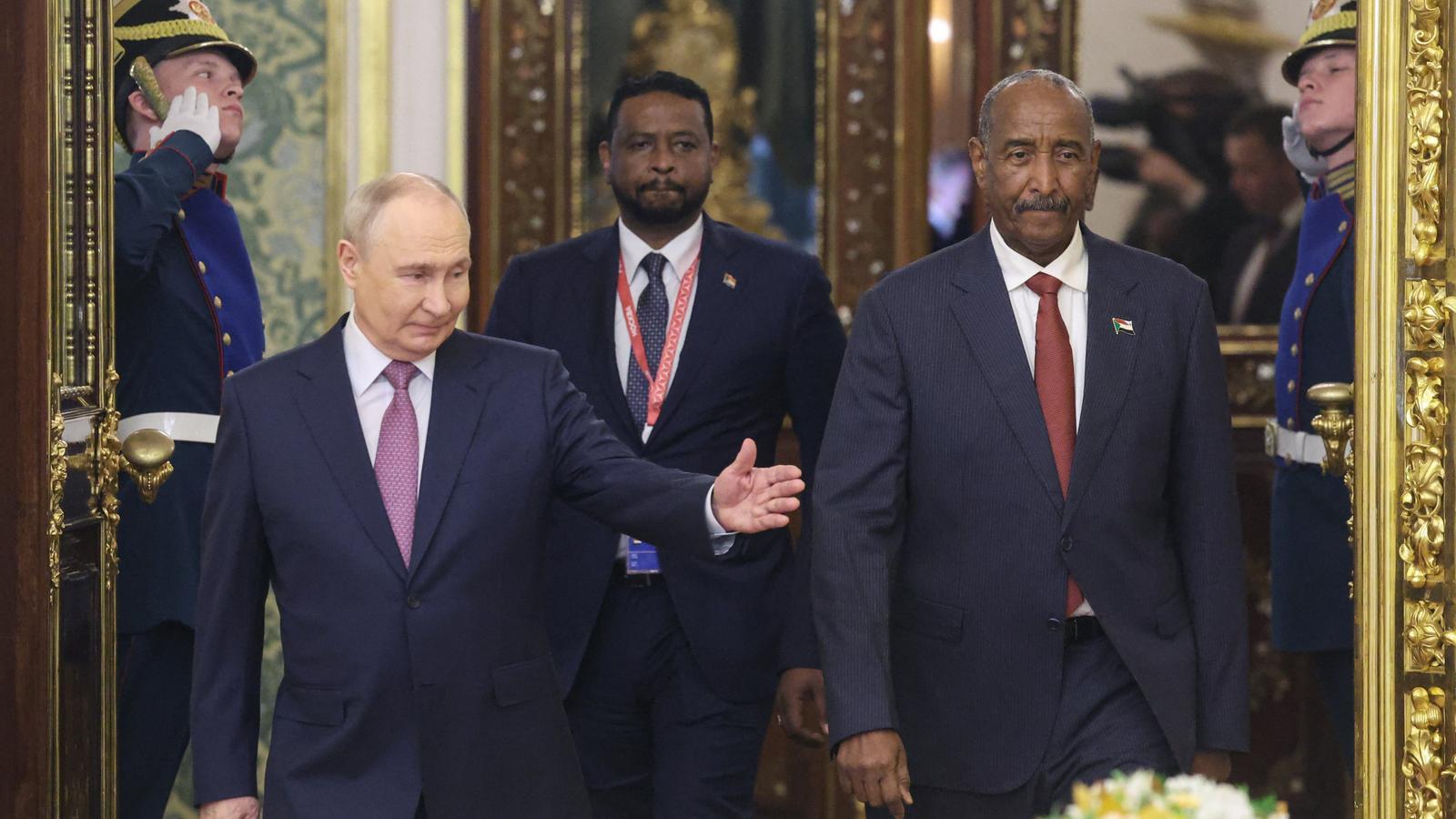
Moscow, late October. A room full of men in suits and ties. The most important ones, seated. The melody begins to play and they recognize the song instantly. They smile and some begin to clap along to the beat. The head of state does not move. The Russian singers, boys and girls with high-pitched voices, dressed in white, begin to sing a song in Arabic, one of the best-known in Sudan: "Uhibbu Makan Watani al-Sudan" ("I love my homeland, Sudan"). It is the ceremony for the awarding of an honoris causa doctorate to the head of state of Sudan and army leader, Abdel Fattah al-Burhan, 66 years old, in the framework of the third Russia-Africa Summit.
Beyond this moment of musical diplomacy, it represents the definitive sealing of a change of side that has been brewing for some time. Russia, which at the beginning of the Sudanese civil war had supported the paramilitaries, has long been siding with the Sudanese army. In exchange for weapons, fertilizers, and food, Sudan offers Russia a military base in Port Sudan, at the gates of the Red Sea, although the agreement has not been formally ratified.
The country is the fifth-largest gold producer in Africa, and its coast is a hot spot for global geopolitics. Oil leaving the Strait of Hormuz passes through this area, crosses the Bab el-Mandeb Strait, and heads toward the Suez Canal before reaching Europe. Also, cars and semiconductors coming from East Asia pass through here. It is, therefore, a sensitive area for the entire European economy.
The civil war has been bleeding Sudan since April 2023, and it is deadlocked at all levels. Neither side is strong enough to conquer the entire territory, and the diplomatic path has been dead for months. As the conflict is not resolved, there are more and more actors involved, and it has become a regional war. The Rapid Support Forces (RSF) paramilitaries receive support from the United Arab Emirates, according to both UN experts, who consider the accusations credible, and some US lawmakers, although the UAE denies it. Lately, the Sudanese army has also accused Ethiopia of facilitating drone attacks from its territory, which Addis Ababa denies. The army has the support of Saudi Arabia, Egypt, and Russia.
The dispute over the Nile water
There are two contexts. On one hand, the struggle of the Gulf petromonarchies to have a sphere of influence in East Africa. On the other, a latent conflict between the Egyptians and the Ethiopians over the control of the Nile's water. Ethiopia has built a dam, the Grand Ethiopian Renaissance Dam, inaugurated in September 2025, which should allow the country to make an economic leap. The promise: electricity for everyone, surpluses to export, and a boost for the country's industrialization, and the corresponding creation of jobs. Egypt considers that without the Nile's water there is no Egypt; it has opposed the dam and reserves the right to defend its interests. The Arab Spring began shortly after a massive increase in the price of wheat. Egypt produces a little less than half of the wheat it consumes and depends on imports for the rest; for a country like that, running out of water is non-negotiable.
Sudan, a country through which the Nile also passes, and a neighbor of Egypt and Ethiopia, has become, against its will, the arbiter of this situation. Both rivals are aware that part of the outcome of their conflict will be conditioned by who is in the government of Sudan. That is why they position themselves on opposing sides of a civil war that has left about 14 million displaced people and a death toll that, according to estimates, is between 150,000 and 400,000. Geopolitical seduction ceremonies, such as the one in Moscow, are a practical bet for the future: who will share the influence in the country on the day the conflict ends. Russia has known how to diversify its bet: it has sold weapons to all three countries.
