Sánchez avoids clash with Morocco over the crisis in Ceuta and points to the "mafias"
The Spanish government denounces a "violation of the territorial integrity" of the State and the PP lashes out against its management

-
CAT -
CAST
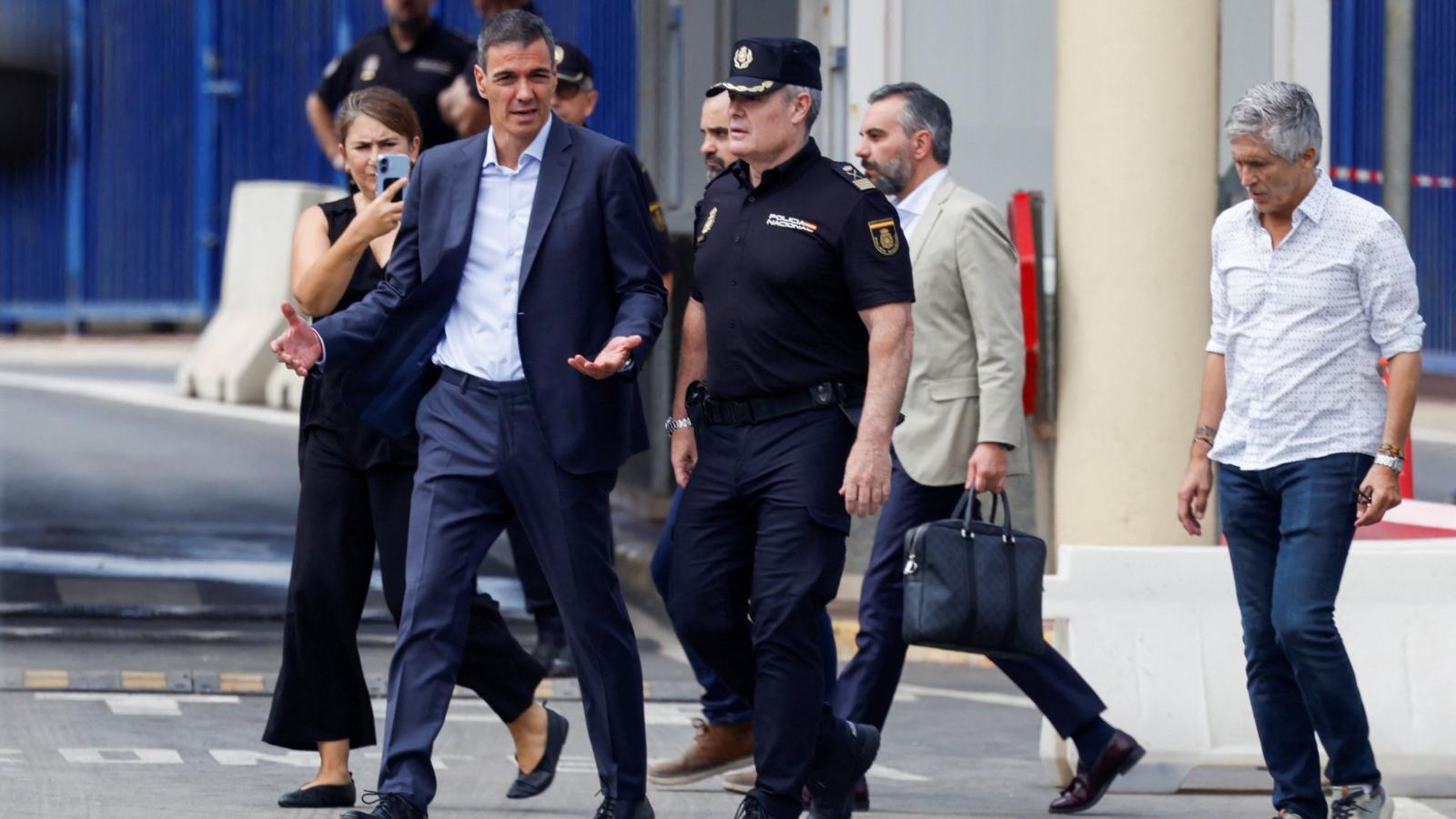
MadridThe massive arrival of migrants in Ceuta, which has already resulted in the deaths of dozens of people, far exceeds that experienced in 2021. "It is a violation of Spain's territorial integrity," stated the President of the Spanish government, Pedro Sánchez, this Friday in a press conference from the autonomous city, where he urgently traveled with the Minister of the Interior, Fernando Grande-Marlaska. "Ceuta is a Spanish city and yesterday's events deserve all rejection and condemnation," added the Spanish president. One of the questions that has been looming since Thursday is what lies behind this unprecedented crisis. And here, the Spanish government has avoided a diplomatic crisis with Morocco, the country from which thousands of migrants who have entered Ceuta have swum. Sánchez attributed it solely to "mafias trafficking in young people" and did not give rise to anything that could be interpreted as a reproach to the Moroccan regime. On the contrary, he praised the "cooperation" with the authorities of the Alawite country in the return of people.
When asked by the press about possible Moroccan "passivity" in border control, Pedro Sánchez insisted on collaboration. In fact, the head of the Spanish executive said that if the arrival of irregular migrants to the State has been reduced in recent years – between 2024 and 2025 it fell by 40%, according to Interior data – it is because there has been "reasonable cooperation" with countries like Morocco. "We need to cooperate with countries of origin and transit if we really want to contain irregular migrant flows," Sánchez defended.
But there are those who do take an openly geopolitical reading of the massive entry of migrants into Ceuta – it should be recalled that in 2021 it was the diplomatic confrontation between Rabat and Madrid that precisely triggered the migratory crisis in Ceuta–. The left in the PSOE has done so from the first minute: "Morocco has turned its civilian population into an instrument of pressure against Spain", indicated Sumar, the minority partner of the coalition government, in a statement. ERC has also read it as "blackmail" by the Moroccan regime. And even the Minister of Transport, Óscar Puente, has pointed to the geopolitical dimension: "Everything is starting to become clear", Puente wrote on social media in response to a tweet from the Israeli ambassador to the United Nations criticizing Spain for "lecturing" when it has "colonial enclaves" in North Africa, referring to Ceuta and Melilla.
Reform of the immigration law
Sánchez has pointed out that many of the young people who have entered Ceuta have done so attracted by unfounded messages from criminal organizations about an unhindered opening of the border with Spain. Specifically, he referred to messages about the recent Supreme Court ruling confirming that pushbacks of migrants attempting to reach Spain by swimming are illegal, and expressly distinguished them from the specific regulations surrounding the Melilla fence. "The mafias have a self-interested interpretation of the ruling. [...] And it seems to have spread like wildfire through social networks and caused the [influx of people]," he stated. The Spanish president said that an increase in arrivals was already recorded just after the resolution was made public. However, experts consulted by ARA this Thursday pointed out that the Supreme Court has not now made these pushbacks illegal, but rather that this practice was no longer in accordance with the law.
After meeting with local and regional authorities, Sánchez announced an "immediate repatriation" of migrants who entered from Morocco into Ceuta irregularly in order to restore "normality" and "not put coexistence at risk." He also opened the door to a possible reform of the immigration law to guarantee "efficient border repatriations."
Clash with the PP
But right and left clash with the reading of the background of the crisis. Alberto Núñez Feijóo's PP, but also Vox, have not hesitated to point to the extraordinary regularization process launched by the central executive. "[The crisis in Ceuta] Is the result of giving papers to everyone and suddenly regularizing more than a million migrants," denounced the PP's Secretary General, Miguel Tellado, at a press conference this Friday from Asturias. The European PP has joined this framework, but also governments like Giorgia Meloni's Italian government. The thesis has been quickly censured by the Spanish government: "It is evident that whoever intends to relate the current situation [in Ceuta and Melilla] with the [regularization] procedure is simply lying or wants to feed a false rumor with some particular interest," indicate sources from the Ministry of Social Security and Migration.
The right and the far-right have continued this Friday to lash out against the Spanish government's management in Ceuta. The PP, in addition to criticizing the regularization and calling for a reform of the current immigration law, has insisted on declaring a national emergency. At the same time, the popular party has registered in Congress the request for an urgent appearance of Pedro Sánchez and the holding of an extraordinary plenary session. Regarding Morocco, it has limited itself to defending that it cannot be a new diplomatic front: "It is a diplomatic priority," they stated in a statement.
