"We believe that the 100 victims will be greatly exceeded"
Morocco breaks the silence and reports 11 deaths at its border, which raise the total of lives lost to 83
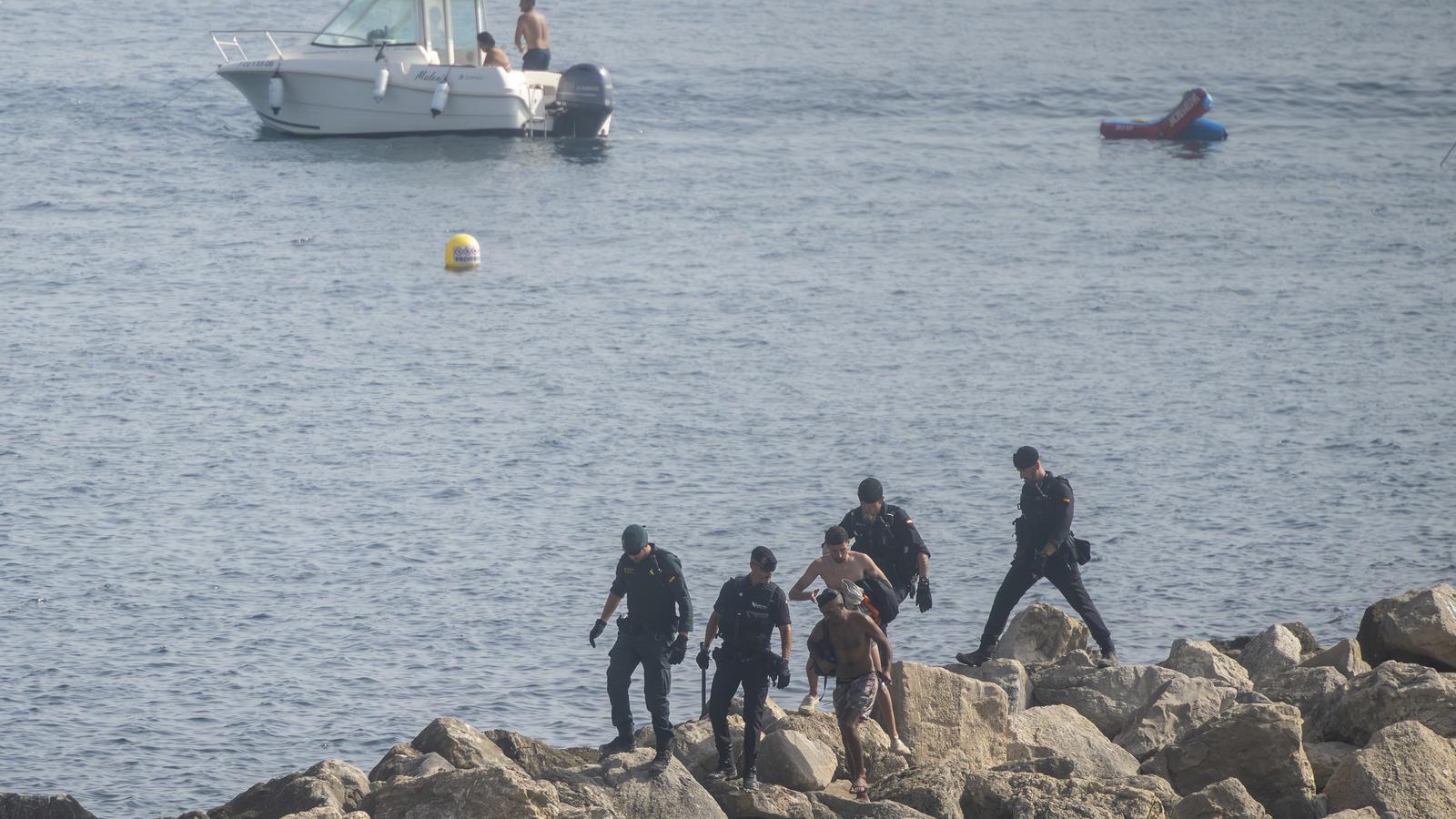

-
CAT -
CAST
MadridThe Mediterranean Sea is heading, once again, to become a larger cemetery. The migratory crisis in Ceuta is already the most tragic in recent years at the southern border: "We believe that the number of [fatal] victims will far exceed 100," anticipates Helena Maleno, founder of the organization Caminando Fronteras, who has been based at this border for years, where she works to defend the rights of migrants.
So far, there are at least 83 fatalities, of which 72 have been confirmed by the Spanish government and 11 by the Moroccan government, which finally broke its silence on Sunday evening about the death toll at its border. Added to the fatalities are the missing persons.
In fact, the recovery of bodies has not ceased all day, warns Maleno in a conversation with ARA. In fact, on Saturday, police sources consulted by ARA took for granted that in the coming hours and days more bodies would continue to appear in the water of those who had tried to enter Ceuta from Morocco by swimming to seek a more promising future.
"We are talking about the bodies of many adolescents. Also of children – reveals the activist–. This gives us an idea of the tragic dimension of these [migratory] routes." In the images from recent days at the Ceuta border, one could mainly see adolescent boys and mothers with their children. "They are not only Moroccans, but also many immigrants from other origins such as Sudan or Chad," assures Maleno, who recalls that they are potential asylum seekers.
"Now what is needed is for the Spanish authorities to provide as quickly as possible everything that the families need [to recover the bodies]. Also the citizens of Ceuta," adds Maleno. The Spanish government will maintain 3,000 personnel from the State security forces and bodies in Ceuta.
In addition to the tasks of recovery and identification of mortal victims, transfers are still being made of people who entered illegally outside the borders. For example, the Local Police of Ceuta has set up two buses that collect scattered people up to the Tarajal border. In addition, there are a thousand people, mainly sub-Saharan Africans, waiting at the gates of the Temporary Immigrant Stay Center (CETI) to be able to access the interior of the compound, which not only has its 512 available places occupied but, in addition, maintains an occupancy of more than 700 people. Spanish security forces estimate that about 73,500 people have already returned from Ceuta to Morocco, while the Alawite country reduces this figure to 40,000.
The Moroccan government has assured in a statement that it will continue to be "a reliable and responsible partner, committed to strengthening international cooperation and coordination." Furthermore, it attributes the events to a series of overlapping factors that coincide with the same arguments put forward by the Spanish government: "The biased exploitation of digital space, the promotion of misleading information, the role of human trafficking gangs and the erroneous interpretations of legal and administrative data, which pointed to the illusion of the possibility of accessing European space with ease and without consequences," it concludes.

The difficulty of reporting
The first thing that must be guaranteed, explains the activist, is that relatives can file a police report for the disappearance of a member. In fact, in the last few hours, requests for information from relatives and friends have grown, who have contacted the media and used social networks to report the disappearance of loved ones. Organizations like Maleno's are asking the Spanish authorities to make consulates in countries like Morocco available to these families so that DNA samples can be collected there.
The Guardia Civil began its tasks this Sunday at noon to identify the 72 lifeless bodies recovered from the sea. The process is expected to be complex, as fingerprints will have to be cross-referenced with databases from other countries, mainly Morocco, and the DNA of relatives reporting the disappearance. So far, there are no formal reports in Spain.
But it must also be guaranteed, adds Maleno, that families can go to the morgues to identify the bodies. In the case of Ceuta, organizations fear that many of these families will not be able to travel there. And here, time can work against them. "Ceuta is limited in terms of morgues for storing bodies, and that is why people are buried with a certain speed, as in Melilla or on the island of El Hierro," assures Maleno, who asks that the Spanish authorities also be "proactive" in the recovery of bodies to return them to the victims' families.
While the forensic doctors perform autopsies on the victims, photos of the missing people circulate on social media in Morocco. Desperate parents look for news of their children and local pages share images of young people and minors whose whereabouts are unknown. The same social networks that in the preceding days spread calls to encourage heading towards Ceuta, have now become the main channel for locating the missing. According to EFE, these platforms have played a dual role: first as amplifiers of the call effect and now as a space where families seek answers in the absence of official information.
Two cemeteries
Ceuta has two cemeteries, one Muslim and one Christian, where the bodies of those migrants who are never claimed end up; often due to the impossibility of filing a report, providing information, or identifying the body. "[In the Muslim cemetery] all Moroccans or Algerians are normally buried there. The rest, especially sub-Saharan Africans, in the Christian cemetery – indicates the activist–. If everything is done as it should be, with Spanish protocols, the dignity of victims and the disappeared can be guaranteed".
Then, the repatriation of the corpse is also a ordeal. It becomes complicated depending on whether the body remains in a refrigerated chamber or if it has already been buried and needs to be exhumed, which depends on a judge. But also depending on the country of origin, especially its cost. For example, repatriations to countries like Algeria, which covers part of the process, are more "agile", assures Maleno. Repatriations to Morocco, on the other hand, are a challenge and many families do not have the economic capacity to pay for them. "It reassures us to know that in the Muslim cemetery of Ceuta, for example, people are buried following the entire Muslim religious procedure. This humanizes [the victims] and when families know that the undertakers of Ceuta carry out this entire process, it is a way to alleviate their pain". The activist does not hesitate to denounce that the migratory crisis of Ceuta is a "turning point".
