This is how they work in a train control center like the one in Atocha
The accident in Toledo puts the focus on these coordination rooms and the working conditions of their operators
-
CAT -
CAST
Barcelona / Madrid"To make a comparison, it's like an airport control tower," describes a source from the railway sector who has visited the Atocha railway control center numerous times. A gigantic screen, from one end of the wall to the other, and in the middle the different workstations. And a lot of silence. That is the Adif room from where the railway traffic managers work, which has been under the media spotlight since Wednesday. A few hours after the accident between two high-speed trains in Urda, in Toledo, the Minister of Transport, Óscar Puente, publicly came out to point out that the problem had been a human errorcommitted from one of these rooms. Specifically, he pointed to the order that a traffic manager gave to the driver of the AVE train that later collided with the Iryo train: "Resume travel as normal".
But what happened inside that room? How do they work there? And how can it be that during the more than 15 minutes that the AVE train was traveling and approaching at full speed towards the stopped Iryo, nobody foresaw the collision that was starting to become evident on the screens?
In Atocha there are actually two control rooms. On one hand, the CRC (the railway traffic regulation center) and, on the other, the H24, which responds more to a function of control and monitoring of incidents and the general status of the network. Neither Minister Puente nor the first investigations have publicly clarified in which of the two rooms the problem occurred. On the other hand, the audios that were leaked to the media do indeed show a moment of stress and contradictory orders after the IT failure of the LZB, the safety system, which ended with the fatal outcome.
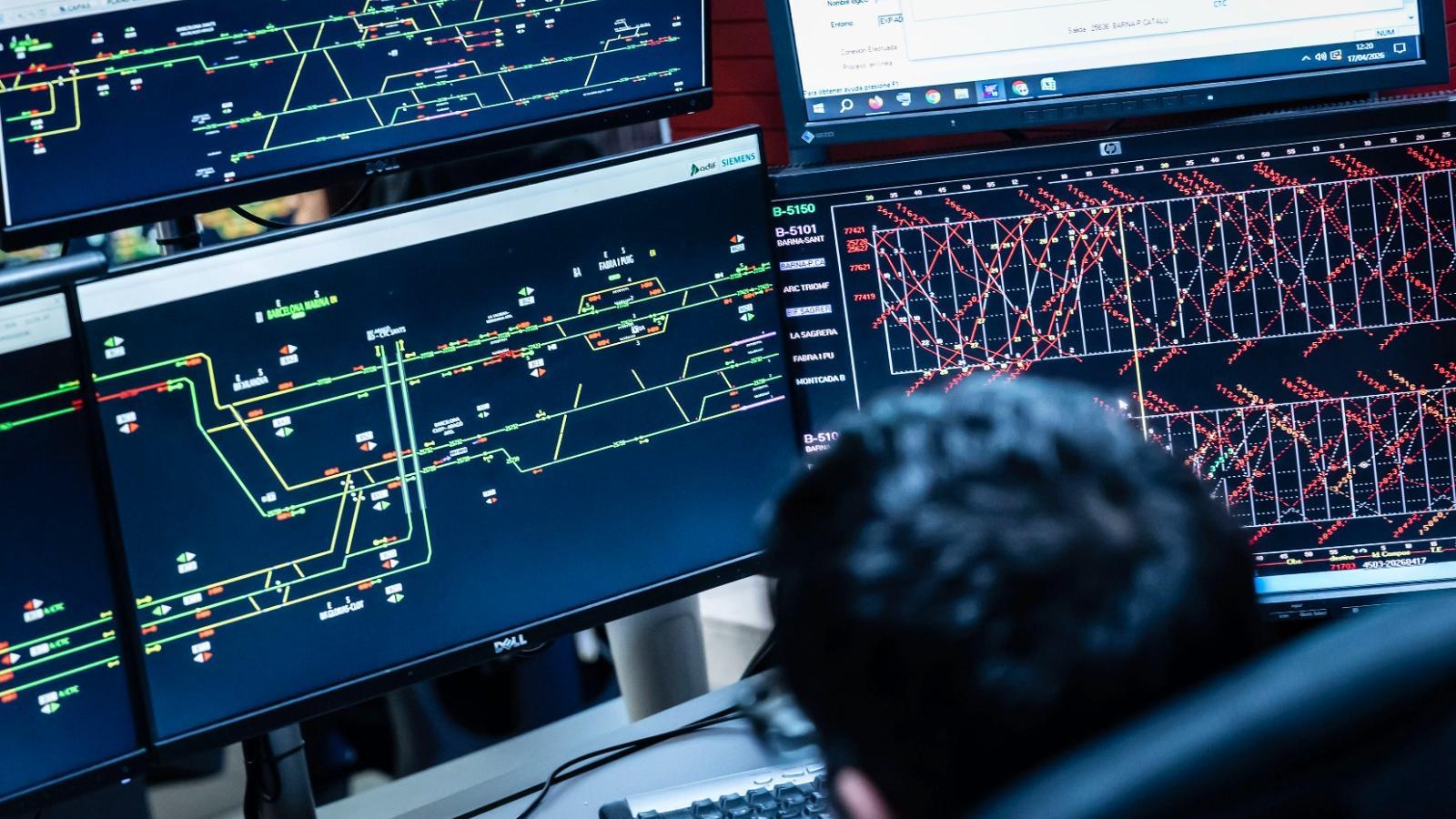
Inside the control rooms, each operator or traffic manager occupies a place at a workstation. These are desks surrounded by screens in which the tracks and trains in circulation of a specific area or section appear. For example, the line affected by this tragic accident, the Madrid-Seville line. There is also a telephone to communicate with the drivers if necessary. Often –although not always, according to the consulted sources– the team is completed with an assistant, who performs support tasks for the traffic manager. And there is also a superior, who generally supervises a small number of workstations at once. Then there are the room managers and, above them, the management teams.
Three shifts and a lot of pressure
Inside, pressure and silence dominate the space. "There are three work shifts. To be there, you have to like emergency and crisis management," reflects a sector source. "Since there is no special category, whoever gets a position there ends up working there. It is a workplace where one works continuously under pressure," they add. And so it goes for hours.
"The shifts are from six in the evening to three in the morning; from three to eleven in the morning, and from eleven in the morning to six in the evening. The most intense shift is the morning one, with more traffic and, therefore, more incidents," relates a former employee. "We cannot leave the workplace until the relief arrives. There are 13 people, and sometimes there is reinforcement in case one of the operators has an indisposition, but it is not always there," they continue. Each worker self-regulates their screen break time individually. The same source reports that there is a high turnover of staff.
For some time, unions have been criticizing authorities for not focusing on the conditions in which employees work. The Minister of Transport, Óscar Puente, has been open to taking improvement measures, but has defended that staff numbers have increased in recent years. For example, at the Adif control room in Atocha, it has gone from 70 workers in 2012 to 133 employees, according to ministry data. Despite the query from the ARA, neither Transport nor Adif has broken down the functions of all of them. Nor how many employees are on the morning shift.
Professionals who know how the railway sector works warn that the Urda accident is a "systemic failure" and not just a "specific operational negligence" derived from human error. This is defended by Ramiro Aurín, a member of the Spanish Association of Civil Engineers, who warns of a "beyond normal" workload at the Adif control center with "22 trains in charge of one person." "It is outrageous; half that would be more than enough," he said in statements to the ACN. The expert also reflects on the degree of responsibility a single operator can have: "The moment they have the capacity to be decisive, it means the whole system has failed along the way."

The same high-pressure atmosphere is repeated in all CRCs, as ARA has been able to verify from inside the Barcelona control center, very similar to the one in Atocha but which controls conventional trains and not high-speed ones. Trade unions have denounced the working conditions and the pressure to which employees are subjected multiple times. Normally, the LZB safety system does most of the work. But on Wednesday it failed. And the voice-based protocols and direct communications between operators and train drivers came into play. Instead of keeping all trains stopped, the room decided to have them resume their journey. Thus, the computer failure and the human decision to resume are two of the key points that the investigation will have to address more intensely to clarify the origin of this railway tragedy.
Aurín points out that even though supervisors may have "the necessary training" to carry out the job, there is a "lack of experience for critical situations" in the workforces. "In a crisis, you need experience," he stresses, noting that the retirement of long-term workers may have left gaps in this area. The expert adds that the work of these operators does not have the technical qualification that, for example, an air traffic controller might have, "who tells the plane exactly what it must do to land".
