Record of immigrant rescues in the Canary Islands in a single day
The first Youth Olympic Games in Africa coincide with a surge in departures from Senegal

-
CAT -
CAST
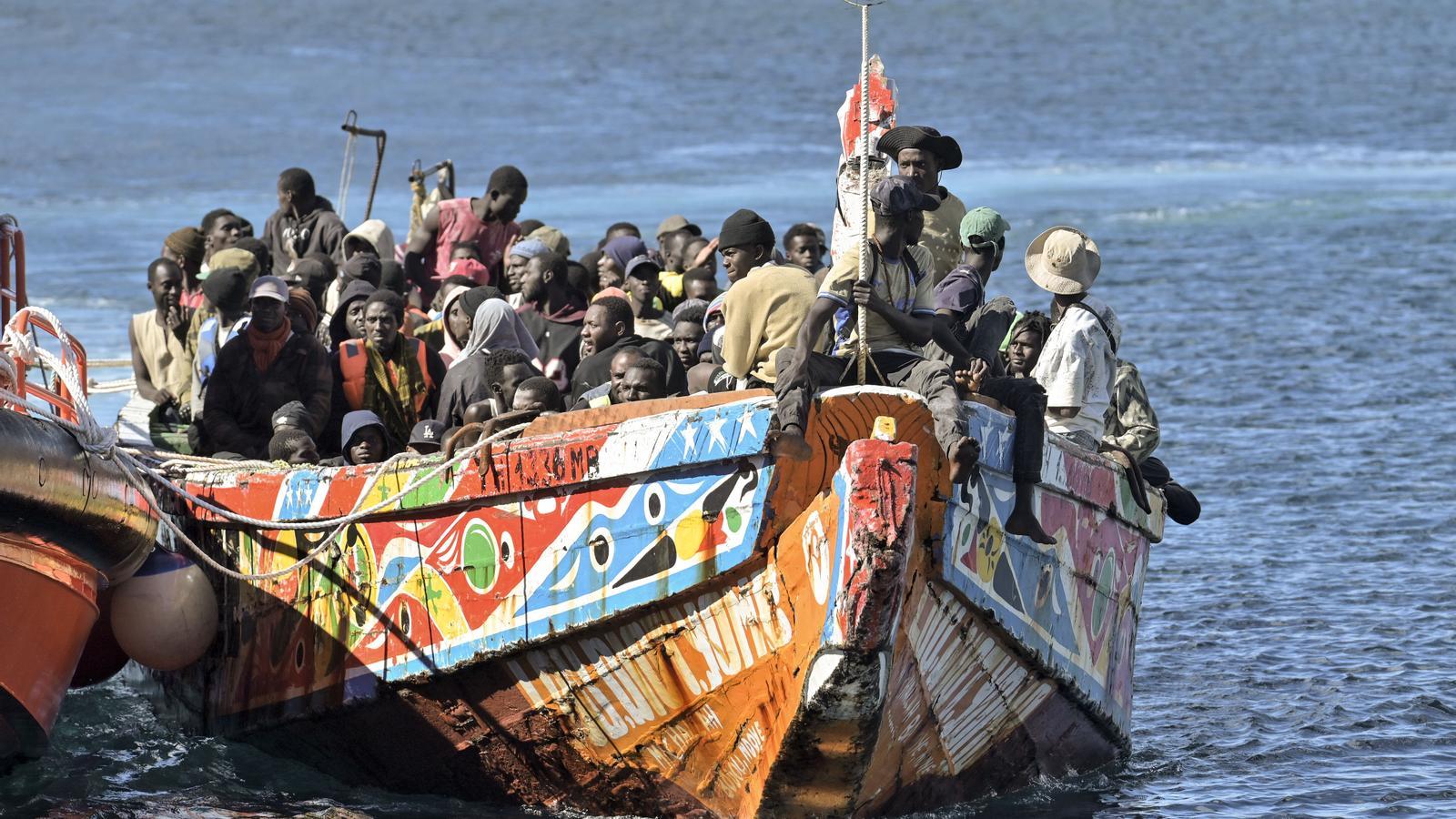
BarcelonaThe Canary Islands experienced on Saturday the day with the most migrant arrivals in small boats since records for the Atlantic route began: Maritime Rescue saved 1,580 people in just 24 hours, mainly in El Hierro, Gran Canaria, and Tenerife. This was done on board fifteen precarious vessels. The figure exceeds what was until now the record for rescued people in a single day (1,461), documented on November 7, 2020, at the port of Arguineguín.
Arrivals from various points on the African continent are now concentrated in El Hierro. In fact, throughout the year, 27,000 people have arrived in the archipelago, and more than half have disembarked on this island, the smallest and the one with the fewest resources to manage such a large volume of newcomers. The president of the Cabildo of El Hierro, Alpidio Armas, has announced that between this Sunday and Monday, it is planned to relocate more than half of the immigrants (about 900) who are currently in the reception facilities, which, according to him, are under strong pressure. Currently, about 1,600 people are being attended to there.
Armas, accompanied by the Minister of Territorial Policy, Ángel Víctor Torres, explained that they are trying to divert these people and “get them off the island as soon as possible.” The Spanish government was already forced last week to declare a migration emergency in the archipelago and announced an extraordinary allocation of 15.2 million euros to increase reception capacity and one million euros for the Red Cross to improve care for immigrants in El Hierro.
In this sense, Torres announced that the Canary Islands will have at their disposal in the coming days a third Maritime Rescue Guardamar vessel –there are five in the whole State– and he stated that on Tuesday new reinforcements will be addressed in a new meeting of the inter-ministerial commission on migration, such as “social and economic measures from the Ministry of Finance”.
The Atlantic route to the Canary Islands archipelago reached its peak of arrivals (40,000) in 2024 and since then had followed a downward trend that has been abruptly interrupted in the first two weeks of November: this year 27,000 people have already arrived, almost 3,000 more than in the whole of last year. However, Torres insisted that the migratory phenomenon is cyclical and argued that there are reception resources and a network of transfers that were not available during the 2020 crisis. “Planes are arriving and are flying from the Canary Islands; in the case of El Hierro, there are also boats,” he explained. However, he recalled that returns cannot be made “overnight,” because they require individual files and many of the newcomers could be eligible for international protection.
The president of El Hierro stressed that administrations must respond to the emergency urgently: he asserted that it is up to the Canarian government to strengthen health resources and care for unaccompanied minors –although the reception system of the Canary Islands is at its limit, with some 3,000 immigrant minors pending relocation to the Peninsula–, and for the Spanish government, the diplomatic task with Senegal, which is “the country of origin of 90% of the immigrants who are arriving.” Armas also pointed out two more problems that will need to be solved quickly. On one hand, the lack of data on immigrant minors –“We don’t know if right now there are 200, 220 or 350,” he said–, and, on the other, the removal of small boats (pasteres) accumulated in the port during the last two days.
The Senegal gap
Although this year only one in five migrants who have arrived in the archipelago comes from Senegal, the number of arrivals has intensified in recent days. The capital, Dakar, became this November the first African city to host a Youth Olympic Games. Elite athletes from all over the world have gathered there to participate – they finished this Friday after two weeks of competition – and the International Olympic Committee (IOC) has praised the organization. However, the sporting milestone has also had humanitarian repercussions thousands of kilometers from the Olympic host city.
To ensure the security of the event, Senegal has mobilized 15,000 police officers in the capital, which has come at the expense of coastal surveillance, which has decreased, and thousands of people have taken advantage of this gap to leave through one of the most dangerous migration routes in the world, the one heading to the Canary Islands. In just over ten days, about 8,000 immigrants have arrived there. Until a few months ago, however, the Atlantic route was blocked in Mauritania and also seemed under control in Senegal, a fact that forced most boats to set off from further south, such as from Gambia and Guinea.
At the beginning of the month, the Minister of the Interior, Fernando Grande-Marlaska, met with his Senegalese counterpart in Dakar to try to curb departures, as since November began almost all vessels have come from this country. “We must seek a joint solution to address this complex situation and prevent more people from putting their lives at risk by undertaking dangerous sea crossings,” he claimed, although the reality is that two weeks later thousands of people have continued to arrive on the islands.
Torres has already announced that the presence of the Spanish plane assigned to surveillance tasks in this West African country will be maintained until December. He also highlighted the diplomatic contacts being maintained with Mauritania and Gambia to try to reduce boat departures. Likewise, he assured that Spain has requested the deployment of Frontex in African countries, a proposal that, as he pointed out, has already been accepted and is pending the completion of administrative processing.
“Addressing the root causes”
The researcher at the Barcelona Centre for International Affairs (Cidob) and migration specialist, Blanca Garcés, explains that there are always more arrivals in autumn because the weather is more favorable for boats and believes that this episode is further proof that the structural causes that drive people to flee their country "remain or are even increasing." "From Europe, it is seen as a crisis, as something exceptional, but this happens regularly, it is structural and we should think about what response we want to provide so that it is more stable, starting by having a reception system capable of absorbing the arrivals," she posits.
The expert explains that the policy of the European Union and the Spanish government "is not to address the root causes," but rather to contain them through agreements with third countries to which border control is outsourced. When these agreements are established, the number of irregular arrivals decreases, as these are policies that have an immediate effect, but they also have a limited duration and in the medium and long term, fluctuations are seen depending on the relationship between states or other situational circumstances, such as, for example, the holding of Youth Olympic Games, explains Garcés. Departures shift towards those areas where there are fewer controls, routes are closed and others appear and it is always fluctuating: "We can never consider them definitively closed," she concludes.
