Why can't a demonstration like the one by those who want to "save Europe" be prohibited?
Neither the Barcelona City Council nor the Government could prevent Save Europe Act without a concrete risk of public order
-
CAT -
CAST
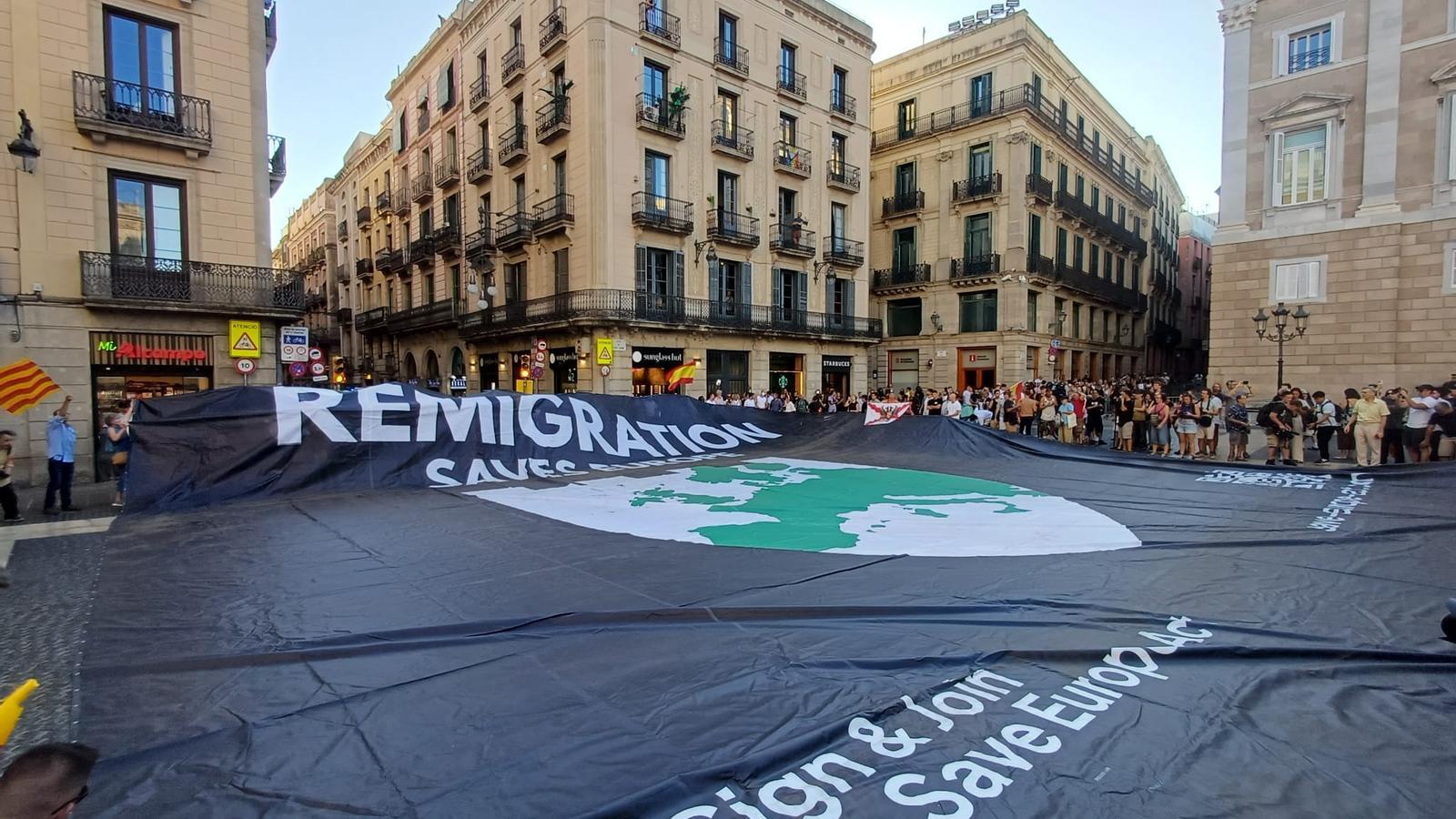
BarcelonaSaturday, Sant Jaume square in Barcelona hosted the first demonstration in Spain of the ultra movement Save Europe Act, which calls for "remigration" – the forced return of non-European migrants. The rally, with only about fifty people, showed a drop in attendance amidst unanimous rejection from institutions and social fabric. The Barcelona City Council announced it will take racist messages expressed during the demonstration to the prosecutor's office – as the Government had also planned on Friday – while the Comuns denounced the act to the Generalitat on Sunday and demanded sanctions of up to 500,000 euros for xenophobic speeches. Previously, parties like the CUP, ERC, and the Comuns themselves had already called to open the way to ban the mobilization; a request shared by the groups present at the anti-fascist counter-demonstration on Saturday in the square. However, can acts like this be banned?
The answer, at first glance, is that it is not simple. The right to assembly and demonstration is protected by Article 21 of the Spanish Constitution, which, moreover, does not require prior authorization – only communication – and only allows the authority to prohibit it when there are "well-founded reasons of public disorder, with danger to people or property." Organic Law 9/1983 reinforces the same criterion: a demonstration cannot be banned for what is said, only for the material danger it may generate. Doing so solely for ideological content would technically be prior censorship. In this case, Josep Lluís Martí, professor of philosophy of law at Pompeu Fabra University (UPF), adds that the content expressed by Save Europe Act "are ideas that political parties defend at the ballot box, that are defended in public debate, and therefore, citizens must also be able to defend them in the street".
This principle is not absolute, but the margin for breaking it is narrow. Martí explains that permission can only be denied "for pragmatic reasons" – related to public order or the specific circumstances of the act, such as requesting to demonstrate in a place or at a time that makes it difficult to maintain it – and, to a more extreme degree, when the very object of the call is criminal: "an explicit call to commit a crime, to glorify terrorism, or to directly incite violence against a group". Outside of these cases, the right to demonstrate covers "any issue," explains Martí. This is where the main controversy with Save Europe Act lies: its discourse calls for restricting immigration and, despite the ideological background that many of the parties that have requested its prohibition perceive, it does not constitute, in his opinion, "a call to racial hatred in the sense provided for by the Penal Code". Even though its promoters claim an "autochthonous" Europe with "white" primacy.
Martí adds a nuance that goes further: this same argument of public order risk could also be applied, he says, to the counter-demonstration organized by anti-fascist groups in the same location. "There could have been an argument of public safety for not allowing it in the same streets," maintains the jurist, who points out that if it had been held "three neighborhoods away" there would be no legal problem, but that the coincidence of space and time between both gatherings was, according to him, a real focus of possible confrontation and violence, even though the extensive police deployment prevented it.
Hate crime
The most recent precedents illustrate this dividing line between what the law permits and what it prohibits. In September 2025, the Spanish government delegation in Madrid banned a demonstration by Vox called in front of a reception center for minors in the Madrid district of Hortaleza – a call that was organized following an alleged case of sexual assault–. The decision was based on a police report that warned of a concrete threat of public disorder and the possible commission of a hate crime, as well as on child protection legislation.
On the other hand, acts with equivalent discourse have not had the same outcome. The ultra group Núcleo Nacional has demonstrated several times in Barcelona without being prevented: last January, at an event in Sentmenat, and in June, in front of the Spanish government delegation, with slogans such as "against ethnic substitution" – language practically identical to that of Save Europe Act–. What separates one case from the other, therefore, is not the message itself, but the existence of a documented and immediate danger, or the commission of an explicit crime within the same call.
