Vox already speaks to children in Catalan
The far-right group has made a turn in terms of identity

-
CAT -
CAST
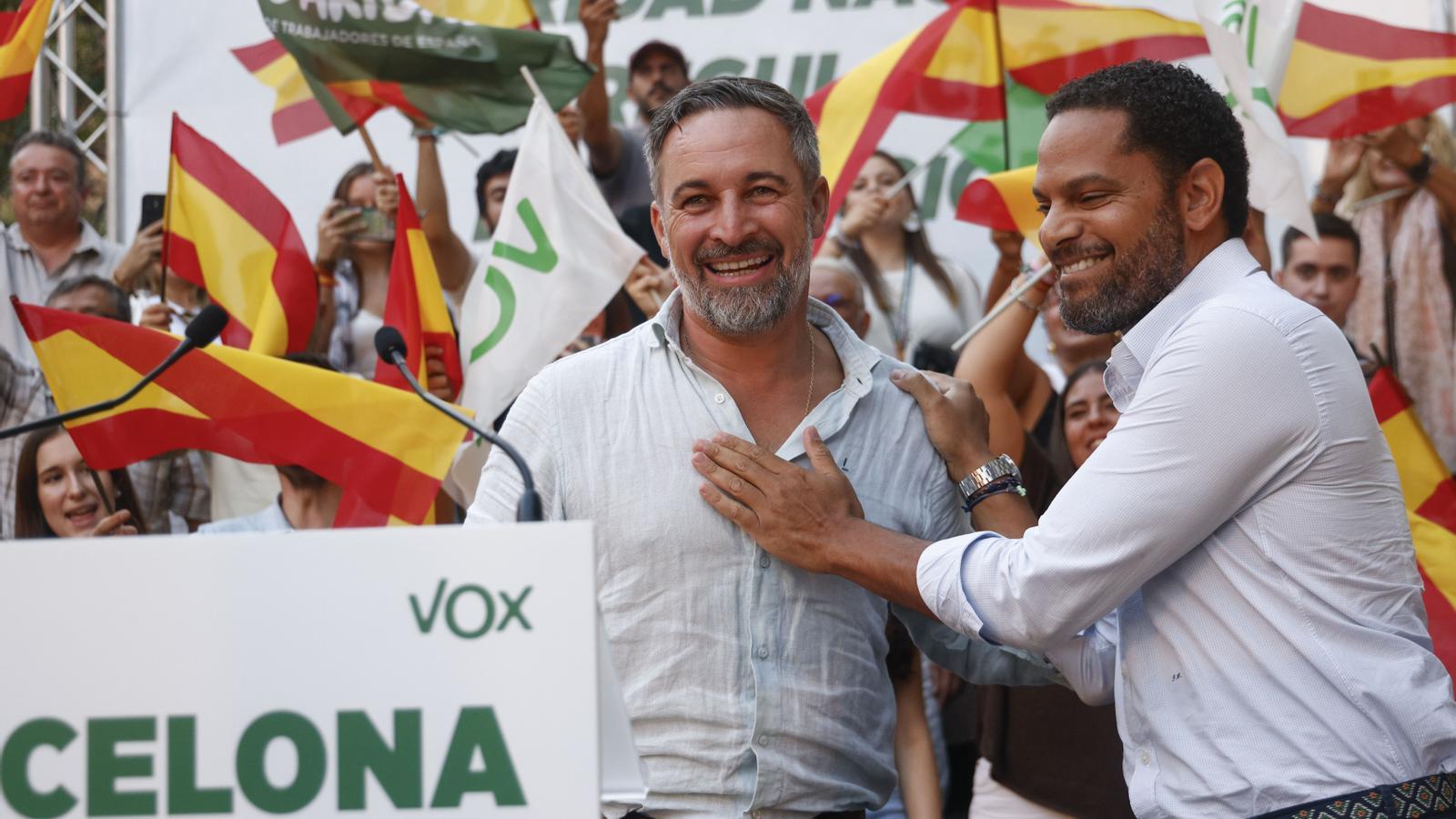
Barcelona"That is why I speak to my daughter in Catalan. Because I do not want her to be unaware of where she comes from, nor what shields she has to defend herself against a stateless globalism, and, worst of all, which imposes our dissolution to give away what is ours to others". This sentence is not from any leader of Aliança Catalana, but from Vox. Specifically, from their head of the list for Tarragona, Jordi de la Fuente, who wanted to recall on X some words from the French far-right politician Jean-Marie Le Pen, in which he would have regretted before dying not having learned his language, Breton. Furthermore, he cited an appeal from an identitarian tweeter: "Learn your language, do not let it be a lifelong regret". This defense of Catalan by Vox, even to prevent it from disappearing, as has happened in part with Breton, is new –and this is admitted internally–. But it is not entirely surprising, especially if one takes into account the identitarian path that the far-right party has been taking.
For some time now Vox has been increasing its use of Catalan and recently it has been openly defending the "Catalan identity", one of the key claims in these elections. It has accelerated this even further during this legislative term, and especially forcefully in this electoral pre-campaign for elections in which it is winning over a notable portion of the Aliança Catalana electorate, an ideological competitor that is nevertheless formally pro-independence. Vox sources consulted by ARA emphasize the fact that at this moment there is "a fight for civilization" against Islam and mass immigration, they state, and that disputes over secession belong to another time.
This is how they justify having toned down their anti-independence rhetoric, "out of empathy" for a part of the electorate. That is to say, they are trying to roll out the red carpet for them so they can take the step. Furthermore, there is a sense of unbridled joy within Vox regarding the stance of the leader of Aliança, Sílvia Orriols, ahead of the state elections, who said she saw "no contradiction" in her voters choosing Abascal's party on November 29th and defended the freedom to vote.
All this while they are multiplying the use of Catalan, which they consider to be a Spanish language just like Castilian Spanish and which can be used with complete normality. A Catalan identity they claim within the broader Hispanidad, leaving behind the fact of restricting themselves only to the uniforming Castilian Spanish nature that has characterized them until now.
However, they are pursuing the same old policies despite trying to put a different accent on their discourse. In other words, they have exactly the same position against linguistic immersion – and in favor of "freedom of choice" –; they are against measures for the linguistic normalization of Catalan; in favor of Castilian Spanish being present everywhere, especially in the administration; against Catalan in the Valencian Community, the Balearic Islands, and the Franja; against Catalan self-government, and against public media in Catalan.
They defend Catalan, then, as part of the identity; the Catalan identity as part of the Spanish one, but defending the Spanish language and national identity; as it happened in France with Le Pen and now with her daughter Marine: they defend regional identities, but they place them in a secondary position and endow them with a folkloric character, while maintaining French centralism intact. The French case, however, is particular because Le Pen has allied herself with the nationalist party of a former terrorist from Corsica, Nicolas Battini, because both argue that the threat of immigration is a priority, among other things.
The position of S'ha acabat
In Catalonia, it has even wanted to reclaim the Catalan identity now the radical Spanish nationalist organization S'ha Acabat, who asked to "celebrate the Castanyada" with a photograph of a boy punching a Halloween pumpkin. Or the Espanyol cheering group Curva, close to the most right-wing political Spanish nationalism, which repeats a similar pattern featuring a skinhead: "Let's not let outside traditions make us forget our own".
