The 29-N and the dynamics of blocs

-
CAT -
CAST
BarcelonaThis time there will be high turnout in the general elections, which makes the forecasts even more complicated. I do not know if November 29th will set any records, but the campaign has been long and omnipresent, it has caused some fatigue and at the same time an undoubted mobilization. Perhaps there will be people who vote yawning and trying to recover from the indigestion, but moved by the desire to secure the shot. The environmental uncertainty and the simplification of what is at stake – progress or involution, according to some; order or chaos, according to others – facilitates the awareness of the importance of taking sides and the decision to go to the polls. We have, and will have again, a fragmented Congress, but the electoral event has drawn a landscape of blocs, fundamentally bipartisan.
The debates – including the one that took place with eight parliamentary spokespersons – have very much synthesized the real options. Traditionally, everything has always essentially pivoted on the PSOE and the PP, due to the fact that they have alternated in the Moncloa for several periods, as key parties of the system. But now that neither one nor the other can aspire to obtain the support of absolute majorities, another formula has been imposed that continues to place them at the forefront of any government option. The PSOE no longer plays alone on the board, and the PP even less so. The socialists have ended up finding in the Broad Front a possible ally with a certain consistency, capable of obtaining a parliamentary group, while the PP has placed a kind of blind trust and infinite patience in Vox, because it is obvious that it depends on the extreme right for the conservatives to be able to touch power again beyond what they already have at the regional level.
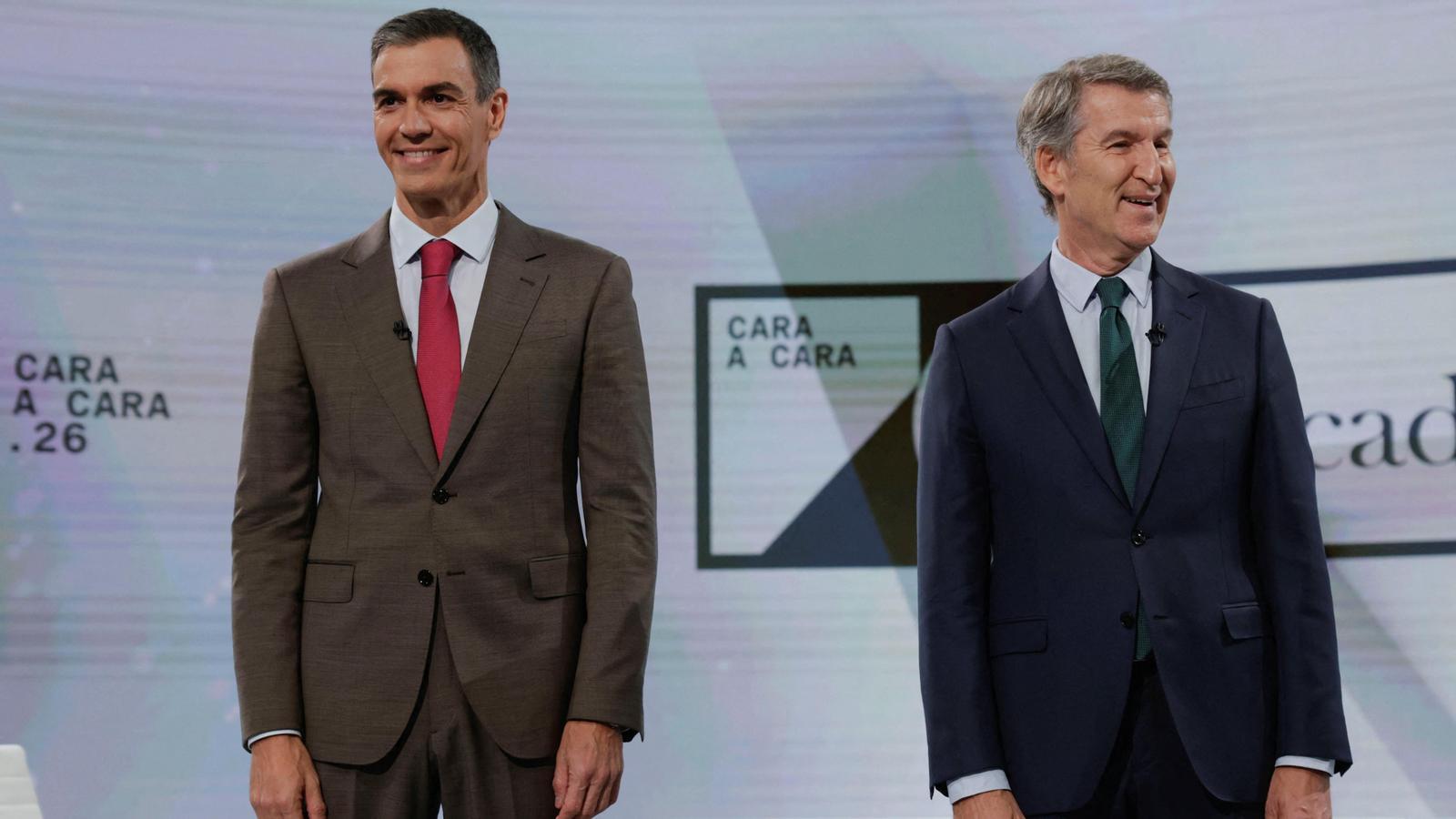
However, the lack of push from Pedro Sánchez in his face-to-face with Alberto Núñez Feijóo on the 19th has complicated things for the left-wing bloc, which allowed for a perhaps too early euphoria from the popular party. A second debate was needed – this one with the participation of Santiago Abascal and Ada Colau – to graphically reset things. We will return to discussing whether these types of pre-election meetings have any influence on the election results, but more than ten million viewers watching the screen is an audience rating considerable enough to think that it cannot be denied to what extent it is convenient for the candidates to pass the test successfully. And certainly, this last meeting between the heads of the lists of PP, PSOE, Vox and Broad Front was important because it changed some relevant aspects of the final stretch of the campaign, bringing expectations closer.
When this last debate ended, the Popular Party and Vox continued to lead in the electoral race. Nevertheless, the left had recovered some ground by showing the weaknesses of their adversaries. Surely this Sunday night, when we hear the reactions to the election results –and if there are no surprises, which are currently unlikely–, we will be able to hear the thesis that the left lacked a week. And it will not be a lie. The fundamental part of the game in this campaign has been between Sánchez and Feijóo –no longer as heads of their respective parties, but as leaders and candidates for the highest responsibility at the head of the government–, but the role of the partners also had great relevance. And the fact is that in the last four-way debate, the left attacked the opponents strongly and knew how to give reasons for what we pointed out at the beginning, that is, for mobilization.
There was an interesting moment to also deduce the moods, in this case of Feijóo, upon whom Sánchez and Colau constantly applied pressure. The PP leader tried to get his socialist opponent to commit to resigning if he is ultimately defeated in these elections. It would have been very surprising if Sánchez had answered in the affirmative. Probably in that case, Feijóo would have answered him that he did not believe him. The PP's hope is that Sánchez leaves if he loses the elections. They do not want him even in painting, nor at the head of the opposition, in a new version of his capacity for resistance. But it cannot be ruled out that he will stay in case of defeat, if it is not very strong. In fact, the socialist lists have been thoroughly reviewed at the Moncloa, as much or more than at Ferraz, the party headquarters, in the absence of differences or tensions between the two sides.
If Sánchez has wanted to ensure the maximum discipline and loyalty of his parliamentary group, it is obviously not because he has thought about any possibility of resigning. The Socialists' intention is not currently to win the elections in terms that would allow them to form a government – an objective that they already know is only possible in the form of a miracle – but to manage to stay ahead of the PP in the number of votes and seats. This hypothesis is not implausible. It can happen. It is made viable by the existence of Vox, which takes a good handful of votes away from the PP, and the late reorganization of the political forces to the left of the PSOE. As much as Colau did a good debate, with very tight marking on Feijóo, the tragedy of this political space is that it has let too much time pass without managing to reorganize, despite the electoral imminence.
I doubt that Irene Montero will obtain a seat again. Podemos has been left very badly damaged. But the new Broad Front arrives too late. It would have also needed not just a week, but a few months. However, if the four-way debate could have had any effect within the left, it would have been to end up scratching together some votes for this candidacy. Those who have felt betrayed by the PSOE – due to the housing crisis, low wages and inflation, which has been very close to 5%, aside from the corruption cases – and were doubting whether to stay at home, may be among those mobilized by how the four-way debate transpired. The votes that the Socialists have already lost are those they received from the moderate areas of the electorate. Zapatero's jewels and Puigdemont's latest statements against Sánchez have done a lot of damage in this sector, where there have never been a lack of opponents to the amnesty law. Finally, Feijóo did not order Colau to be quiet. What he was reproaching her for was her silence regarding Sánchez's departure from Paiporta, when he was attacked. But the expression and the gesture of putting his finger to his lips were very unfortunate, and that is how many voters, men and women, will have seen and heard it.
