"They ask us for the impossible": situation at the limit in the consulates to remove from the census those naturalized under the 'grandchildren law'
They have to review thousands of files in record time to sort out the nationalized ones who accredited the exile of their ancestors

-
CAT -
CAST
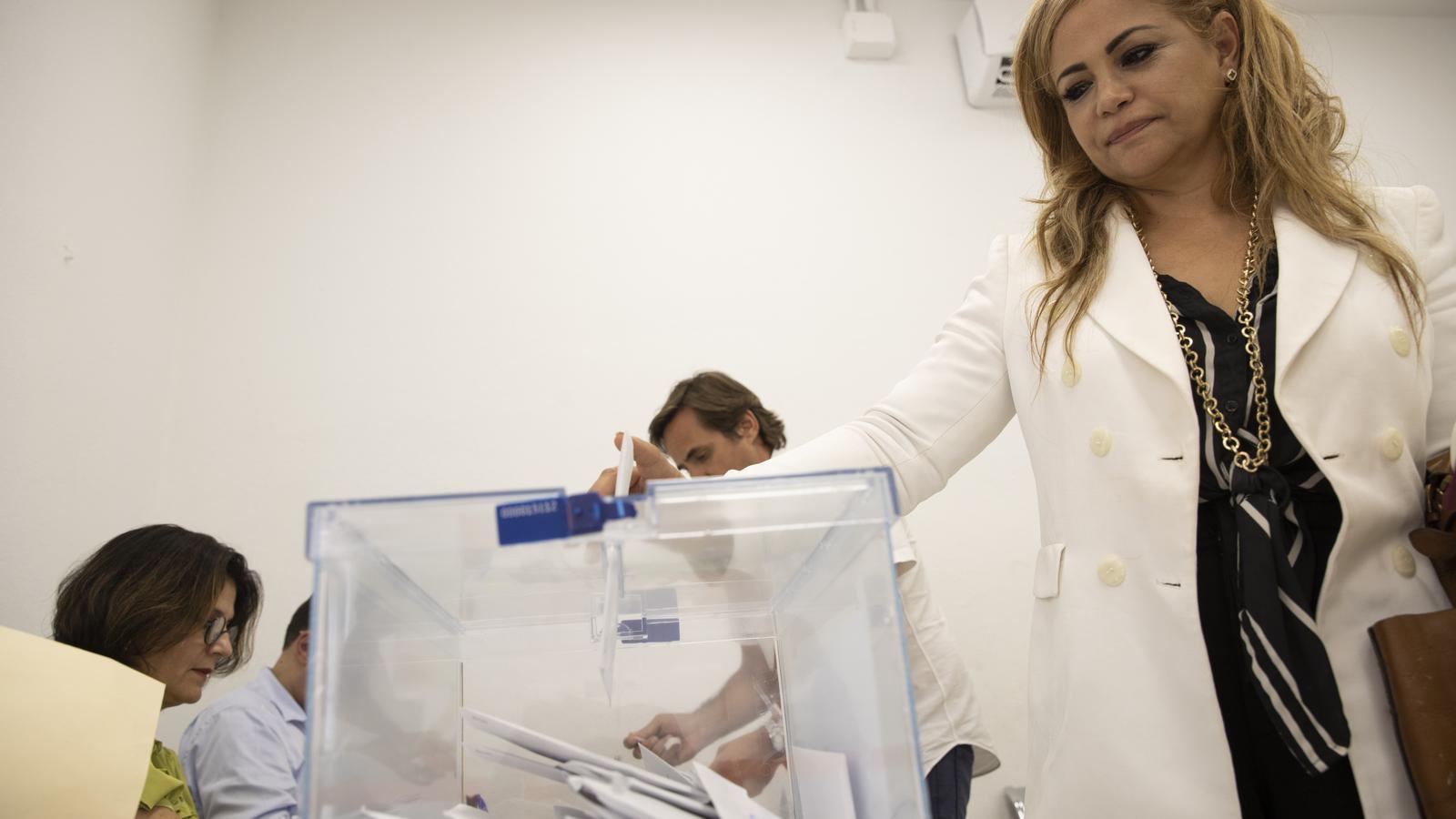
MadridThe Supreme Court has suspended the electoral rights of people naturalized under the clean law, a decision that the Spanish government has labeled as "extraordinary gravity" and which has generated a new political battle between the right and the left. While for the PP and Vox it is a way to guarantee the "cleanliness" of the November 29th elections, for progressives it is an unacceptable violation of fundamental rights. However, beyond the noise, what does the decision taken by the Supreme Court on Monday imply in practice? What must the Spanish government do to comply with the precautionary measures and exclude from the census the 163,020 people who have been naturalized through the so-called clean law? The greatest responsibility falls on the State's foreign service and the Electoral Census Office, which is the entity that must in practice suspend the vote of those affected.
Although Pedro Sánchez's executive has openly criticized the Supreme Court's decision, it has also admitted that it must comply with it, and for this reason, according to various sources consulted by ARA, the Ministry of Foreign Affairs has sent the following instructions to all consulates: first, they must post on their notice board the Supreme Court resolution in which five working days are given to those affected by the decision to appear as injured parties; second, it asks the consulates to review all individual files to separate those naturalized persons who presented proof of exile from those who did not. From there, according to these sources, the instruction states that a data platform will be provided by the ministry so that all this information can be uploaded and processed directly by the Electoral Census Office.
"They are asking us for the impossible," state diplomatic sources consulted by ARA. The consulates dependent on the Ministry of Foreign Affairs are the ones with the most complicated task: reviewing thousands of files to distinguish between those individuals who have obtained nationality by proving they are descendants of exiles and those who have not. "I have tons of paper at the consulate," complains one source. Everything, moreover, must be done in record time, since the census for the November 29 elections closed on Monday and must be on public display for eight days, to be finalized on October 23. Therefore, before this date, the consulates must send all the information to the Electoral Census Office.

All in all, for a minimal impact, assure sources knowledgeable about the election census: in total we are talking about 163,020 people registered in the Census of Spaniards Absent Residents (CERA), whose participation in the previous elections was 10%. This low participation is what the State Attorney's Office used to argue that there is no real risk of affecting the electoral result, taking into account, furthermore, that not everyone would vote in the same constituency, since they are distributed by provinces depending on which was the last place where their ancestors lived in Spain. "Is this the great electoral fraud?", asks a person knowledgeable about the procedures, who regrets the politicization of this very complex legal debate.
Officially, the Ministry of Foreign Affairs maintains that the Spanish government is complying with current legislation, but it also acknowledges that the implementation of the Supreme Court's precautionary measures is "very complex". They also point out that a paradox will occur: that citizens who have already been able to vote previously in regional or general elections of 2023 will now not be able to do so on November 29.
The figures
According to the data provided by the State Attorney General's Office, up to 570,063 people have requested nationality through the grandchild law, that is to say, through the eighth additional provision of the Democratic Memory Law which grants nationality to descendants of exiles. Of the half a million people who have requested nationality, there are 168,896 people who have registered in the Electoral Census of Absent Spaniards (CERA). 163,020 people up to August 1st, which is when the census for the 29-N was closed. According to the same source, there are 96,895 applications pending registration and 304,272 pending resolution.
However, not all consulates have the same volume of work. In fact, the State Attorney's Office used the following data to argue the "material impossibility" of executing individualised reviews of the files. There is a total of 172 consular offices around the world, but only 16 account for 84.5% of the total registrations made through this channel.
The consulates with the most applications for nationality are basically in Latin America, where the situation of structural "collapse" that the Association of Spanish Diplomats has been denouncing for some time has worsened. It must be taken into account that, following the political battle that has been generated by the grandchildren law, consulates are in the spotlight and the association also reports threats and pressure. In fact, Manos Limpias has reported consuls in Argentina, Mexico, and Cuba to the Prosecutor's Office for granting nationality under the grandchildren law. Diplomatic sources remark that they cannot act with discretion and that they have had to apply what the regulations indicated to them.
The Supreme Court does not directly question the Democratic Memory Law nor the provision that grants nationality to descendants of exiles, but rather the administrative instruction that developed it. This guideline, drawn up by the General Directorate of Legal Certainty and Public Faith, expanded de facto the scenarios under which nationality could be granted. What did it say? That Spanish nationality would be granted to people who had originally been Spanish and also to the grandchildren of those who had to leave for political reasons. In the latter case, it would be presumed that it was due to exile for all those who left between 1936 and 1955. That is to say, in practice it was sufficient to demonstrate ancestors in Spain, decoupling it from political persecution. The Supreme Court has questioned this and, for this reason, at least provisionally until it rules on the merits of the matter, it has requested to differentiate between the new Spaniards who proved to be descendants of exiles and those who did not prove it.
The structural situation
It must be taken into account that naturalization through the Democratic Memory Law has tripled the workload at consulates. This circumstantial task due to the Grandchildren Law has been added to the already habitual functions that consular offices had to carry out and which in recent years has also grown exponentially: the number of Spaniards abroad has tripled, from one million in the 2000s to 3.2 million at present. All this, with a minimal civil service structure and workers hired in the country of origin, who often chain temporary contracts.
