Pressure on Collboni to buy at-risk blocks in Barcelona multiplies
The City Council warns that it studies case by case each option because it cannot acquire everything

-
CAT -
CAST
BarcelonaBarcelona has made the right of first refusal one of its main levers to expand the city's public housing stock. The tool, which gives the City Council the final say on every entire building block sold in the Catalan capital, has allowed the municipal government to acquire 1,600 apartments in the last ten years. The mechanism, however, constantly places the municipal government in a dilemma: having to decide what to buy and what not to buy.
This dilemma has been exacerbated in recent weeks, after the eviction of Maricarmen Abascal in Madrid and the subsequent decrees of the Spanish government precipitated the end of the legislative term in the State. With the Spanish President, Pedro Sánchez, championing the defense of housing, the socialist government led by Jaume Collboni in Barcelona is facing growing requests to act regarding the blocks at risk in the city.
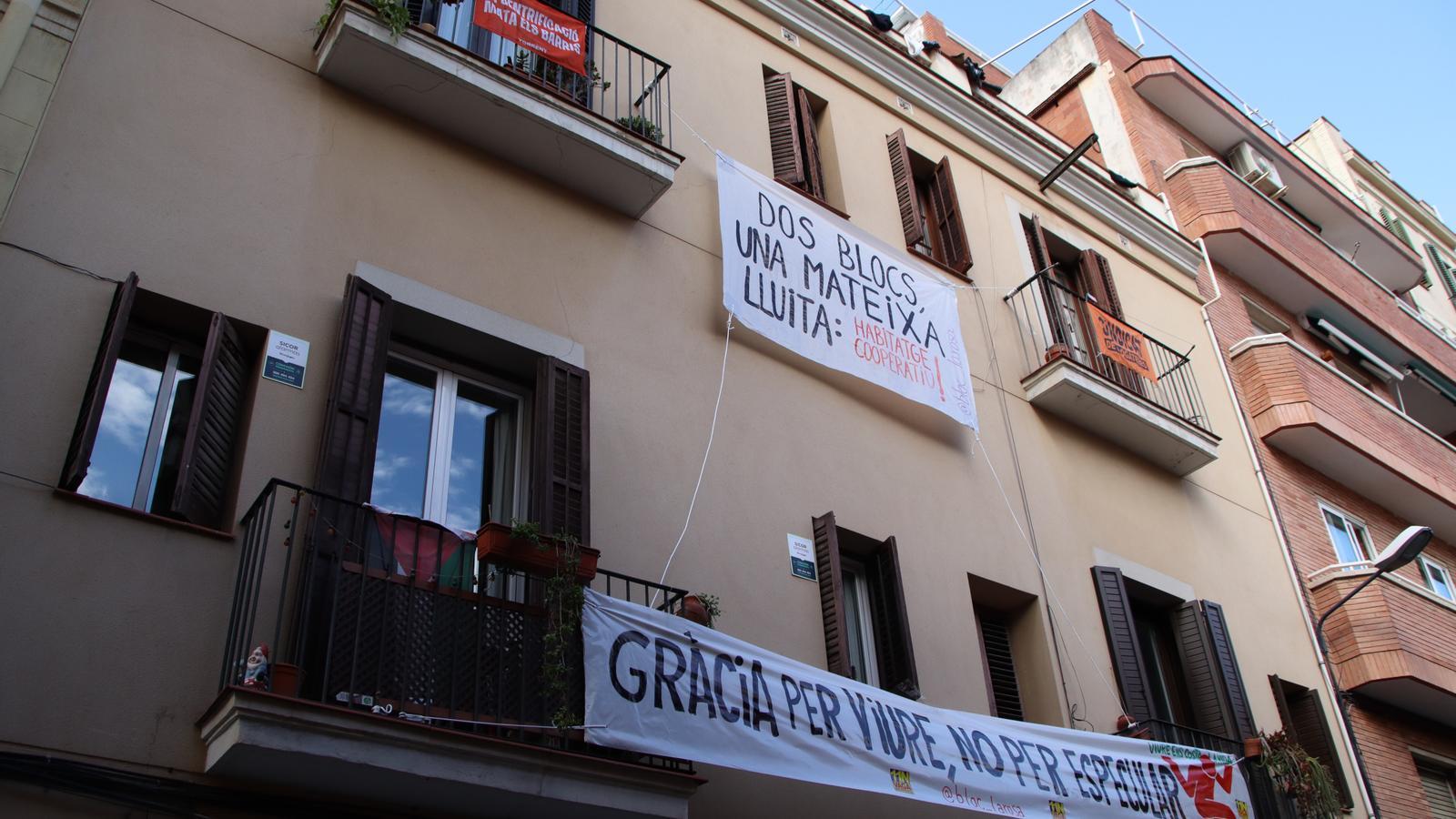
This Thursday, the folders on the desk of the mayor of the Catalan capital have piled up twofold. In the morning, it was the residents of five blocks – Ros de Olano 20, Planeta 11, Mare de Déu de Montserrat 123, and Travessera de Gràcia 156 and 157 – who asked the City Council and the Generalitat to intervene to prevent the 118 residents from being evicted from their homes due to "speculative purchase" operations. They were accompanied by members of the Tenants' Union (Sindicat de Llogateres), the Cooperative Housing Sector of the XES, and the COSHAC. A few days ago, ERC also requested to buy the block located on Mare de Déu de Montserrat street.

In the afternoon, during the October plenary session –postponed last week due to the train accident in Toledo–, it was the Barcelona en Comú group that demanded the municipal government purchase the building at Travessera de Gràcia 156 and four other buildings where residents are threatened with eviction: the one at 14 Sant Agustí street, the Papallona block on Llançà street, the one at 41 Concòrdia and the one at 153 Ramon Turró.
"Why these five blocks and not others?", asked the fourth deputy mayor, Jordi Valls, during the debate, who emphasized, however, that the City Council is working with all the properties, both those on the Barcelona en Comú list and those reported by the neighbors. "We will continue doing what we are doing, talking to the residents and looking for solutions", he said. But he remarked that he does not want to create "false hope" and reproached the 'comuns' that with proposals like this, what they are doing is "increasing the purchase price".
City Council sources underline that not all the blocks for sale in the city can be acquired and that "a careful examination of each case" is being carried out. They also remark that the new right of first refusal ordinance approved this term establishes which requirements must be met in order to exercise this mechanism.
And what are they? Among the factors to be taken into account are: prioritizing the purchase of properties with more than ten dwellings and where there are empty apartments; where there are people with contracts with forced extensions or vulnerable groups such as people at risk of social exclusion or disability, the elderly, victims of gender-based violence, or single mothers. The regulation ensures that the importance of acquiring buildings in areas "with a higher risk of gentrification" will also be taken into account, where few buildings have been acquired in recent years, where there are few alternatives for affordable housing, or that are in a poor state of repair.
The role of cooperatives
Regarding the neighbors of Vila de Gràcia and Guinardó who have reported their case this Thursday, the situation is unique. All five buildings are currently for sale and different real estate funds have shown interest in acquiring them. To avoid this, the neighbors want to organize themselves into a housing cooperative. For now, they have obtained the support of organizations such as Sostre Cívic and la Dinamo, which have shown their interest in acquiring the properties. To be able to do so, however, they need the financial support of the administrations before the end of the year.
Municipal sources explain that in the cases of Ros de Olano 20, Planeta 11, and Mare de Déu de Montserrat 123, "the city council is following up on the case and is in contact with the affected neighbors." They do not yet specify, however, if they will collaborate in the acquisition of the properties.
-
Shock plan for the Vila Olímpica
The plenary session has approved a proposal by Junts per Barcelona that urges the municipal government to draw up a shock plan for the Vila Olímpica neighborhood. The proposal, defended by the leader of the Junts group, Jordi Martí, calls for attending to and rehousing the homeless who sleep in the area; a specific action for cleaning and dignifying public space; strengthening the preventive presence of the Urban Guard, and the acquisition of the Centre de la Vila by the City Council.
-
Criticism over the management of Blocus
During the plenary session, a motion to censure the mayor, Jaume Collboni, and the Minister of the Interior, Núria Parlon, for the Blocus riots on October 24 in Barcelona was also rejected. Although the proposal, promoted by the leader of the PP in the City Council, Daniel Sirera, was rejected, the People's Party, Junts, and Vox criticized Collboni for not having prevented the looting. The three groups reproached him that the security operation on October 31 proves that the riots of the previous week could have been avoided.
-
Encouraging generational turnover in businesses
During this Thursday afternoon's session, a proposal by ERC was also approved that promotes measures to encourage generational turnover at the helm of local neighborhood shops. “Behind losing that lifelong shop for another copy, we don't just lose a business, we lose a little piece of the city's identity,” lamented Elisenda Alamany. The proposal bets on economic and fiscal incentives for people who want to continue a business's activity, and grants to cover the costs of the transfer. It also calls for simplifying administrative procedures and creating a census of establishments with owners aged 55 or over.
-
Cultural consumption vouchers sold out
The 20,000 Culture Vouchers from the first wave of this program to promote cultural consumption in Barcelona sold out in 24 hours. A situation that sparked criticism from ERC, which criticized the City Council for allowing people from outside Barcelona to acquire them as well. The Councilor for Culture, Xavier Marcé, specified that 19% of the vouchers were acquired by people from outside Barcelona, and assured that in the next two calls, proof of residence in the Catalan capital will be required.
