How to build a general uproar with 1% of the votes?
The incidence of the external vote is so small that only two seats are known to have been affected in democracy

-
CAT -
CAST
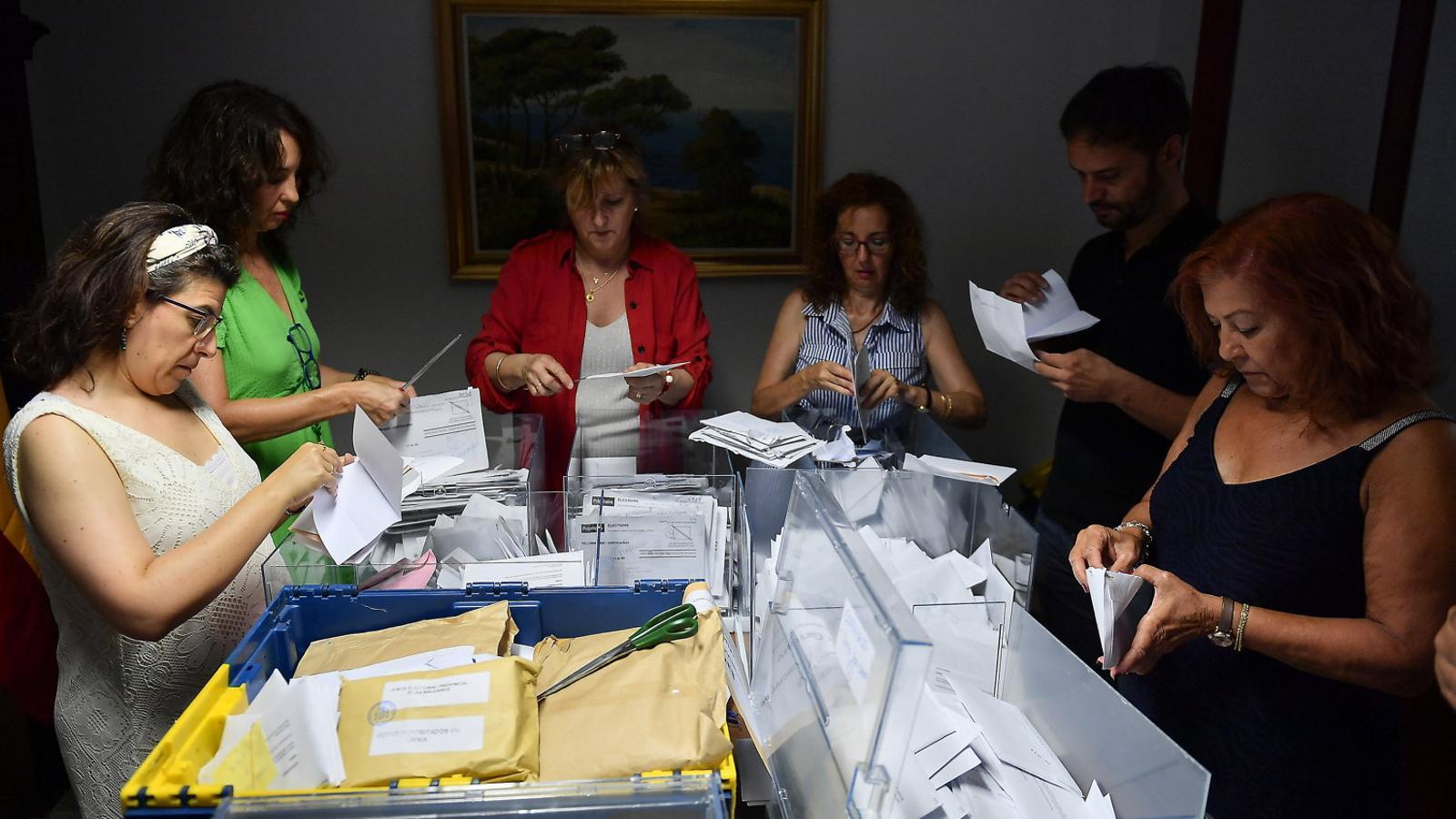
BarcelonaOn the night of July 23, 2023, the PP was 1,749 votes short of its sixteenth deputy in Madrid. A week later, it obtained it thanks to the vote of Madrid residents abroad (the PP surpassed the PSOE by 8,600 votes in this count). It was the only incident of the so-called CERA vote (electoral census of absent residents), which the PP and Vox are now criminalizing with an eye on the supposed "rigging" that Pedro Sánchez is preparing for next year.
on the supposed "rigging" that Pedro Sánchez is preparing for next year.
In fact, there is only evidence of two seats that the CERA count has overturned in the general elections. In addition to Madrid, in the second elections of 2019, in Biscay, the PNV lost a seat to again benefit the PP. It doesn't matter. Now the popular party has embraced the theory that the law of the "nets" (law of return), which allows granting nationality to relatives of Spanish exiles, will serve the PSOE to inflate the electoral census in its favor. Without providing any evidence, Vox has even gone so far as to estimate "between 10 and 15" seats that could be at stake. Does this theory have any basis?

The Spanish Constitution establishes the right of Spaniards to vote from abroad, which was introduced into electoral law in 1985. The following year, nearly 53,000 out of the 250,000 people who could have done so voted in the general elections. Forty years later, the CERA census has climbed to 2.7 million people, although just over 200,000 voted in the 2023 elections. What impact could the "clean law" have? If elections were called today, there would be about 300,000 more people eligible to vote than there were three years ago. The number can continue to increase in the coming months – the Spanish government acknowledges that, in total, there have been one million applications and that 1.3 million people are waiting for an appointment–. But how many of these would vote? And, above all, where would the votes be counted?
A less active voter
The first thing to consider is that the CERA voter is much less participatory than the one residing in the State. Generally, they live more disconnected from the reality of their country of origin and casting a vote usually has more costs, for example, travel to the consulate or embassy – depending on where they live, the postal service can also be a trial. In the Spanish elections three years ago, the participation of residents abroad did not reach 10% (it climbed to 67% domestically). How does this translate when it comes to the count? CERA votes only represented 0.8% of the total in the elections. That is, 99.2% of participants voted from their polling station. In fact, in only 12 out of 50 Spanish provinces did the incidence of votes from abroad exceed 1% (Madrid, precisely, was one of them).
"Mass elections are unpredictable: you cannot know who the pivotal voter will be," explains Marc Guinjoan, professor of political science at the UAB. That is, in 2023 it could not be anticipated that the external vote would be decisive in Madrid. Guinjoan completely dismisses the possibility that a party can know in which constituency the last seat will be at stake and even more so hypothesize taking into account the external vote. "If parties anticipated that there would be a constituency where they would be fighting for scraps, it would be easier for them to change the register within Spain of their militants," he ironically states. Regarding the low participation of residents abroad, he points out that it is even lower among those who have not had any stage of socialization in their country of origin. That is, people who are Spanish nationals because their grandparents were (like those under the "descendants law"), but who have never resided in the State, participate less than those who have emigrated.
"Theoretically, they are quite a few thousand people, but distributed very unevenly by provinces," points out Carol Galais, also a professor at the UAB, to highlight the low incidence of votes from abroad in changing the results.
France, Germany, Argentina, and the United Kingdom are the countries from which there was the most voting in 2023. In the three European cases, the average turnout exceeded 10%, but in the South American case it was only 5%. Argentina is the country with the most potential CERA voters. They exceeded 430,000 in the last elections, and it is also the country where more naturalizations will likely occur with the clean slate law. The PP and Vox allege that the PSOE may be trying to register many of these new Spaniards (who we've already explained are the ones who vote the least) in key provinces. But when a person registers in the census, they can only do so in the last place they resided in the State, in the place where their ancestors resided, or, finally, wherever they decide.
Galicia is the community with the largest portion of its census outside its borders. 30% of Ourense, for example, is in the CERA, even though its turnout is also low (and this is one of the reasons why the overall turnout in Galicia is among the lowest in the State). In the 2023 elections, for example, CERA votes represented double the state average, but despite this, their impact was below 2% of the total votes (in Ourense it reached 3%). "The vote is very dispersed," insists Carles Pàmies, a political science professor at the UNED. "If someone wanted to rig the election, officials from the foreign administration would have to get involved, and in the best-case scenario, for those who wanted to do it, it would represent 3% or 1% of the total voters in a constituency," he highlights.
The census of absent residents has been multiplying over the years. From 250,000 in the 1986 elections to more than 2.7 million currently. The year with the most voters was 2008, when 380,000 people voted, only 1.5% of the total votes counted in those elections (the count is not done in the country where the vote is cast but in the electoral boards within the Spanish state). "Since the votes from within the country are counted first and then those from abroad, you already have a first fixed picture and it seems that the last ones counted are the most decisive votes," reflects Pàmies, to insist on the low relevance of CERA.
For years, it was precisely the Galician parties that complained the most about CERA votes due to the supposed irregularities detected: a fairly common one was that someone voted on behalf of someone else, even if they were dead. Alberto Núñez Feijóo (PP), when he was in opposition in Galicia, had already used the argument of fraud to attack the government of the socialist Emilio Pérez Touriño.
Difficulties in voting
With the argument of resolving possible irregularities in the CERA, the PSOE and the PP (with the support of CiU and the PNB) changed the electoral law in 2011 to introduce the requested vote. Registered individuals stopped automatically receiving electoral information and intermediate steps were introduced so that they themselves would have to proactively move to participate in the process. Galais, who spent a few years in Canada, participated in some initiatives to end the requested vote, which caused participation to plummet: from 32% in 2008 to 5% in 2011. In 2022 the law was changed again, but participation has not taken off and in 2023 it stood at around 10%. "Not everyone has even found out, and the inertia that voting from abroad is cumbersome because procedures have to be done has remained a bit," laments Galais.
And who do they vote for from abroad? It is true that initially the PSOE was the big beneficiary, although, as we have said, the impact on the distribution of seats was minimal or nil.
"People who migrated did so habitually for economic reasons and were rather working class. The second generations, moreover, used to often adopt their parents' political values," indicates Galais, who points out that all of this has been reducing over the years and that today the behavior of the external vote is quite similar to that of the internal vote. "It can no longer be said that the CERA is a stronghold of socialist votes," he insists.
In other countries, such as France, expatriate voters decide their own seats. It is a system in which their votes no longer count for any of the usual constituencies, but rather they elect 11 deputies from among those registered in the census of absent residents. "It would be an option in Spain, but then the effect of the CERA vote would indeed be more evident. It would be a limited effect, for example to one or two seats, but it could be that a party's majority depends precisely on that seat," concludes Pàmies.
