The Spanish government explodes against the Supreme Court over the 'net law': "It is of extraordinary gravity"
According to government sources, it should be those affected who appeal to the Constitutional Court in order to be able to vote

-
CAT -
CAST
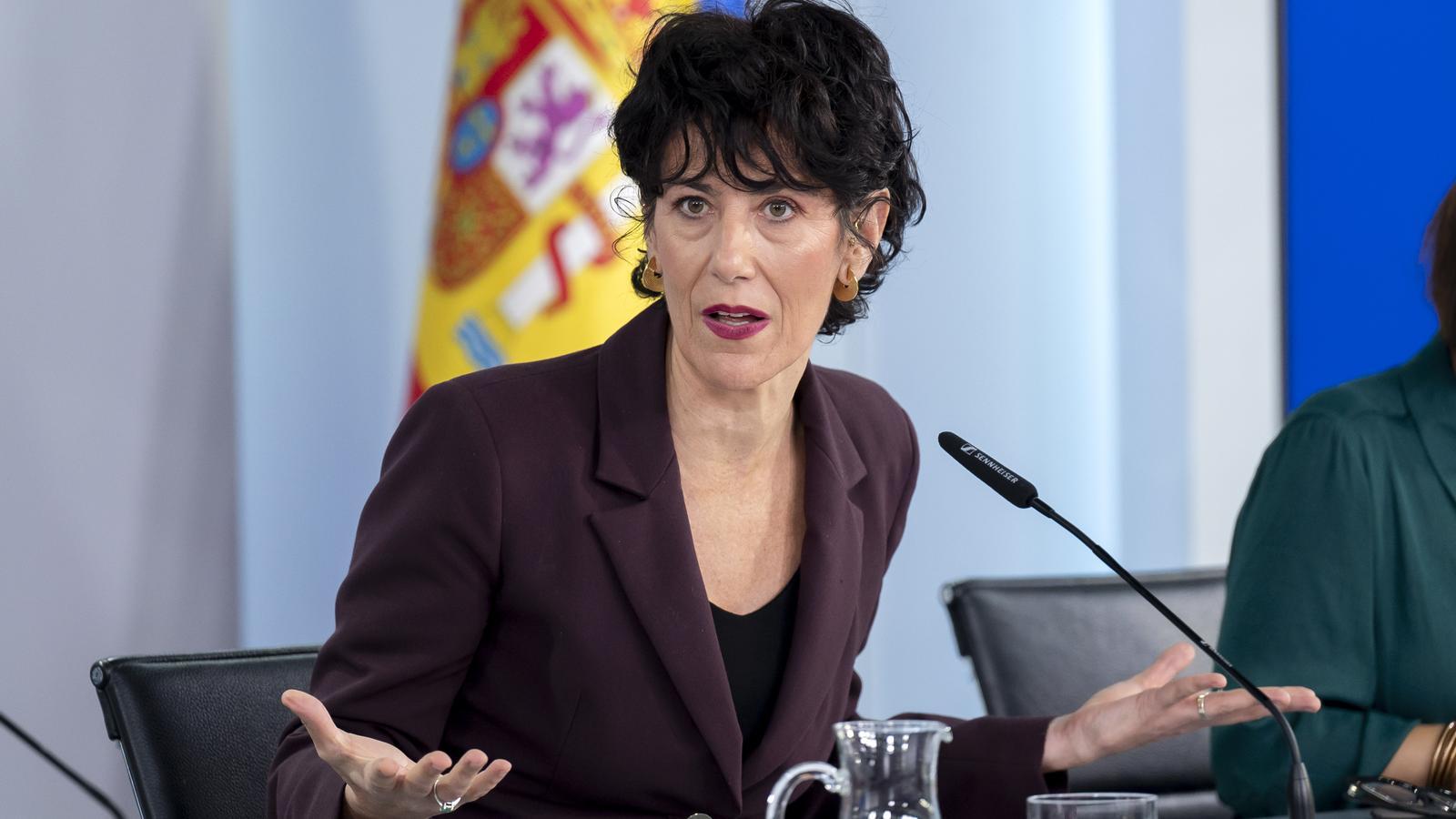
MadridThe Supreme Court's decision to deny the vote to some 163,000 people who obtained nationality through the grandchildren's law has been interpreted as a declaration of war by the Spanish government. "It is of extraordinary gravity," exploded the Spanish government spokesperson, Elma Saiz, in the press conference following the council of ministers. "These are people who fled a country due to a dictatorship –she remarked–. In a democracy, the right to vote is guaranteed and not restricted".
In this sense, she said that the State Advocacy is studying the next steps to take, although government sources point out that those who should file an appeal with the Constitutional Court are directly those affected by the decision. Even so, Moncloa sources avoid confronting the Supreme Court and focus on the reaction of the PP and Vox, who are celebrating that a part of the citizens naturalized through the grandchildren's law has been excluded. "It is Trumpism," these same sources point out. Furthermore, they are perplexed because it would be a minimum percentage of voters; in the 2023 elections, the participation of residents abroad did not even reach 10%, and in the last elections, the PP won.

"There is no democratic cleanliness if there is no cleaning of the census –proclaimed this Tuesday the leader of the PP, Alberto Núñez Feijóo, in an interview on esRadio–. We do not oppose granting the passport or the right to vote, but it cannot be opened indiscriminately to any citizen who has an ancestor in Spain". Furthermore, he has added to the insinuations of fraud that have already been fueled by Vox and other PP leaders such as Isabel Díaz Ayuso. "I will work until the last moment, including the reflection day, with observers and representatives at the polling stations, so that there are no tricks or manipulations", he added after the PP had questioned the guarantees of the postal vote.
The PP questions –just like the Supreme Court– the administrative instruction promoted by the Spanish government in 2022, which develops the grandchildren law to grant nationality to the descendants of exiles –which assumes that all people who left Spain between 1936 and 1955 are included–. For the high court, only those who have proven that they were effectively relatives of people who left for political reasons should be able to vote, and not all those who left the State during that period.
The Spanish government warns of the difficulty of proving this because it recalls that many people who fled into exile "left with only what they were wearing" and perhaps did not keep supporting documentation proving that they were politically persecuted. For this reason, in the administrative instruction that the executive branch drafted to develop the democratic memory law, it stated the following: "The condition of exile will be presumed for all Spaniards who left Spain between July 18, 1936, and December 31, 1955". Subsequently, until 1978, one would indeed have to "prove the condition of exile".
The complexity of the application
Beyond criticizing the measure, the Moncloa also admits that they must comply with it. The Supreme Court has urged the suspension of the registration in the Census of Absentee Residents Abroad (CERA) of the 163,000 people who have accessed nationality through the grandchildren's law, according to the administration. However, this task is of "great complexity" and the Spanish government acknowledges that they do not know how it will end up being applied to consulates spread around the world.
As ARA already explained, consular services have long been reporting that they are "collapsed". In recent years, two phenomena have aggravated the situation. On one hand, the number of Spaniards abroad has tripled: from one million in the 2000s to 3.2 million currently. And, on the other, requests to access nationality have increased following the democratic memory law for children and grandchildren of Spaniards who went into exile. Now, compliance with the precautionary measures dictated by the Supreme Court must be added, which ask for the review of the files of foreigners registered in the CERA who have accessed nationality through this legal route.
In arecent newsletter recent, the Association of Spanish Diplomats warned that the administrative order that developed the grandchildren's law "significantly expanded the potential number of applicants" for nationality, but "without preparing the consular network to manage it in the desired manner". This lack of resources, they stressed, was resolved with an "extraordinary effort" by public employees in the consular network. Now, they will be back in the eye of the storm.
