The Spanish government now announces a single command to coordinate the crisis in Ceuta
The Ministry of Health agrees with the autonomous communities to send 45,000 vaccines to Ceuta
-
CAT -
CAST
MadridAlmost a month after the entry of tens of thousands of immigrants into Ceuta (which Pedro Sánchez defined as a "violation of the territorial integrity" of the State), the Spanish government will declare a "situation of interest for national security" and will agree to establish a "single command" that will be led by the Minister of Territorial Policy, Ángel Víctor Torres. It will be approved at this Tuesday's cabinet meeting, the first after the summer period.
The measure comes after the same government of Ceuta requested to declare "national emergency" on the very first day of the migratory crisis, July 30, and to consolidate a single command at the head of crisis management. In fact, last week the executive already announced the designation of Ángel Victor Torres as "coordinator" of the ministries, but refused to speak of a single command.
Security Council and European aid
But this has not been the only decision that has marked Pedro Sánchez's return from vacation. With the humanitarian crisis in Ceuta latent for weeks, more than 140 deaths on both sides of the border, dozens of missing persons and management criticism from the opposition – the PP attacks Sánchez because it considers him absent – the Moncloa has now convened the National Security Council. It will be this Tuesday at 9 a.m., according to sources from the state executive to ARA. At the same time, the government has formally requested funding from the European Commission to respond to the humanitarian emergency, as reportedby a spokesperson for the community executive to Efe.
"It is important to strengthen coordination between all relevant and competent authorities," said the first vice-president and Minister of Economy, Carlos Cuerpo, this Monday from Ceuta, after announcing the unified command. Cuerpo has also announced an extraordinary expansion of the socioeconomic plan for Ceuta for 2022, which will be approved in the coming days, with three objectives: to strengthen urban and border security, manage returns and provide a solution for immigrants, and strengthen public services and boost the economy. The discontent and tension in the autonomous city have not ceased, on the contrary, with the peripheral neighborhoods assuming part of the humanitarian response and a city center trying to regain a certain "normalcy", even if it is superficial. The citizens of Ceuta have been denouncing for weeks that they feel "abandoned".

The PP insists on confinement
Meanwhile, this Monday the PP insisted on confinement to face a possible health crisis in Ceuta, even though epidemiological experts do not support the measure. The party's spokesperson, Borja Sémper, argued that the possibility must at least be studied, because according to the PP there are thousands of people wandering around Ceuta in unsanitary conditions and there is a risk of a health crisis. They speak of cases of tuberculosis, gastroenteritis, scabies, or other infectious diseases. However, Popular sources admit they cannot provide figures, and they blame the Ministry of Health for "not having yet made a complete diagnosis."
In any case, the Spanish government maintains its position. "It is a major irresponsibility," said the spokesperson for the Spanish government, Elma Saiz, this Monday. "The PP should abandon its ultra drift and stand with the government in this situation," added Saiz, who did not hesitate to warn that "what is contagious is xenophobia." "We have seen Feijóo's rallies more similar to Santiago Abascal's," she added in an interview with TVE.
The Spanish government calls for "listening to science" to address the health situation in Ceuta, stemming from the entry of people from Morocco on July 30th, who more than three weeks later have still not been able to receive adequate medical attention. Doctors and nurses in the autonomous city, who have been working double shifts for days, have denounced a "collapse" of services.
In this regard, the Ministry of Health has agreed with the autonomous communities on the dispatch of 45,000 vaccines, as reported by the ministry. Specifically, the dispatch of 15,000 doses of MMR vaccine and 10,000 doses of diphtheria-tetanus, varicella, and polio vaccines has been agreed upon "as a preventive mechanism in light of the situation in the autonomous city," as explained by the government. The key to a dispatch of this nature lies in the fact that the vaccination status of many of the immigrant individuals is unknown, not in the fear of an epidemic, contrary to what the right-wing has suggested. "Although the situation is not a public health emergency, preventive work is necessary [...]. The most urgent measure is to guarantee dignified conditions for immigrants," indicated the Spanish government.
"The main focus of epidemiological risk does not lie with immigrants, but with the extremely harsh and undignified conditions to which they have been subjected since their arrival," recently warned Pello Latasa, vice-president of the Spanish Society of Epidemiology (SEE), in an interview on TVE. The SEE has rejected the idea of a lockdown.
The distribution of minors
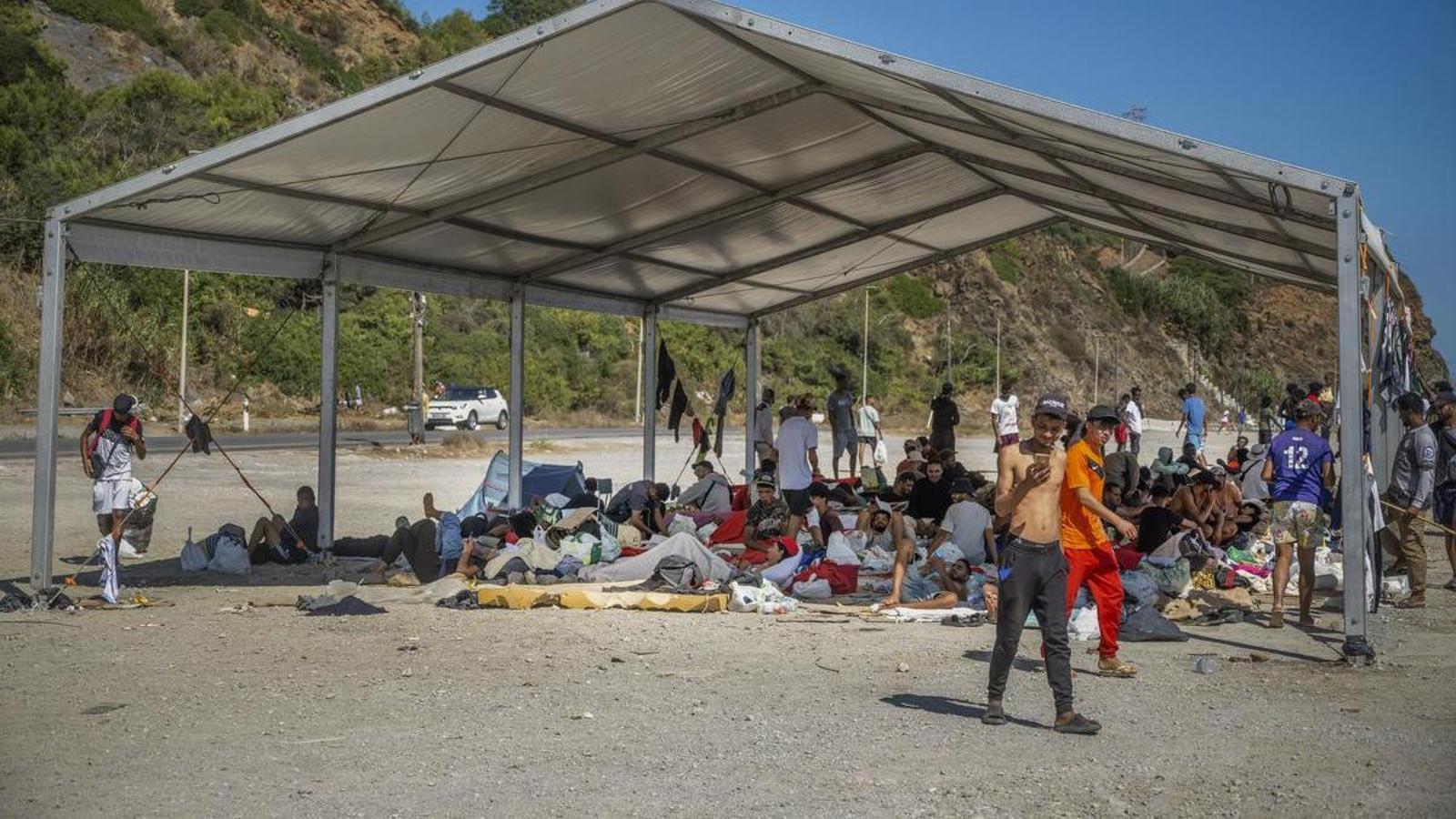
Regarding the current reality experienced in the city, after weeks in which the focus has been on border control and reinforcement, and on the "return of each and every immigrant",", as defended by the Minister of Foreign Affairs, José Manuel Albares, the Spanish government assures that it is redoubling its efforts to provide a humanitarian response to the people who are still living in precarious conditions on the streets of Ceuta. For now, 1,800 people have moved to sleep in the two enabled temporary reception spaces. However, the exact number of immigrants still sleeping rough is not yet known for certain.
One of the most urgent situations in Ceuta is the management of minors: the Spanish government states that there are at least 2,900 registered in the city, according to the minister, a figure that everyone assumes will be higher given that registrations are still ongoing. However, for the PP, the return of all people must be immediate, whether they are minors or not. "It admits no debate," said Sémper, who has called for an increase in staff shifts to speed up the processing of files.
Finally, the Secretary of State for Justice has sent a letter to the General Council of the Judiciary so that reinforcements can be processed for the courts of Ceuta.
Relationship with Morocco
In diplomatic terms, and after the media focus has been brought up again about Felipe VI and a possible visit to Ceuta, the Spanish government continues to avoid opening a diplomatic crisis with Morocco. "Without Morocco, the situation in Ceuta could not have been resolved and 90% of the immigrants who entered the city would not have returned to the country - Saiz stated -. Morocco is a reliable partner in migratory matters," the minister defended, following speculations about the Moroccan regime's passivity at the border on July 30, when tens of thousands of people entered. The PP has considered that Spain's interests are not being defended before Morocco, but has avoided questioning the country as a partner. Only Sumar has again lashed out against the Moroccan regime.
This week, up to eight ministers from Pedro Sánchez's executive will appear in Congress to account for the management of the migratory crisis. One of the unknowns is precisely the role of the Alaouite country in the crisis and whether, as different voices have suggested, it is a new way to pressure Spain and Europe by using the migrant population as a bargaining chip. "The main message for the current Spanish government, the future government, and even the European Union is how essential the southern neighbor [Morocco] is for maintaining border control and the stability of cities like Ceuta and Melilla," reflected Irene Fernández, a researcher and specialist in the Maghreb, this weekend in ARA.
