Lisa Tuttle: "When the teacher asked us for an essay about our best friend, I would hand her something else"
Writer

-
CAT -
CAST
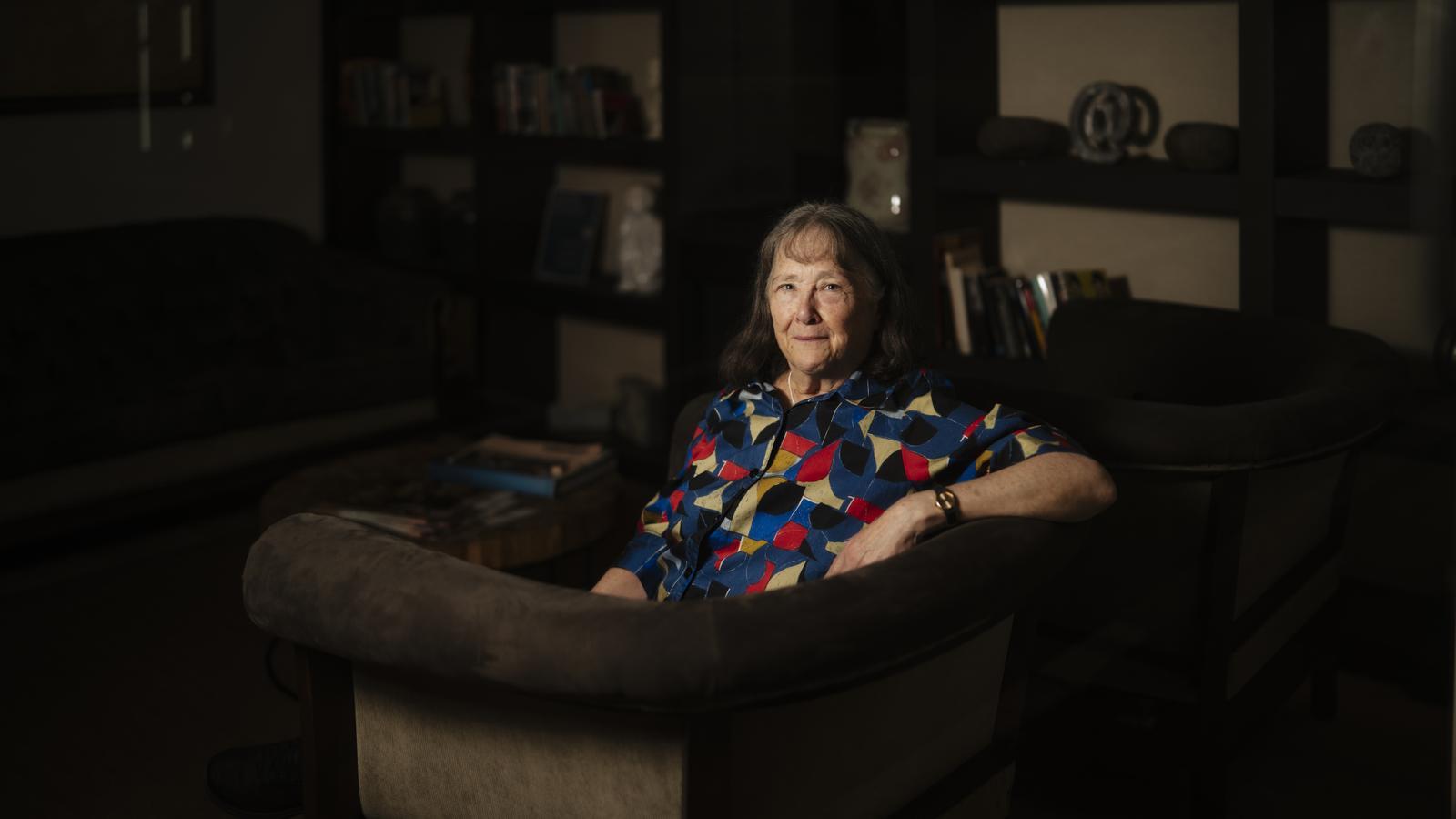
BarcelonaPerhaps because she was born and raised in Houston, a city under the influence of NASA's main space center, Lisa Tuttle (1952) developed an early love for fantastic genres. For nearly five decades, Tuttle has written more than a hundred short stories and nearly twenty novels that, in some cases, have achieved milestones as unusual as those the author makes her characters experience. My Death, which Males Herbes has just published in Catalan, translated by Míriam Cano, had a second life when Tuttle received a call from a small American publisher that wanted to reissue the novel twenty years after it was published in the United Kingdom. “When they told me that the small publisher was New York Review Books, one of the most prestigious in the world, and that they wanted to publish My Death in their classics collection, alongside Balzac, Chekhov, and Flaubert, I was stunned,” acknowledges the author, who has been one of the headliners of Festival 42.
Is this your first time coming to Barcelona to talk about your literature?
— No. But I was about not to come.
How is it?
— The first time I came to Barcelona was in 2016, to participate in the Eurocon, and shortly after arriving in the city I read in the newspaper that Donald Trump had just won the election in the United States. The second time was in 2024, at Festival 42, and Trump had won again. When I was invited this year, I looked at the election calendar and saw that a few days before the festival the midterms were being held. If I returned to Barcelona, a disaster would happen, I told myself for days. But I accepted the invitation. And Trump did not achieve the results that were expected.
Trump received a slap in the face from the voters, on this occasion.
— Yes. We are in luck.
After decades of writing and publishing novels and stories, we can finally read her in English. To reach My Death, I think it is worth going back to her origins as a writer. How did she discover the fantastic genres and why has she explored them as an author?
— Space imagery was very present in Houston, the city where I was born and raised. The preparation for the expedition to the Moon was widely discussed: we had the NASA base very close by, and it still is. Since I learned to read, the stories that grabbed my attention the most were the fantastic ones. Ghost stories, fairy tales... and from there I arrived at science fiction. When I was 14 years old I discovered what fandom was.
How did it go?
— We are talking about the mid-60s of the last century. It was a time when there were many science fiction magazines. Sometimes, in a corner of a page, you would find contact ads like the one for the National Fantasy Fan Federation. I plucked up the courage and wrote them a letter. I explained that I was from Houston and that I wanted to know if there were other fantasy fans I could meet. They replied that they were aware that there were only two fantasy fans in Houston. They recommended that I go to a comic book fan gathering, because it was very likely that I would find what I was looking for there too. My father took me there by car. There was only one other woman besides me: the mother of a boy named Bill Wallace, who became my first boyfriend. It didn't take me long to move forward with the Houston Science Fiction Society and take charge of the fanzine we were publishing.
Did his parents support his interest in fantasy and science fiction?
— Totally. I was very lucky with them. Also with my language teachers. I had one at ten years old who immediately noticed my hobby for writing. When the teacher asked us for an essay about our best friend, I would hand her something else.
Which one?
— I explained to her that my best friend was a snake that could talk. Instead of getting angry, she said that my essays were wonderful. “Write whatever you want, queen, don’t put limits on your imagination,” she would tell me. That was how, years later, when I was already studying in New York, and later on, when I returned to Texas, I began to send stories to magazines, and the first one I managed to get published I sent to that primary school teacher who had encouraged me so much.
When he returned to Texas after his career, he dedicated a few years to journalism, during which he co-wrote three short novels with a young author who showed promise, George R. R. Martin.
— The best way to end up publishing novels is by training every day. Writing for the press helped me a lot. Reviews. Chronicles. Columns about television. In parallel, I had this project with George, which consisted of three short novels gathered in the volume Windhaven [1981]. When we got the contract to publish them, I quit my job. It was a hasty decision. I believed I would make a living by writing, and more or less I have achieved it, but I have gone through difficult times.
The same year that Windhaven was published, he also moved to the United Kingdom.
— The rest of the books I have published I have written from there. I have lived in Scotland with my husband for a long time. We raised our daughter in a small village in the middle of the forest. To go buy bread we had to take the car. Last year we made the decision to move to a small town, where there would be a supermarket, a gas station... and a small hospital, in case we needed it.
The protagonist of My Death is a writer who has just turned fifty and finds herself in a double crisis: her husband has died and she does not know what she wants to write.
— I conceived the book as a game of mirrors with my life, which in some cases offered distorted images. I am not a widow, unlike the character, and I have never suffered from creative block, luckily.
But she has seen how success in the literary world has had to do, for a long time, with being a man or not. This is the case investigated by My Death: the narrator considers reclaiming the life and work of a forgotten writer, Helen Ralston, and during this journey, she will discover parallels between Ralston and herself. The book was published in 2004 and was ahead of many subsequent recoveries of real female authors.
— It is a subject that has always interested me and yes, I suppose I got ahead of myself because I believed it wasn't being talked about enough. Now the situation is very different, some of the authors that have been recovered have had a lot of success, and we could even say that it is an editorial trend. Perhaps the pendulum ends up swinging back to the other side, I don't know.
My death is his most translated and read book?
— No. It is Windhaven, which I wrote four-handed with George. When the Japanese translation arrived at my house, I was dumbfounded: the cover featured all sorts of flying women fighting a sea monster with laser swords. There isn't a single laser sword in the entire book, but they are part of the genre's clichés. There was a huge wave of translations when George became world-famous thanks to Game of Thrones.
Are you still in touch?
— Yes, absolutely. Whenever he comes to the United Kingdom we try to see each other. When they were filming Game of Thrones, he invited me to a part of the filming that was taking place in Belfast. I told him I would go, but that I could only afford to pay for one night at a hotel. It was a fun experience, especially if I compare what I saw there with what later appeared in the series. This very summer he invited us to the premiere of The Mad King, a prequel to Game of Thrones that could be seen at the Royal Shakespeare Theatre. We went there with my husband and our daughter. That night we couldn't talk, but the next day we ran into him at brunch time and we chatted for a while before returning to Scotland. “You should have stayed for more days,” he told us. We couldn't, because we had a long trip ahead of us and our daughter had to be at the office on Monday.
Two decades have passed since the publication of My Death. What are you working on now?
— I wrote three novels where I mixed the crime genre with the fantastic. After that, I have been writing short stories... and a novel of which I have finished the first draft. As I was telling you before, we moved recently and I still haven't been able to get back to it, but I look forward to getting started as soon as possible. I need to rewrite at least the entire opening section.
