Ceuta cries out for a "solution" to the humanitarian crisis
The four religious communities ask for "solidarity" from Spanish society while migrants concentrate mainly on the outskirts of the city.

-
CAT -
CAST
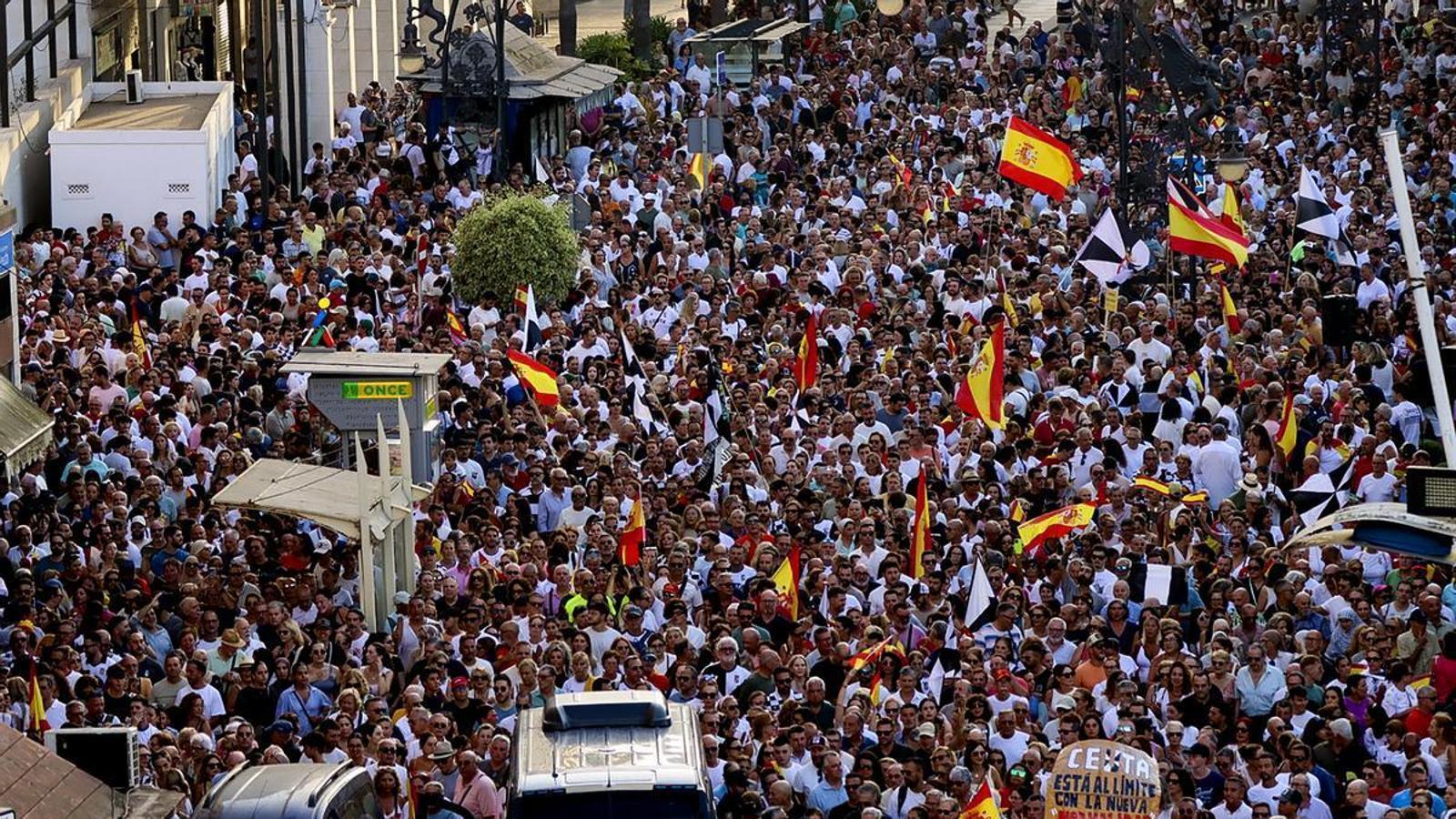
CeutaIn Ceuta, four religions coexist: Christian, Muslim, Jewish, and Hindu. However, the population is largely divided between those who share a Christian faith and those who share a Muslim faith. On the street, it is easy to hear Spanish and darija. This is the first example of where and how this Spanish enclave in North Africa was established. The humanitarian crisis it is currently experiencing, stemming from the arrival of thousands of people swimming from Morocco, which has so far resulted in the deaths of 141 people on both sides of the borders, according to NGO figures, has led to an almost exceptional event: a gathering that has united the four religious communities and took place this Sunday afternoon in Constitution Square.
"Enough is enough. Ceuta does not surrender" has been the slogan chosen by the organizing bodies. These entities have called for "solidarity" from Spanish society, while asking the population of Ceuta for "serenity." "We must put differences aside," appealed the organizations, which demand "solutions, commitment, and responsibility" from institutions to regain a "normality and tranquility" that has now disappeared, as some protesters denounced in statements to Ceuta TV.
The four religious entities wanted to make it clear that the call was not "against anyone." However, among some protesters, attacks could be heard towards the migrant people who arrived ten days ago and are still in the city, many of them sleeping in the open: "They are like rats," blurted out a protester while waving a Spanish flag. Others did not hesitate to speak of an "invasion." The claim of Ceuta's "Spanishness" was also noticeable.
The tragedy has overwhelmed a population accustomed to seeing a trickle of arrivals of migrants seeking a better future. Also accustomed to the Center for the Internment of Foreigners (CETI), a place where immigrants are sent once registered with the National Police and before being expelled to their country of origin or transferred to the peninsula, being over its capacity. But no matter how accustomed, it is still tiring, many neighbors agree. "We have become a containment barrier for the European Union [...] A prison for many people," laments Antonio, a lifelong resident of Ceuta, in conversation with ARA.
These days, some have targeted the central government, others the regional one, but also the European one. During the rally, darts were thrown, but the executive of Pedro Sánchez took the prize; the president of Ceuta, Juan Jesús Vivas (PP), and members of his government supported the call.
Exceptional unity?
The unity shown this Sunday evening is a rara avis in Ceuta, where different voices acknowledge a clear division between the peripheral neighborhoods and the center. In fact, the "return to normality" that the central government has called for is being felt these days.
In the center, there is mainly a mass of population of Spanish origin, most of whom are state officials: Ceuta stands out for the weight of the army, the Civil Guard, and the National Police. Beyond being a geostrategic point, it has historically been a military enclave. Just at the entrance to the city, there is a monument dedicated to the Legion. Opposite, a museum also dedicated to the Legion. In this area, life has returned to the bars, both day and night. Shops are open as normal and the presence of young people wandering lost has decreased, although there are still some. There is more population on the supermarket shelves, some of which still have the army and the Civil Guard at the entrance.
The periphery assumes the pressure
On the outskirts is where the majority of the Muslim population is concentrated. And where, over the days, the State's security forces and bodies have pushed the migrants remaining in the autonomous city. Here, the neighbors continue to do their best to improvise places to accommodate people who, this Sunday, have already spent ten nights sleeping rough. "There has been an abandonment of the outskirts [...] There continues to be a humanitarian crisis that the neighbors are facing. If a social explosion occurs there, the responsibility will lie with the government of Ceuta and the Spanish government delegation," denounces Mohamed Mustafa, from the localist group Ceuta Ya.
"There is a lot of tension. People are not bad, they are desperate to find food or chargers to call their families. Even some are taking advantage of it. I am selling them bread for 0.50 cents and others for 1 euro," said Yamal (Ceuta, 50 years old) this Sunday, a resident of the La Reina neighborhood, on the outskirts, who keeps his small shop running at half speed. Yamal has decided to let people in to buy in small groups. The most basic items, like bread, he sells through an improvised window next to the door.
Yamal, for example, has left a charger outside so they can turn on their phones and talk to their families. He made the decision because he admits to having felt anguish when he suddenly saw so many people, especially young boys and girls, desperately and thirstily looking for food. "I had to take two diazepams," he says. "As I told you, this is a blow for us. We will lose money, but we have to try to make things easier. It is very complicated, one thing is two, ten..., but a thousand? It is impossible. They are desperate and the hunger is getting more intense," he laments.

