Confine migrants in Ceuta for sanitary risk: PP's request rejected by experts and Spanish government
Feijóo proposes isolation measures, but Health finds them unjustified because the risk of disease transmission is low
-
CAT -
CAST
BarcelonaThe umpteenth confrontation over Ceuta between the Spanish government and the PP revolves around the health situation and infections that are said to have been detected following the massive influx of migrants at the end of July. The Ceuta College of Nursing had warned of an increase in cases of gastroenteritis, scabies, and tuberculosis, which it linked to the overcrowded and unhygienic conditions in which some migrants find themselves. Now, the leader of the Popular Party, Alberto Núñez Feijóo, has asked the executive to study the isolation of affected migrants, but the Minister of Health, Mónica García, has rejected the request, arguing that it could be counterproductive. Instead, she urged Feijóo to demand that the Ceuta government immediately hand over all available spaces to house these people in sanitary conditions.
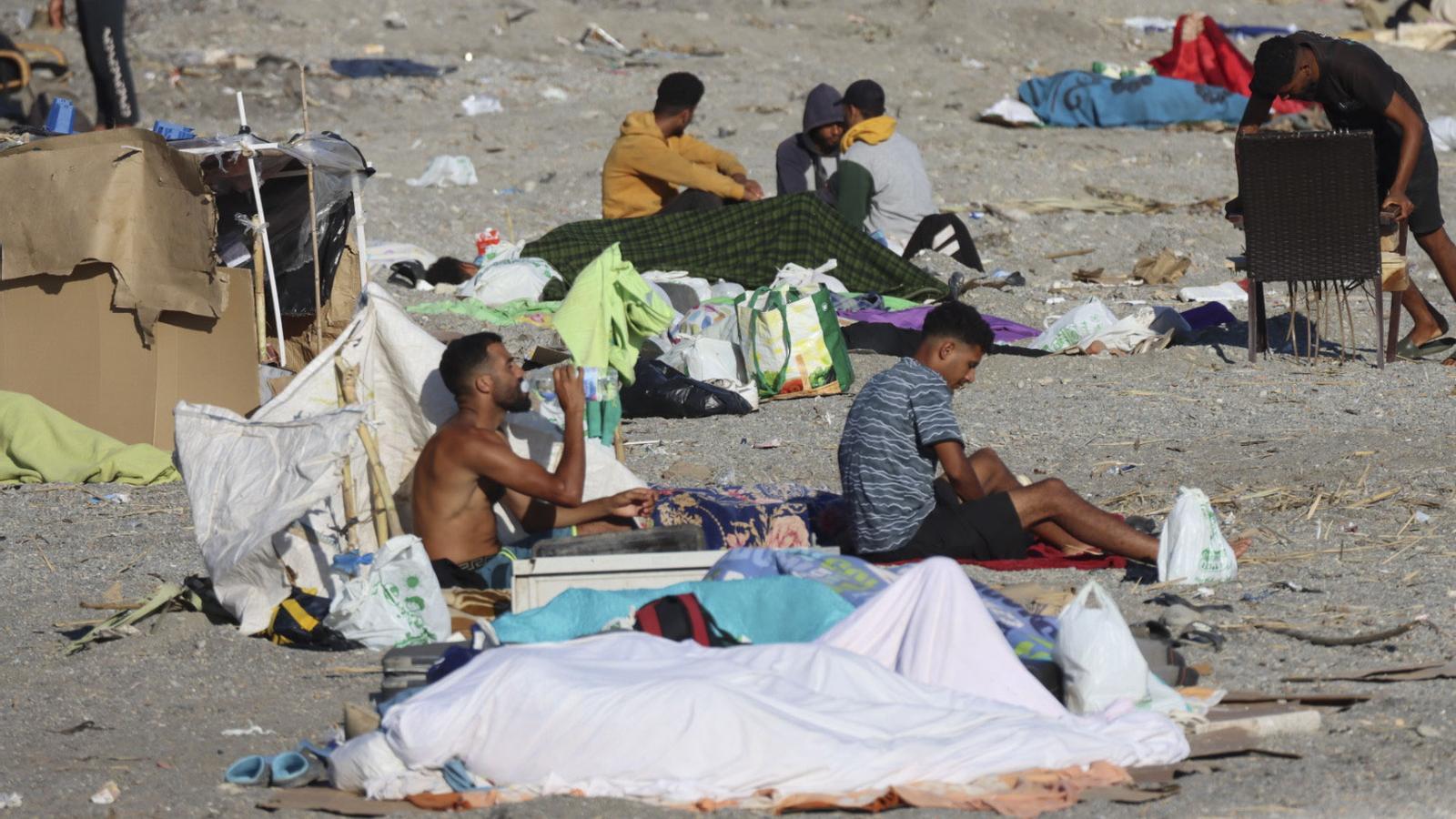
Since their arrival at the end of July, thousands of people have lived for weeks in improvised settlements in the streets and beaches of Ceuta, in precarious conditions and with difficulties accessing drinking water, hygiene, and sanitation. The Spanish government did not announce a specific reception plan until twenty days after the massive influx, which has not convinced some of the migrants, and the concentration of these people in precarious spaces has been continuous. This delay in response, coupled with overcrowded conditions and lack of hygiene, may have favored the transmission of some infections among people living together.
But the fact is that, at present, health authorities have not declared any general epidemiological alert in Ceuta. The Spanish Society of Public Health and Health Administration (SESPAS) also does not consider there to be a generalized epidemic, although it calls for strengthening surveillance and health resources in view of the overcrowded conditions. The Royal National Academy of Medicine of Spain (RANME), for its part, points out that the migrants are mostly "a young and healthy population" and that the most relevant health problems in this case are those derived from displacement, especially trauma.
However, the leader of the PP called on President Pedro Sánchez to decree the confinement of migrants who crossed the border with Morocco and remain in the autonomous city due to the detection of infectious diseases. Specifically, he assured that health professionals in the Spanish enclave had informed him of the existence of cases of tuberculosis and scabies, more than 450 cases of gastroenteritis, and some cases of chickenpox, while admitting that he did not have complete data. Shortly after, however, he qualified his words and limited the possibility of confinement to sick migrants.
This Sunday, García accused Feijóo of "inciting fears and measures" that, in his opinion, he would not propose if the affected population were not migrants from Africa. In fact, the confinement proposal does not convince scientific societies either. In an interview with the SER, the president of the Spanish Society of Epidemiology, María Joao Forjaz, stated that "the circumstances are not met" to confine the migrant population, mainly because the risk of spread outside the environment of these people is very low.
Few confirmed cases
The detection of infectious disease cases does not, in itself, imply that there is a risk of widespread propagation. This risk depends, among other factors, on how each disease is transmitted and on the type of contact with affected individuals. In the case of tuberculosis, García pointed out that three cases have been confirmed in Ceuta, but one of the patients was already undergoing treatment and was not contagious, while another suffered from cerebral tuberculosis, which is also not contagious, and the third was a person who was already in Ceuta. Since the border closure in 2020, approximately 90 cases of tuberculosis have been registered in Ceuta and around 20,000 in Spain as a whole, she stressed.
Regarding gastroenteritis, García clarified the figure of 450 cases mentioned by Feijóo: according to the minister, the Preventive Medicine services of the Ceuta Hospital have studied an outbreak that allows for talking about 55 probable cases of enteroinvasive E. coli, which is already under control and for which no new cases have been detected. The infections would be linked to the consumption of unfit water in Ceuta.
Regarding chickenpox, García has reported three suspected cases. One was ruled out, while the other two remain without diagnostic confirmation. The minister assured that these last two cases "have nothing to do with the migrant population" nor are they related to each other, and recalled that chickenpox is not eradicated in Spain. On scabies, García implicitly confirmed that there are confirmed cases, but stressed that it is a much more frequent condition in Spain than believed: between 2021 and 2023, 1,529 outbreaks and 11,301 cases were detected across the country.
The head of Health assured that the detected positives are controlled according to health protocols and that the risk of transmission to the population of Ceuta is low. “The migrant population and the Ceuta population do not live together in the same spaces,” she stated, adding that occasional interactions on the street do not constitute a relevant public health risk for the mentioned types of diseases. Therefore, she said, the confinement of migrants in the autonomous city would be “totally disproportionate” taking into account what is stipulated by the legislation on special measures in public health matters.
