The PP considers returning to the Diada
Sirera took the first step by attending the institutional act of the Parliament and multiple cadres are rowing in the same direction

-
CAT -
CAST
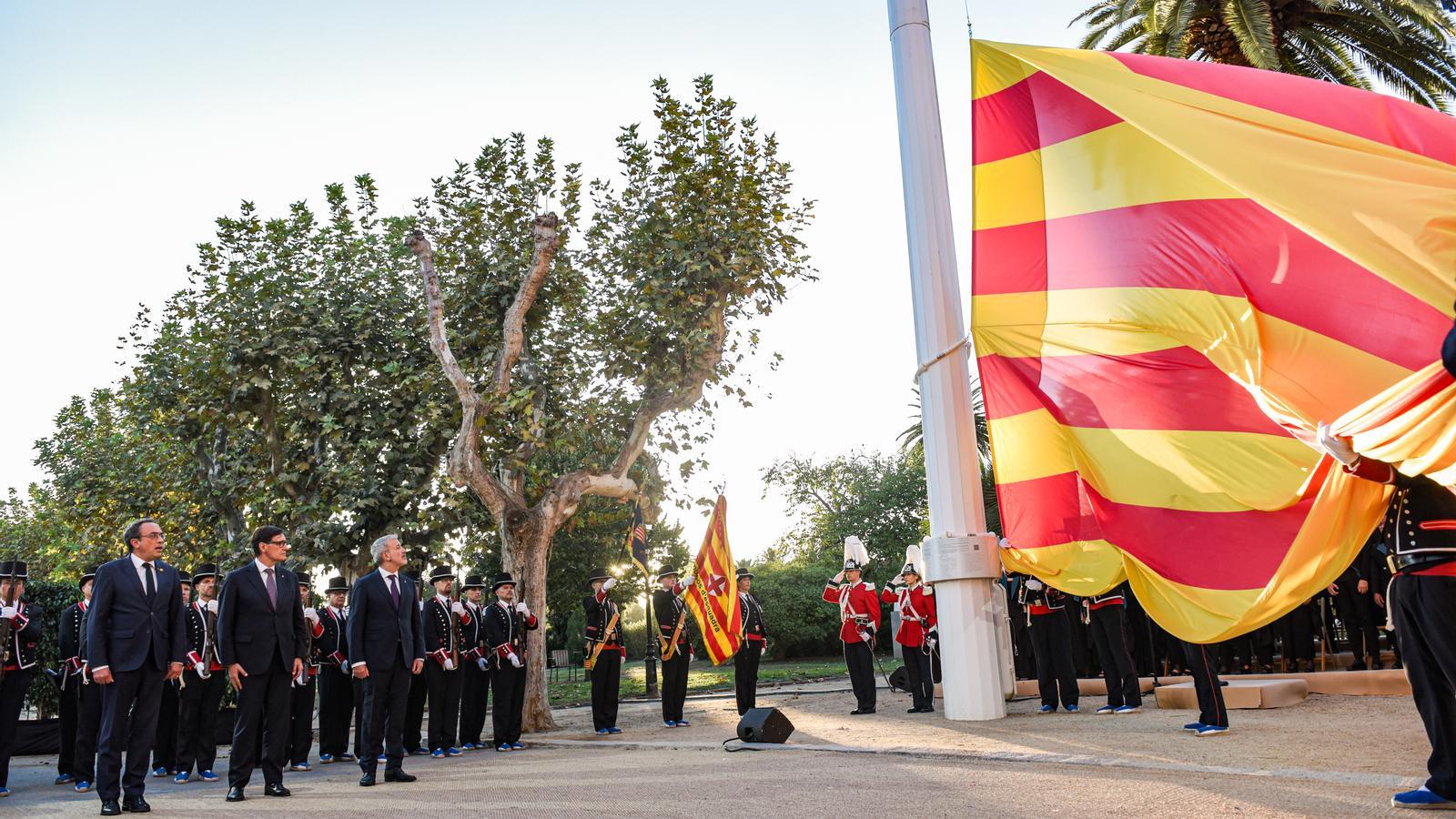
BarcelonaThere are debates that seemed buried, but which are resurfacing. Just as last Friday the PP celebrated the Day of the Valencian Country or also celebrates the Galician holiday of July 25th (needless to say, this Monday they were on the streets of Madrid and Barcelona doing the same for Hispanidad), in Catalonia the populars have been skipping it for years. But that could change soon. With the end of the 'Procés', the 'Diada' is seen in a different light by the PP. In fact, this year there was no internal order prohibiting their leaders from attending the institutional acts of September 11th, as had existed in other years. The leader of the PP in the city of Barcelona, Daniel Sirera, decided to attend the solemn flag-raising ceremony held in front of the Parliament. It was a gesture that he had not shared internally, but which he had planned, and which may mark a turning point for next year, as confirmed by ARA in conversation with different party leaders.
The PP has been boycotting the 'Diada' since 2010, in a pre-'Procés' climate that led them to conclude that it was no longer the space for "all Catalans". However, that veto led to some exceptions –beyond Sirera's this year–. For example, in 2013, the PP deputy and second secretary of the Parliament's Bureau, Pere Calbó, and the then delegate of the Spanish government in Catalonia, Llanos de Luna, attended the official event at the Ciutadella Park. At the same time, since 2019, the former PP spokesperson in the Barcelona City Council, Josep Bou, also broke the veto to celebrate the 'Diada' by honoring Rafael Casanova with an offering in the Catalan capital because he saw the city's last 'conseller en cap' as a "very Spanish" Catalan. Indeed, it was common to see popular representatives at Rafael Casanova before the 'Procés'.
Sirera is a trusted man of Alberto Núñez Feijóo in Catalonia and his move was well calculated. Beyond causing unease among some members of the hardline wing, it has contributed to reopening a debate that multiple cadres assume the party will face heading into next year: the PP must also be at the Diada. Various leaders, from divergent popular families, assume that it now "makes no sense" that no one went to the Parliament's event this year. They agree that a return to normalcy is necessary in those spaces that, like this one, are not "pro-independence witches' sabbaths," according to various voices. In this way, the mantra that the PP defended last year falters: that the party would exclude itself from the Diada while Salvador Illa governed, a "hostage" to the independence movement. This year, far from the old proposals that the party had launched, such as changing the national holiday to St. George's Day, the PP has stated bluntly that it "defends the Diada," but without the "nationalist liturgy".
The connotations and territory of the PP
"I don't know why we shouldn't be there; when there is Andalusia Day you go, why not in Catalonia?", some leaders ask themselves, thinking about the official acts of the Diada. According to some sources, "during the Process, the institutional acts were not held or were a coven", while an act such as the one at the Parliament is of absolute "normality", unlike the nationalist touch of the Fossar de les Moreres, or for some also the offering to Rafael Casanova in Barcelona. The problem that some leaders believe exists, and thus they convey it to the state bodies, is that "it is necessary to be part of the day-to-day life of the community, of the landscape", just as Josep Piqué used to say. Not doing so implies an exclusion that clashes with this proposal for regional integration that Alberto Núñez Feijóo demands –and which is applied in Galicia, Andalusia and the Balearic Islands, with nuances.
Furthermore, within the party it is recalled that in the municipalities there has always been "freedom" of action, which allows us to understand that a series of local PP groups did indeed participate in the municipal acts of the Diada. And that the popular mayors did so too. The mayor of Castelldefels, Manuel Reyes, has celebrated the Eleventh of September every year, with involvement: he has given a speech and led the floral offering and the act in the municipality, just like Xavier García Albiol in Badalona –where, in fact, the terminology of "National Diada" is used and not just "Diada"–. The same thing that mayor Núria Carreras does in Monistrol de Montserrat, where she also uses this term. In Pontons, the other mayor that the PP has, Josep Tutusaus, had celebrated the Diada with normality for many years, and now he limits himself to congratulating the neighbors on the "National Diada". According to multiple leaders, throughout the territory it is understood that the Diada must be celebrated and that is where the "regionalist" understanding takes on more strength, with the clear proof of the mayors. Now the question is why no one else went, at least to the institutional act of the Parliament, and what will happen next year.
