
The big question that hangs in the air after the report was leaked is whether the Guardia Civil should have informed the Minister of the Interior. It depends on whether they were acting as Judicial Police. The law stipulates that the function of Judicial Police "comprises the assistance" to the courts in "the investigation of crimes" and establishes that, in these cases, they "will act under the direction" of the courts and the Public Prosecutor's Office. Therefore, departing from the usual organic hierarchy. The legislation provides that they "may not be removed or set aside" until they have completed their mission.The criminal case concerning Ceuta is not formally open because the judge has not yet declared herself competent to investigate the facts, but Iustitia Europa, the extra-parliamentary party that filed the original complaint, maintains that the members of the Guardia Civil did indeed "perform functions" of Judicial Police. In a document sent to María Tardón, it alleges that the diligence they have carried out and the information they have obtained "are subject to the functional direction" of the National High Court and, therefore, to the "established guarantees" for Judicial Police, who do not have to report to their superiors.In fact, María Tardón directly ordered the investigators not to provide any information to their superiors about the preparation and content of the report. For this reason, the director general of the Guardia Civil had no prior knowledge of it until it appeared in the media.
The police report points out that the Moroccan security forces "actively guided" the migrants to Ceuta
The ARA has had access to the document, which points to a "prior planning" and a will to "collapse the system" of border management
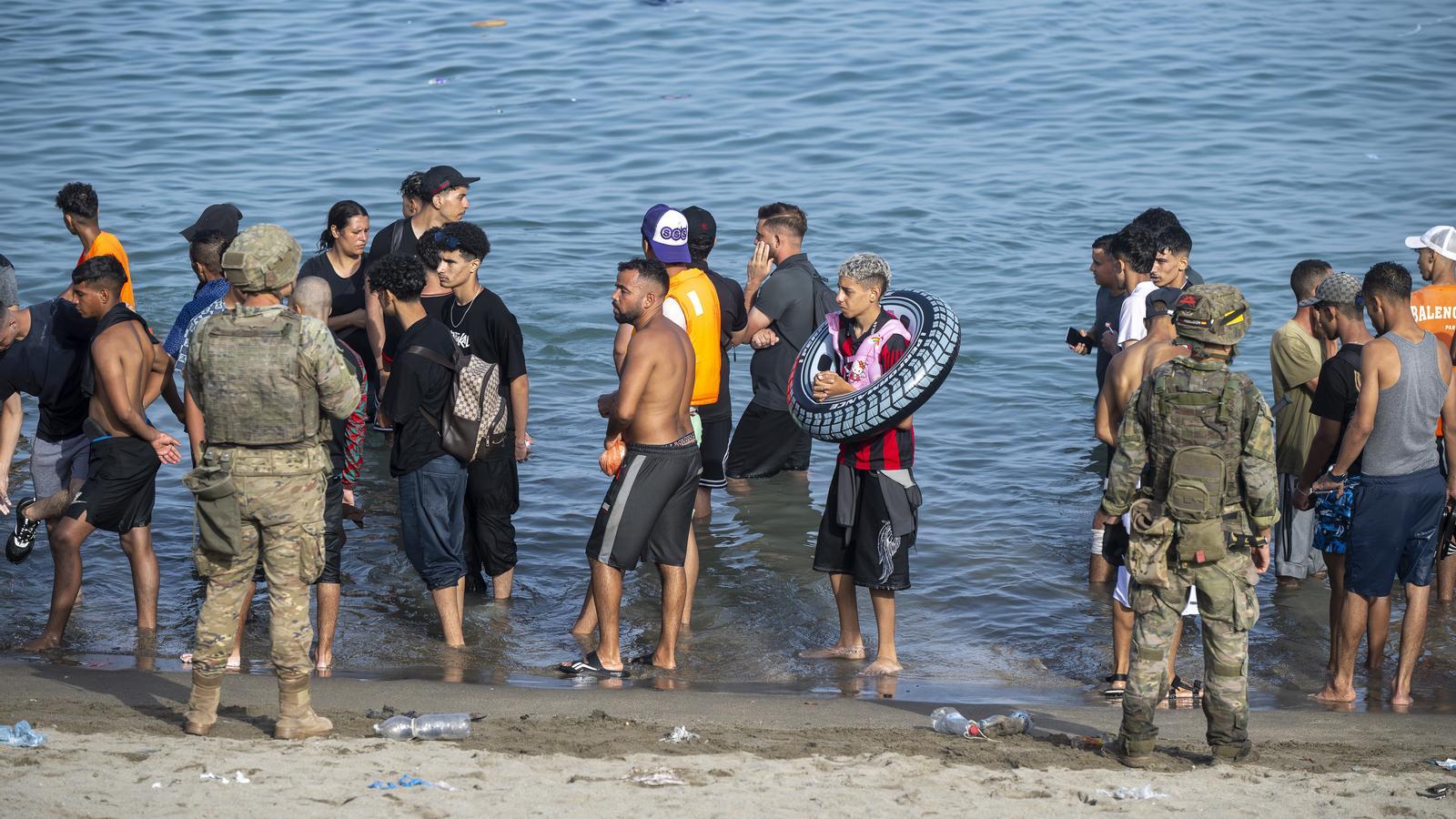

MadridThe National Centre for Immigration and Borders (Cenif) has concluded that the entry of 80,000 migrants into Ceuta at the end of July had the complicity of Moroccan security forces. This is evident from the report it has sent to the National Court and which ARA has had access to. It alleges that it was a process with "prior planning" that had "objectives different from migratory ones" and which had "favorable management" through two main channels: an "scarce" presence of Moroccan Forces and Security Corps, which also led an "active guidance of the masses towards crossing points". This is a version that directly clashes with the explanations from the PSOE ministries and Pedro Sánchez, who have disassociated Morocco from the crisis and have highlighted its "cooperation".highlighted its "cooperation".
The 55-page document explains that the "behavior and evolution" of the entry into Ceuta is "incompatible" with the actions of a "spontaneous group without internal organization" because, unlike what happens at large concerts or sporting events, there were no "blockages in access routes" or in the means of transport, and there were no "public order incidents". Likewise, it argues that they have detected a "high level of specialization of tasks or functions" that "is not within the reach of any criminal structure" of those operating in the area.
It also reports that access to Ceuta had a dual objective. Firstly, to "collapse the system" of border management at one point and "saturate a reception and containment area for immigrants" to "draw even more resources" from border control and management. Secondly, to "eliminate the response capacity" from Spain. To achieve this, the first group of people who entered were prepared individuals with equipment, followed by women and children to provoke "any reaction to control the border perimeter to have a null or very limited impact".

On-site monitoring
The Spanish police report that there was also an "on-the-ground" control, which would demonstrate the existence of an "organization" and "coordination." And how was it? Investigators have detected individuals with a "profile, attitudes, and actions" that "do not correspond" with those of the mass of people entering and leaving Spanish territory irregularly.
Delving into the profile of the "active subjects," the report differentiates between two types of behavior. On the one hand, uniformed Moroccan security forces gave "instructions" to people crossing the border to "overcome obstacles." On the other hand, there were also non-uniformed "dynamic agents": a series of people with behavior that "does not fit the dynamics of the mass. They were men between 30 and 50 years old with a "strong or athletic build" and short hair, wearing "neutral and understated colored t-shirts" and closed sports shoes, and carrying "backpacks, fanny packs, or small handbags."
Why did they attract attention? They were "attentive" to their surroundings and displayed "attitudes of control, leadership, and direction," in contrast to the people around them: "They walk against the flow of people, moving away from the paths while observing the passage of groups, inciting the crowd to continue marching or constantly talking on their mobile phones, as if monitoring the event." In some cases, they even "gave instructions" to uniformed personnel.
The version of the Ministry of the Interior
After the news became known first thing in the morning, the Minister of the Interior, Fernando Grande-Marlaska, sent a letter to the director general of the Spanish police, Francisco Pardo, asking for explanations about the “veracity” of the report, alleging that it is “essential” for the Spanish government to be able to “adopt the appropriate decisions.” “This would be information that must be immediately made available to the members of the National Security Council,” Marlaska reproached him.
Now María Tardón has authorized access to it and, despite what El Español has revealed, sources from the Ministry of the Interior assure that Francisco Pardo has communicated to Fernando Grande-Marlaska that “there is no police report” that “atributes” the “planning or execution” of the massive entry of migrants to the Moroccan Security Forces. All in all, one day before Pedro Sánchez appears before the Congress of Deputies to account for his management.
The judicial case that originated this report, which the judge requested at the beginning of August, was born from a complaint by Iustitia Europa. The Prosecutor's Office, which is the only one that has had access to the document, has yet to take a position on whether the National Court has jurisdiction to investigate the massive entry of migrants into Ceuta. After the pronouncement of the Interior Ministry, the judge will have to decide whether to formally open a criminal case. The PP and Vox have appeared as popular accusations in the proceedings, where the complaints from Manos Limpias and Hazte Oír have also been accumulated. For now, the judge has not yet resolved it. It is also awaiting a report from the Civil Guard to clarify whether the armed institute received "any information in the preceding days" that "could have alerted" about the massive entry.
A prior alert sent to border posts
Beyond this report prepared at the request of the National Court, the Cenif, the police unit that has now jumped to the forefront, also sent a notice on July 29 to the border crossings of Ceuta and Melilla. This document, to which ARA has had access, explained that a "potential risk of irregular entries" had been noted and pointed to the "possible consequences derived" from the Supreme Court's ruling on hot returns. And it added that there was an "extreme risk" of swimming entries and coordinated fence jumps.
However, despite these warnings, the director general of the Spanish police explained that the communication was a "frequent risk alert" and that it "did not include any allusion" to a "possible massive entry." In other words, the Spanish government maintains that it did not have prior warnings to anticipate the crisis. For now, only the head of Defense and head of the CNI, Margarita Robles, has admitted that there was indeed information about an increase in people swimming across the border.
