Sánchez defends Morocco's "cooperation" and says Felipe VI will visit Ceuta
The Spanish president, who says he will finish the term and run for re-election, points to the "reactionary international", Russia and Israel as the origin of the crisis

-
CAT -
CAST
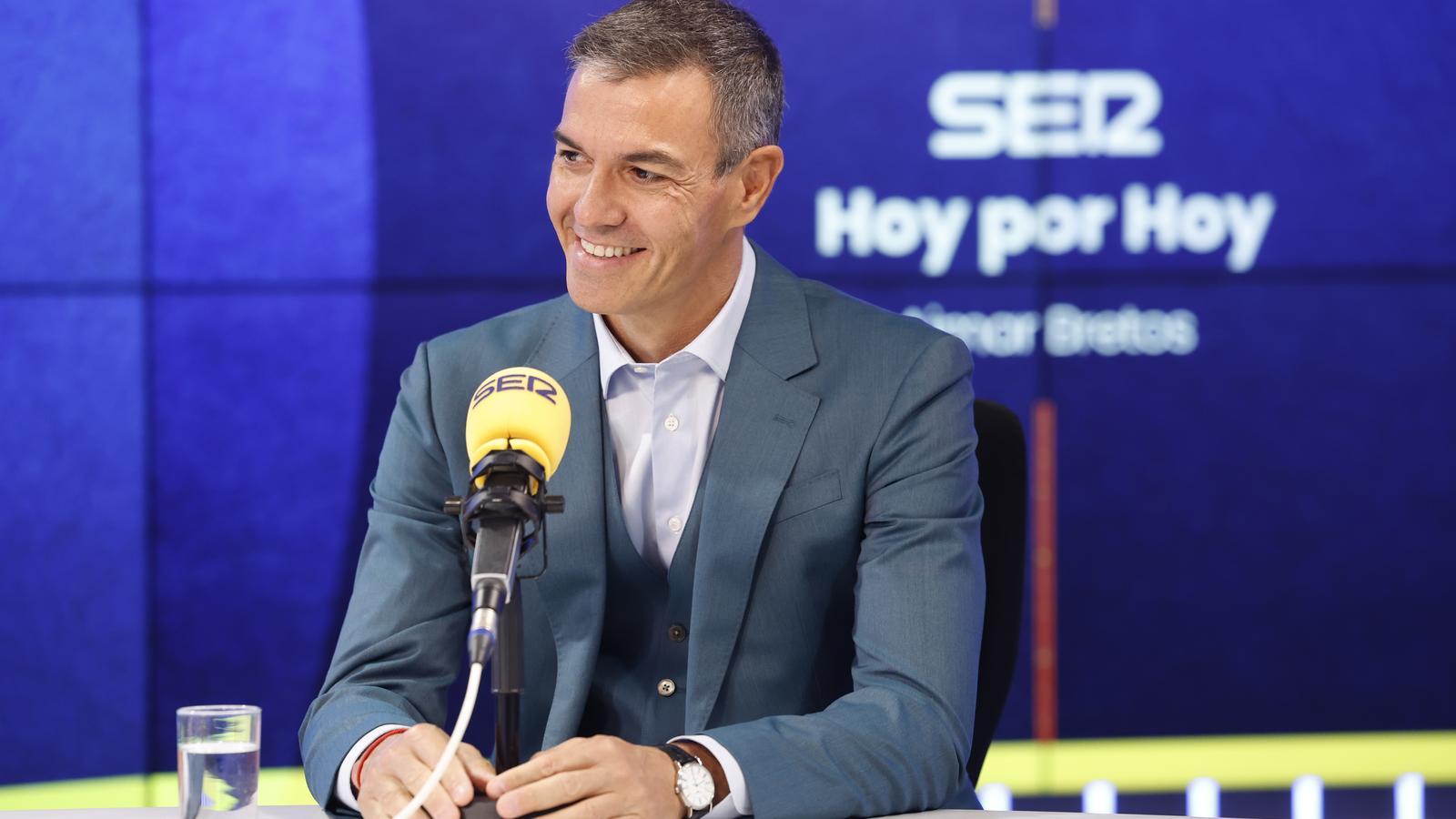
MadridIt had been a month since he last spoke publicly and faced criticism from all sides regarding the Spanish government's management of Ceuta. Pedro Sánchez chose this Monday, August 31, exactly 30 days after labeling the massive influx of migrants as a "violation of the State's territorial integrity," to break his silence and defend his decisions at the helm of the executive. Without admitting any self-criticism, in an interview with Cadena SER, Sánchez dissociated Morocco from the crisis, pointed to the "far-right" international, and opined that there are "arguments and reasons" for King Felipe VI to visit the autonomous city. A visit that he announced would take place, but without specifying dates: nor do sources from the Royal Household wish to reveal anything, limiting themselves to saying that they "will work" with the Spanish government for it to happen. This Monday afternoon, precisely, Sánchez and Felipe VI met to "discuss routine matters," without giving further details of the meeting. According to Moncloa, it had been scheduled before the summer and proceeded "as usual," even though it is evident to everyone that with his statements, Sánchez has put the king in the spotlight.
The fact that the monarch visits the autonomous city is an exceptional matter and something that had generated controversy because the right-wing suggested that Felipe VI wanted to go there and the Spanish government did not authorize it. In fact, the PP has interpreted the move as a lack of respect from Sánchez towards the monarchy considering the tone he used during the interview. The last and only time in democracy that a head of state visited Ceuta was twenty years ago during the government of José Luis Rodríguez Zapatero, with the visit of Juan Carlos I and Sofia, but it generated a clash with Morocco due to its territorial claim over Ceuta and Melilla. "If Alberto Núñez Feijóo were president now, he would visit Ceuta with the king," stated the PP spokesperson, Borja Sémper, as the party interprets that if Felipe VI has not gone there, it is because Moncloa has not allowed him to.

The other most relevant issue from Sánchez's interview on the Ser has been Morocco's exculpation of the entire crisis. A thesis that only the PSOE defends, since both the opposition and its partners point out that it is impossible for the Alawite country not to have detected the movement of more than 70,000 people heading towards the border. "The experience I have is one of instant and immediate cooperation on the part of the Moroccan authorities," Sánchez assured, adding that Morocco is an indispensable partner for resolving the current crisis, with the idea that it should collaborate in the repatriation of migrants who are still in the autonomous city.
What is the origin, then, of the crisis? According to the Spanish president, although he said that the "investigation" is still ongoing, it all began with a "distortion" of the Supreme Court ruling that rejected "hot returns" for those entering by sea and with an amplification of fake news by mafias, the "far-right international", Israel and Russia. "Conspiranoia," the PP reacted to Sánchez's hypothesis, in addition to reproaching him for blaming everyone for the crisis except himself: "He just needed to blame Franco," Sémper said. The explanations also did not satisfy the rest of the groups, who accuse him of being benevolent with the Alawite country. Vox has called for the friendship treaty with Morocco to be suspended, while Sumar and Podemos have once again pointed to the regime as also responsible for the crisis.
In fact, the PP has reproached Sánchez for the Spanish government's inability to weave a single narrative about the crisis, alluding to the clash between Defense and the Interior over whether or not there were warnings from the CNI. What happened, according to Sánchez? During the interview, the Spanish president defended that there was no information about the magnitude of the massive influx of migrants, which does not mean that the CNI did not explain the information it had. In fact, for Sánchez they are not contradictory versions: he stated that the secret services warned of an increase in entries to Ceuta by swimming, but not of the dimension of what happened, so the reinforcement that occurred at the border was not sufficient. "Nobody predicted that we would have an entry of those characteristics," he said, nor did other intelligence services with whom Spain usually collaborates.
Places to accommodate migrants
The Spanish president began the interview by giving figures on Ceuta: he said that around 72,000 people entered —of whom he said most returned in the following days thanks to collaboration with Morocco— and that currently 5,000 remain in Ceuta, 1,200 of whom are minors. He could not say how many are currently being attended to. "In a short time we will have the capacity to welcome them," he promised. Sources from the Ministry of Migrations, headed by Elma Saiz, explained this Monday that the Spanish government has so far opened 3,300 new temporary reception places to accommodate immigrants in Ceuta. A figure that shows that it still does not cover the needs of the 5,000 people remaining in the city, although the executive has committed to reaching 6,000.
Sánchez has assured that "the vast majority of migrants who entered did so for economic and not humanitarian reasons", and therefore predicted that most people will have to return to Morocco because they will not have the right to asylum. In this regard, he said that the priority is to return them to their place of origin and resolve the cases in the autonomous city itself, without transferring them to the Peninsula, a wish that could further strain Ceuta given how long the city has been in this situation. In fact, from Sumar, Ernest Urtasun has warned that changing their location is "essential" to restore normality. From Catalonia, Oriol Junqueras (ERC) has warned, however, that the reception capacity in Catalonia "is not infinite". Regarding minors, the Ministry of Youth is indeed working to transfer 700 girls in a situation of special vulnerability in the coming days.
Sánchez wants to finish the legislature
For Sánchez, the Spanish executive has been on the front line throughout the crisis and has dismissed the possibility of errors or late management. Furthermore, he defended his "right to rest" against those who reproach him for taking holidays.
Sánchez has once again defended that there are arguments to move forward with the legislature and see it through to the end, he has reaffirmed that the elections will be in 2027; that he will present the budgets and, even, that he could lean towards waiting to call the general elections after the municipal and regional elections in May. A scenario that several socialist barons distrust, who prefer Sánchez to face the polls before them. What does the PSOE leader say to these critics? Besides specifying that they are a "minority", he reminded them that four years ago he got a better result in the general elections than the PSOE did in the regional and local ones.
