Margarita Robles remains alone: the Spanish government maintains that there was no warning about a crisis in Ceuta
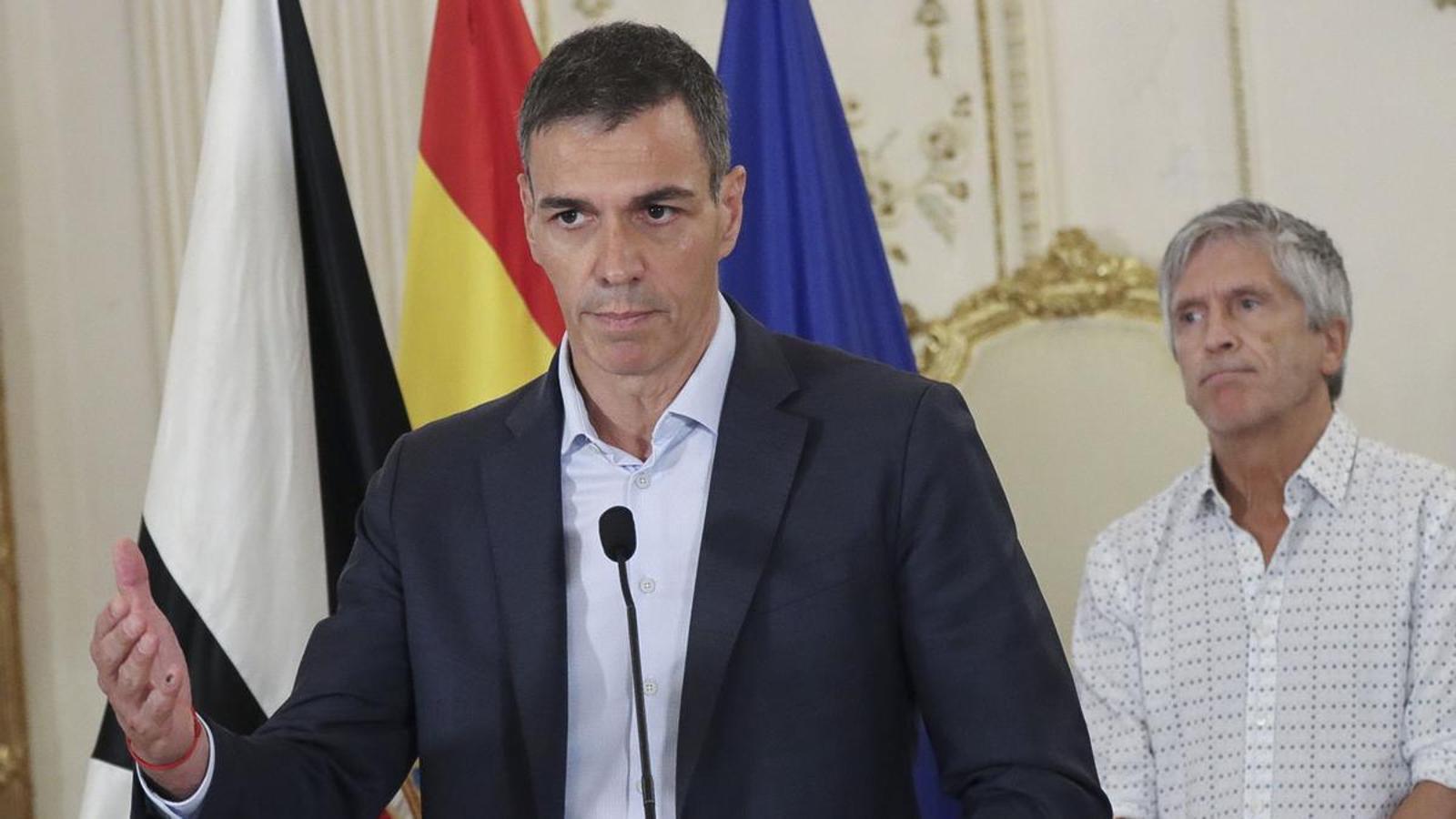
Pedro Sánchez will appear in Congress for the Ceuta crisis on September 3

-
CAT -
CAST
MadridWas there a warning from the CNI or not, to foresee that there would be a massive influx of immigrants on July 30? This is the question that has led to a clash of versions within the Spanish government, especially between the Ministry of Defense, from which intelligence services depend, and the Ministry of the Interior, which is responsible for border control. Minister Margarita Robles, who at no time said she was aware of a migratory wave like the one that occurred, has assured that the CNI shared two warnings with the Interior, the government of Ceuta, and the Spanish Government Delegation verbally: on the one hand, that there was a surge in swimming entries; and, on the other, that there was a call on social networks to enter Spain through Ceuta. A statement that has called into question the entire Spanish government and, especially, the Ministry of the Interior, as it implies that if there were warnings, it could have acted. For this reason, Moncloa aligns with Fernando Grande-Marlaska: it emphasizes that there was no report from the intelligence services from which it could be inferred that there could be an entry of more than 80,000 immigrants into Ceuta.
This was highlighted this Wednesday by the Minister of Territorial Policy, Ángel Víctor Torres, who is now in charge of leading the unified command on the Ceuta crisis and is in the autonomous city. In an interview with SER, he defended Marlaska's position and assured that there was evidence of an increase in immigrant entries into Ceuta, but no information about an arrival of tens of thousands of people: "The situation is reported every day. There had been an increase of about 1,000 people in seven days. But no warning was received that there would be an arrival like the one that occurred," he explained, and assured that the Minister of the Interior's response has been "clear." "If we had been aware of it, the action would have automatically been different," he explained. A version that yesterday was also supported by the Spanish Government Delegation in Ceuta in a statement. The PSOE spokesperson, Patxi López, in statements to the media, clarified that perhaps the CNI warned of the entry of immigrants but not of the magnitude. "If the information had existed, the resources that the police, the Civil Guard, and the army would have deployed would have been infinitely greater," he declared.

In turn, the president of Ceuta, Juan Jesús Vivas, in a press conference before meeting with Torres, reaffirmed that he had no report, but also that before July 30 he asked the Spanish government to activate the emergency. "The surge in arrivals [of migrants] was worrying and exponential," he asserted, giving figures: from 180 to 800 in a week. However, he asserted that the Secretary of State for Security replied that there was no exceptional situation.
And the paradox facing the Spanish government is the following: when Robles defends the role of the CNI and says that they analyzed and shared information about the entry of immigrants, she is placing (willingly or not) the responsibility on the Interior Ministry, which was the one that had to provide the means to reinforce (or not) security at the border. Emphasizing Robles' version, therefore, is counterproductive for Moncloa, as it implies focusing on whether the Interior Ministry allocated sufficient resources to the situation. On the other hand, what Marlaska says facilitates the defense of the Spanish government's management: if there were no CNI reports warning of the situation, the crisis becomes inevitable.
Following the controversy, the PP has not taken long to strike a nerve. The president of the PP, Alberto Núñez Feijóo, has called for the "immediate" convening of the Official Secrets Commission in light of the versions from the Interior and Defense ministries regarding the role of the CNI. In a message on X, the leader of the popular party assured that, "given this mess of versions about what happened in Ceuta, the immediate convening" of the aforementioned commission is essential.
Sánchez's appearance
Although the focus in recent hours has been on what the Spanish government knew and didn't know about what could happen in Ceuta, the opposition groups and also the partners have maintained pressure on Pedro Sánchez. After Moncloa proposed a appearance on the crisis on September 9, a majority in Congress demanded that he bring it forward due to the seriousness of the situation, so the date set is September 3.
The Spanish lower house hosted a session of the Permanent Deputation this Wednesday marked by requests for explanations from the Spanish government. An avalanche of ministerial appearances has been discussed – this week, after Robles, there are still six left in the Courts – and also that of Sánchez. "It should have already happened. There are things that Sánchez has to explain to the nation. If there was an attack on the country, how can he have gone on vacation?", asked the spokesperson for the PP, Ester Muñoz, who, along with the spokesperson for Vox, Pepa Millán, was the harshest. The Vox deputy defended that the Spanish government was negligent in its duties in the face of the entry of immigrants – "one day we will know what they owe Morocco", she said – and promised that they would do everything possible for Sánchez and Marlaska to answer before justice. "It is treason", she sentenced. From the partners of the plurinational majority, the tone was not so harsh, but they also criticized the management that the Spanish government is carrying out.
"No one has gone on vacation here. Would you be more agile?", responded the PSOE spokesperson, Montse Mínguez, visibly agitated, who accused the right of spreading fake news and having "fantasies"."Hot returns of minors or confinement for gastroenteritis is a proposal?", Mínguez replied about what the PP is asking for. Thus, she challenged Feijóo to sit down and talk to "help" Ceuta and for the autonomous communities governed by them to agree to take in unaccompanied minors. A point that the popular party has already rejected. This Thursday, ministerial appearances will continue in the Courts – Félix Bolaños and Ángel Víctor Torres –, which for now are turning against the Spanish government.
