Oaks and Marlaska get tangled up with the CNI's warnings about Ceuta
The government delegation in Ceuta denies having received any prior information about the massive entry of immigrants

-
CAT -
CAST
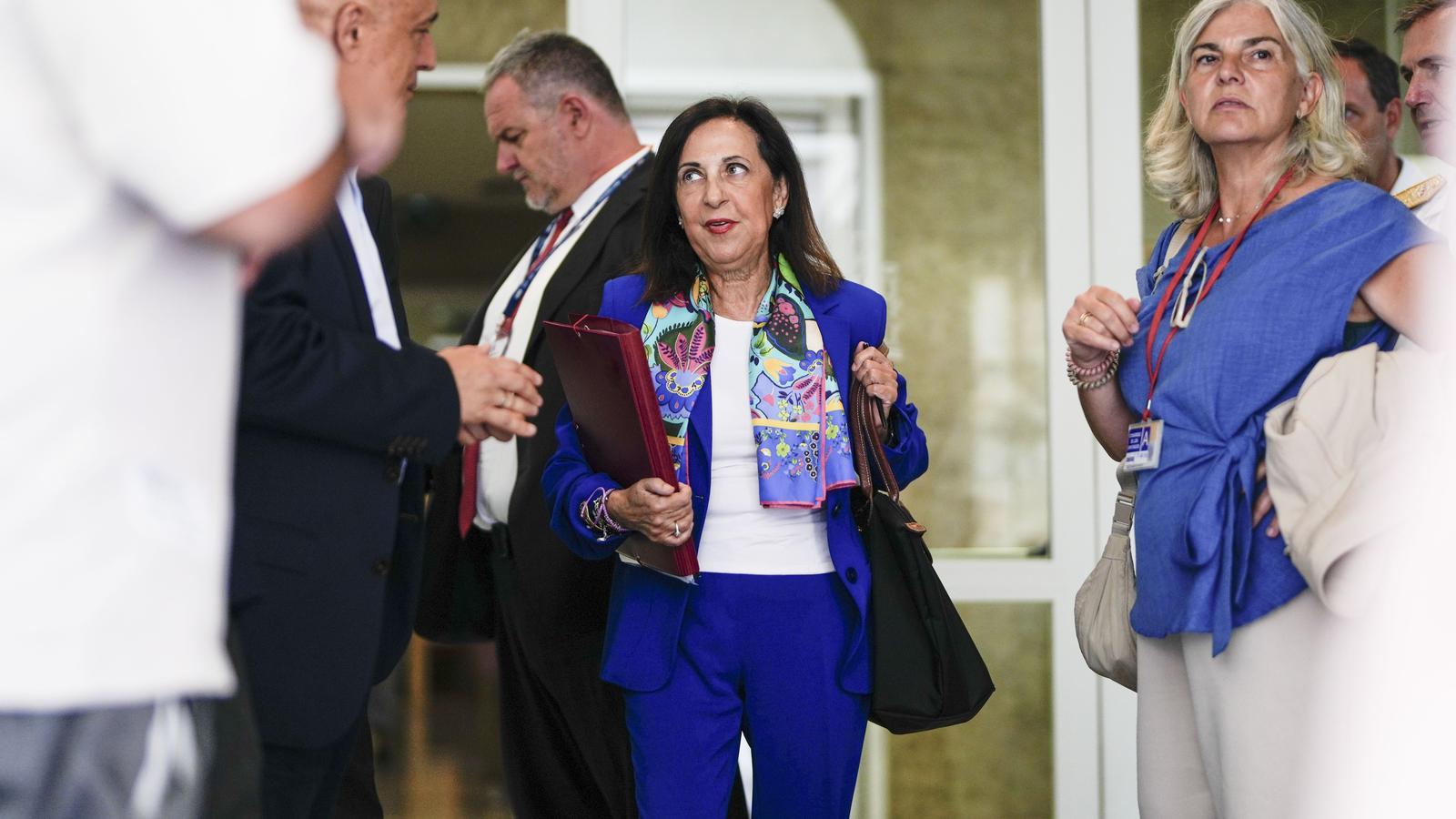
MadridThe CNI has re-entered the scene regarding the crisis in Ceuta. The role of the intelligence services was one of the keys in the appearance of the Minister of Defense, Margarita Robles, this Tuesday in Congress. The unknown hovered over her and her ministry as to what the CNI knew about the entry of tens of thousands of people – around 80,000 – on July 30 and 31 from Morocco. And in particular, whether the services had warned of the possibility of the migratory crisis. The question has led to a tangle between this portfolio, the Ministry of the Interior, and the Spanish Government Delegation in Ceuta, as everyone wants to defend their actions. While Robles assures that the CNI transferred information to the Interior and the Delegation, they clarify that they were not warned in any way about a massive entry of migrants.
Initially, Robles resolved the doubt in her own way: after revealing that there are 25 members of the intelligence services in Ceuta, she limited herself to saying that they had "shared and analyzed" the information that was "within their competence" with the State security forces, the government of Ceuta, and the Spanish Government Delegation in the city in two meetings, and they did so "without the need for reports," meaning, verbally, said the minister without going into further detail. One meeting was on July 27, in which, according to Robles, it was noted that entries of people swimming from Morocco were increasing. The second was on July 29, in this case only with the Government Delegation: "The call for the next day [via social networks] to enter Ceuta by swimming is being transferred [also verbally]," said Robles. The minister did not refer, however, to an explicit warning of a massive entry.
In a statement, the Spanish Government Delegation in Ceuta was quick to say that no information was shared with it to foresee that tens of thousands of immigrants would cross the border on the 30th: "This delegation did not receive, at any time, information that warned of what was going to happen on July 30th," the statement released this Tuesday maintains. However, it specified that they did receive daily information about the increase in arrivals by sea.
Divergence with Marlaska
Robles's response has not convinced the deputies and has once again meant that the ball is in the court of the Minister of the Interior, Fernando Grande-Marlaska, who is the one with responsibilities in the control and reinforcement of the border. "There was no report that hinted that what finally happened should have happened on July 30," Marlaska said this Tuesday from Moncloa, while Robles's appearance was already underway. A narrative that coincides with that of the government delegation in Ceuta.
The rift between these two departments first opened in early August, when some information pointed to the existence of warnings from the CNI of the massive entry and, therefore, a lack of foresight from the Interior in border control. Sources from the Spanish government insist that both ministers "are talking about the same thing". The same sources say that it was shared that in the summer there is always a "peak in entries", that it was discussed, but that "in no case" was the arrival of 80,000 people considered. Both Marlaska and Robles agree in praising the work of the intelligence services.
For the opposition, the explanations have been insufficient: Ester Muñoz said that the crisis was "avoidable" and called for accountability.
Warning to Morocco
Robles began this Tuesday the round of appearances of the Spanish government for the crisis in Ceuta. Eight more ministers will follow throughout this week and next, if we take into account the last-minute appearance announced by the Minister of Territorial Policy, Ángel Víctor Torres, this coming Thursday. Pedro Sánchez will also do so, as requested by the opposition, but there is no date yet.
Torres has been appointed coordinator of the single command that will now manage the crisis and that the executive has finally decided to approve. In fact, this Tuesday he already met with the president of Ceuta, Juan Jesús Vivas, to enable new spaces for migrants and tomorrow, Wednesday, a first joint meeting will be held. Why has the Spanish government waited until now? Moncloa sources assure that they are in a different phase compared to the start of the crisis, where the return of people was prioritized. Now, when reception spaces need to be sought and everyone needs to be registered to initiate individualized proceedings, that's when the State's single command comes in to guarantee coordination. One of the problems the Spanish government has is that it has not counted how many people are still in the autonomous city.
Robles' explanations coincided with a new allusion by the Minister of Religious Affairs of the Moroccan regime regarding the sovereignty of Ceuta and Melilla – it is a historical and habitual claim of Rabat–. In a religious ceremony before Mohammed VI, Ahmed Toufiq called for "the liberation of occupied territories". "Let no one forget that [Ceuta and Melilla] are Spain," said Robles.
The minister has been the harshest in the Spanish government against Morocco over the crisis. She demanded that Rabat "not look the other way". However, deputies to the left of the PSOE have criticized a lack of assertiveness from the government towards the Alawite country, which they do not hesitate to point out for using the migrant population within the framework of a "hybrid war", in the words of ERC deputy Francesc Marc Álvaro. Junts, for its part, has once again requested the powers in immigration.
The role of social networks
At the beginning, the minister offered words of remembrance for the deceased victims, as it was the deadliest migratory crisis with 140 deaths according to organizations on the ground. She also asked for "forgiveness" from the citizens of Ceuta who felt "abandoned," acknowledging that perhaps something was not done "well".
Robles once again pointed to the mafias that traffic people and attributed the entry of migrants into Ceuta to a "call effect" through social networks with messages suggesting that the border was open following the Supreme Court ruling. The minister anticipated that there will be things that are not yet known and "perhaps will never be known." She spoke, for example, of "destabilizing agents" without specifying what she was referring to.

