The big question lingering after the report was leaked is whether the Spanish police should have informed the Minister of the Interior about it. It depends on whether they were acting as judicial police. The law stipulates that the function of the judicial police "includes assisting" the courts in "investigating crimes" and establishes that, in such cases, they "shall act under the direction" of the courts and the Public Prosecutor's Office. Therefore, they are detached from the usual organizational hierarchy. The legislation provides that they "may not be removed or set aside" until they have completed their mission.The criminal case regarding Ceuta is not formally open because the judge has not yet declared herself competent to investigate the events, but Iustitia Europa, the extra-parliamentary party that filed the original complaint, maintains that the members of the Cenif did indeed "perform functions" of judicial police. In a document sent to magistrate María Tardón, it alleges that the investigation they carried out and the information they obtained "remain subject to the functional direction" of the National Court and, therefore, to the "guarantees established" for the judicial police, who do not have to account to their superiors.In fact, Tardón directly ordered the investigators not to provide any information to their superiors regarding the preparation and content of the report. For this reason, the Director General of the Spanish police had no prior knowledge of it, until it appeared in the media.
The police report points out that the Moroccan security forces "actively guided" the migrants to Ceuta
The Ministry of the Interior reiterates that the document “does not allow establishing” the involvement of “any government, service, agency or person” in the massive entry

-
CAT -
CAST
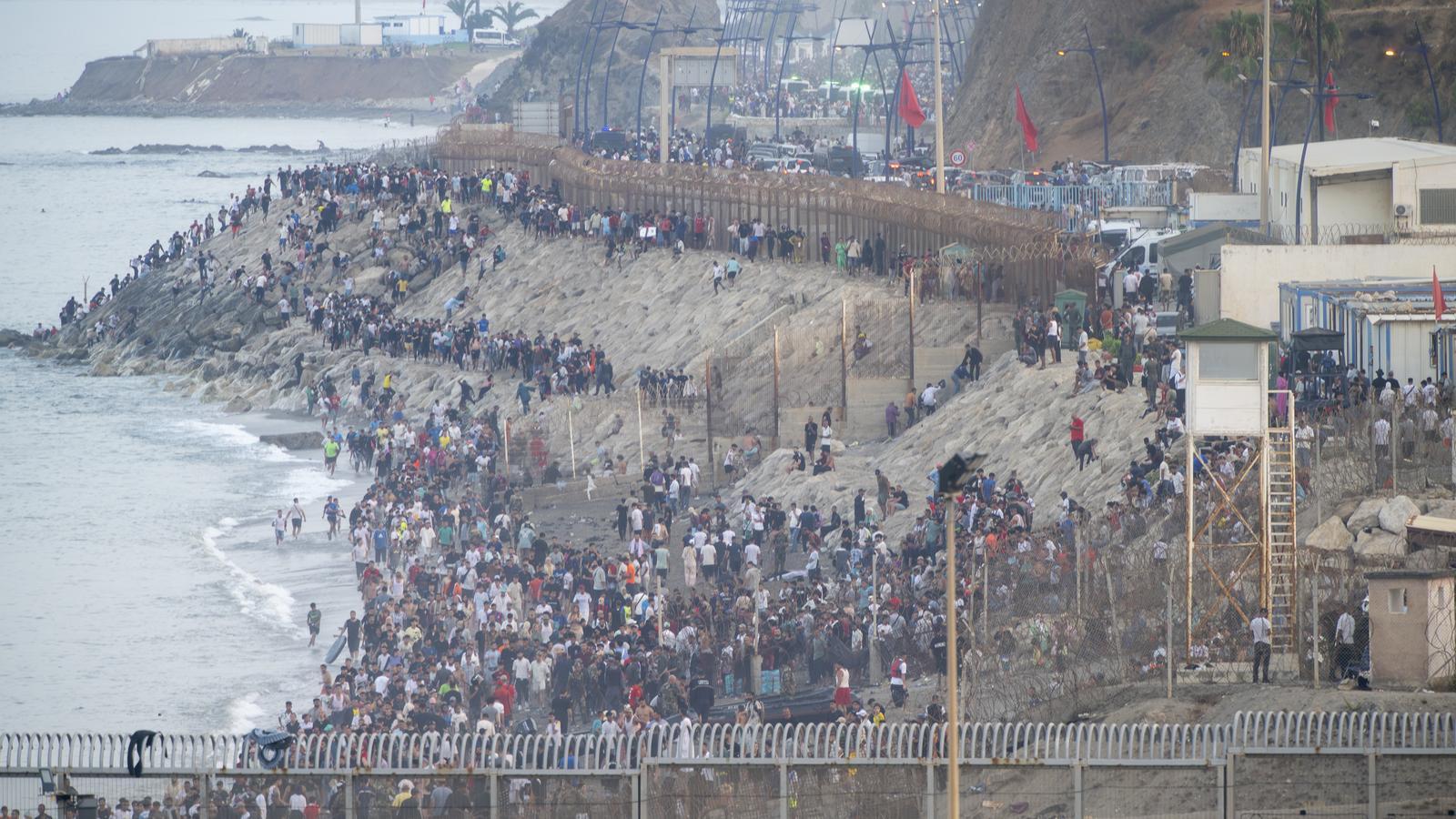
MadridThe National Immigration and Borders Center (Cenif) has concluded that the entry into Ceuta of nearly 80,000 migrants at the end of July had the complicity of Moroccan security forces. This is according to the report submitted to the National Court, to which ARA has had access. It alleges that it was a process that had “prior planning” and “objectives other than migratory ones,” and that it was “facilitated” by an “active guidance of the masses towards crossing points” by the security forces and bodies of Morocco, added to a “scarce presence” of agents. It is a version that clashes head-on with the explanations given so far by the PSOE ministries and Pedro Sánchez, who at all times have distanced Morocco from the crisis and have highlighted the “cooperation” of the Alawite country. All this on the day before Sánchez appears in Congress to give explanations for the events in Ceuta.
“The massive entry does not respond to a spontaneous phenomenon of irregular immigration, but is the consequence or purpose of a planned process that is designed in advance,” states the 55-page report. One of the objectives was to generate “a diffuse intellectual and directive authorship” so that it would be difficult to identify. In fact, the Moncloa clings to this to continue exonerating Morocco. However, the Spanish police have been able to “determine the existence of a structure of at least five levels” as responsible for a “process planned, monitored and executed in phases.” In three of them, it is possible to “point out specific and individualized people.” In the third, regarding the “organizers of the flow of people on the ground,” is where the document directly points to the Moroccan security forces.
It speaks of two types of “active subjects”. On one hand, the uniformed ones who gave “indications” to the people crossing the border to “overcome obstacles”. And, on the other, the non-uniformed “dynamizing agents”: men between 30 and 50 years old with a “strong or athletic build” who wore “neutral and inconspicuous colored t-shirts” and closed sports footwear. Why did they draw attention? They were “attentive” to their surroundings, “gave instructions” to the uniformed personnel, and showed “attitudes of control, leadership, and direction”, in contrast to the people surrounding them: “They walk in the opposite direction to the flow of people, observe the passage of the groups, harangue the crowd to continue the march, or maintain permanent conversations on their mobile phones, as if they were monitoring the event”.

The Ministry of the Interior continues to exonerate Morocco
The Spanish government has been backed into a corner once El Español revealed that the main conclusions of the report pointed to Morocco. At dawn, the Minister of the Interior, Fernando Grande-Marlaska, sent a letter to the Director General of the Spanish police, Francisco Pardo, to ask him for explanations regarding the “veracity” of the document, arguing that it is “essential” so that the Spanish government can “adopt the appropriate decisions”. Hours later, sources from the ministry explained that Francisco Pardo had communicated to him that there is no police report that “attributes” the “planning or execution” of the events to the security forces of Morocco. It is a version that the text of the report completely contradicts.
At the last minute, the same voices refer to the version that the Deputy Operational Director has conveyed, which maintains that the document “does not allow the involvement of any government, service, agency or person to be established, as the intellectual authorship of the massive entry is unknown”. The report acknowledges that it “has not been possible to individualize” who has the highest level of responsibility, but it does emphasize that the police response was one of “total permissiveness”, without making “any serious attempt” to try to “reduce, disperse or move away” the mass of people from the border: “The officers not only remained in a passive attitude before the attempts to enter, but they offered them indications to access through the water by the area of the Tarajal breakwater”.

In parallel, Interior Ministry sources are trying to downplay the importance and validity of the Cenif. They allege that it “does not have the status of an investigative unit” of the judicial police, that it “has no personnel deployed” in Morocco, and that it is “unusual” for it to act under the mandate of a court. To undermine the credibility of the report, they also argue that it is based on data from monitoring messaging applications and social networks of an “open nature” and images and videos “broadcast by media outlets.” Far from this, Fernando López Aguilar, current PSOE MEP and Minister of Justice under José Luis Rodríguez Zapatero, maintains in an interview with Euronews that the massive influx of migrants “could not have happened” without the Moroccan authorities “turning a blind eye.”
“It does not respond to a migratory intention”
To support its thesis, the Cenif report justifies that the dynamics of the migrant entry and the “almost immediate return” of the majority of those who entered –90%– allow for the conclusion in an “unequivocal” manner that the true purpose of the migrants “does not respond to a migratory intention”. “The migratory purpose operates only as a formal cover that serves to encourage, promote, and direct a massive flow of people to the border”, it adds. The first wave of people was led by young men, most equipped with wetsuits, with the objective of “saturating the means of containment to force the opening of the access points”. The second wave consisted of “family units with women and young children”, dressed in sportswear and flip-flops, to “deepen the saturation” of border control and “deactivate” the possibility of using force.

“It is observed that they act with relative calm, which conveys a certain sense of impunity. This perception is probably reinforced by the almost active tolerance attitude of the Moroccan security forces,” reiterates the document. “It is not understood in any other way that this mobilization extends to social groups – such as family units or young children – that would not participate in such a generalized way if it involved any danger,” it adds. The remaining 10% were people who had a “prior or sudden will” to stay in Spain and “took advantage of an organized and massive movement”.
A prior alert sent to border posts
Beyond this report prepared at the request of the National Court, the Cenif also sent a notice on July 29 to the border posts of Ceuta and Melilla. This document, consulted by ARA, explained that there had been evidence of a “potential risk of irregular entries” and pointed out that entries by swimming combined with “coordinated fence jumps” had an “extreme risk” and a “medium-low probability”. “It cannot be ensured that this will occur, but when this type of activity has been detected, it has sometimes materialized,” it added.
However, despite these warnings, the director general of the Spanish police limited the communication to a “frequent risk alert” that “did not include any allusion” to a “possible mass entry”. In other words, the Spanish government maintains that it had no prior warnings to anticipate the crisis. For the moment, only the head of Defense and person in charge of the CNI, Margarita Robles, has admitted that there was indeed information about an increase in people crossing the border by swimming.
