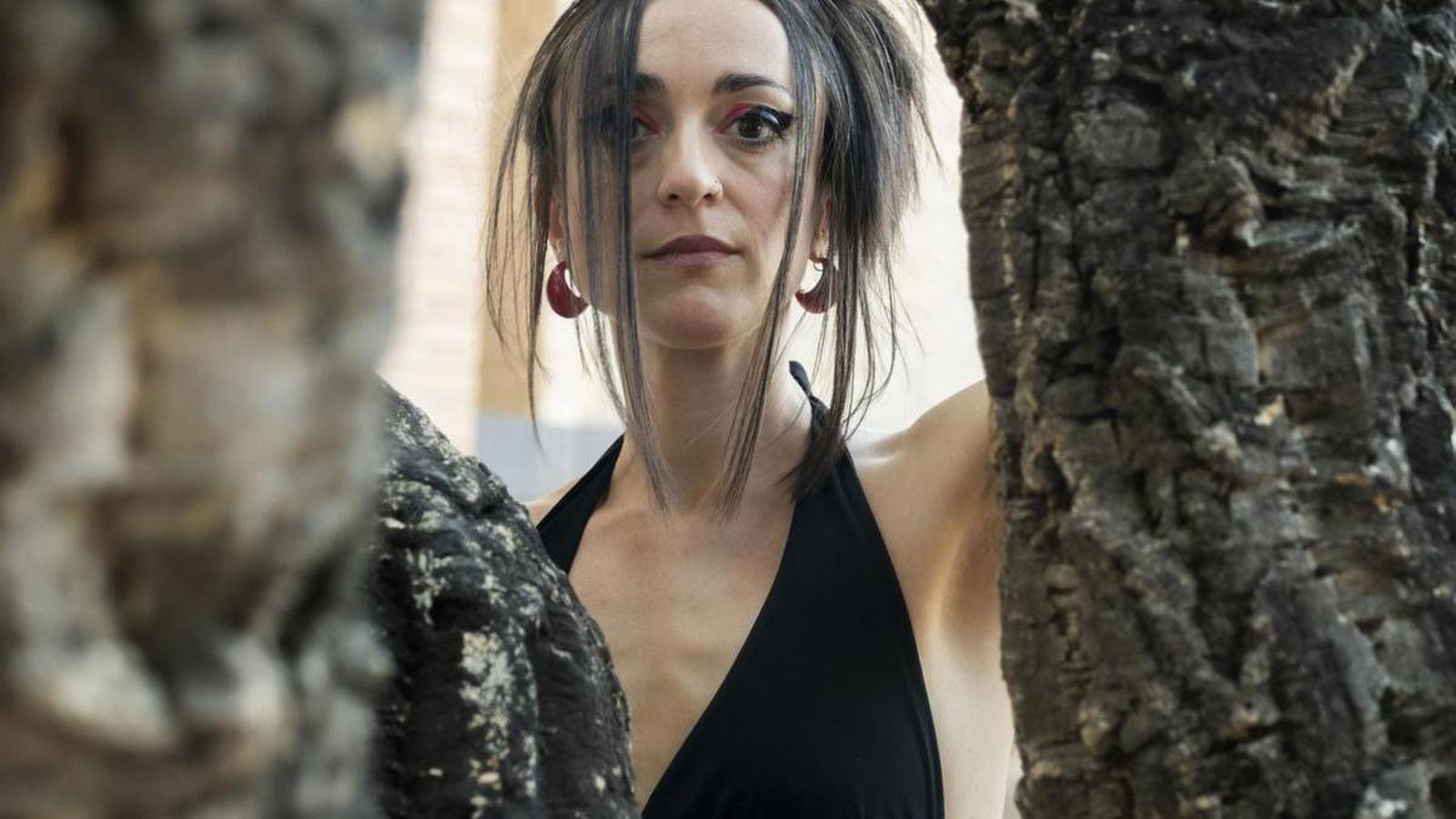
Maria Sevilla: "The parents took the difficult path of speaking to us in a language that was not their own"
Poet and teacher

-
CAT -
CAST
Barcelona"Yes: in my second year of ESO I started / speaking Spanish / because the Catalans didn't get it / and because, as Sylvia Plath said, / every woman adores a fascist", writes Maria Sevilla Paris (Badalona, 1990) in one of the poems in Sylvia Plath, / every woman adores a fascist", writes Maria Sevilla Paris (Badalona, 1990) in one of the poems in Ni una o l'oposada flor (Arrebato Libros). On the left pages we read the original poems in Catalan. On the right, the Spanish version, which often becomes a transformative game, by Juan Andrés García Román and the author. Ni una o l'oposada flor explains, in a ductile and precise language, Sevilla's devotion to animals, plants, and all sorts of living organisms –including men–, while at the same time reflecting on her relationship with Catalan, which, although not the language her parents spoke to each other, has become her usual language, a professional tool – she is an associate professor at the University of Barcelona and runs workshops at the Casal dels Infants in Raval – and a vehicle for artistic expression, which has so far resulted in half a dozen books, including Dents de polpa (AdiA edicions, 2015), Plastilina (Fonoll, 2021), and La nit ovípara (Documents Documenta, 2024).
A few months ago you edited an anthology of little-known texts by Josep Palau i Fabre about Jacint Verdaguer, "Poeta i fangador só" (Fundació Palau/Vibop, 2026). In the prologue you recalled that Palau i Fabre was the alchemist poet, and Verdaguer the mediumistic poet. How would you define yourself?
— The idea of medium appeals to me, and I would say it connects both with what can be read in Ni una o l'oposada flor and with the line of things I want to write. My intention is to connect with the visual, auditory, tactile, and olfactory frequencies of the entire non-human world. While writing Ni una o l'oposada flor I had very much in mind an idea from Marta Tafalla in the book Ecoanimal [Plaza y Valdés, 2019] inspired by Theodor Adorno: the climate crisis is in large part an aesthetic crisis.
Why?
— Both wonder how we will be able to preserve, protect and respect the ecosystems and the world we live in, if we do not know how to appreciate it or listen to it. We don't have to go far to realize that this is the case: surrounding the cities there are all sorts of streams and spaces between urban and rural that we don't even know exist.
A Not a single or opposite flower appear, "black pine forests", the "stench that oleanders make in June", an "untranslatable vein of quartz" and the song of the blackbirds.
— I like to connect mediùmically, even if it has nothing to do with any paranormal operation, with everything that lies beyond our aural world, and to transmit it with words as precise as possible. When you focus on the world, it multiplies. It is fascinating that there is a word to describe the vomit that birds of prey make.
The mentions in a poem, right?
— Yes: egagropila. With what they cannot digest, they make a ball that they end up regurgitating, which is called that. When I come across a word like egagropila I can't help but invent a whole poetic fiction to end up putting it in. This language also allows me to play with tensioning what the reader expects to find in a poem.
At what point did you start observing nature and translate your observations into poems? In La nit ovípara it was already visible, but I would say that before it was not so present.
— I dedicate Not a single opposite flower to my grandfather Joan's siskin and my grandpa Fernando's canary. It's a way of referring to these two soundscapes I had in my life as a child. Since my parents worked late, I spent many hours at the homes of both sets of grandparents. They both came from the pre-industrial world and loved birds, even if they kept them in cages, which I wouldn't do. Grandfather Joan used to take me for walks around Badalona and taught me to distinguish a few bird species. I did this first learning as a child, but then I didn't pay any more attention until the pandemic. Then, confined to a 57 m2 apartment in the Eixample, with a minimal balcony where I had practically never gone out, I started to notice how the date trees and plane trees in front of me were sprouting. Since I was bored, I ended up spending time on the balcony, and thanks to a mobile app, I started to identify the birds I saw in the trees: sparrows, greenfinches, serins... The next step was learning to distinguish bird songs. Later, I also became interested in migrations.
To Not one or the opposite flower dedicate a poem to a cat, the Wolf, who instead of saying "meow" or "baa" says "mrau".
— Loba belonged to a roommate. She was a cat but her name was Loba: she had gender dysphoria, right? When the roommate moved out, my ex and I kept her. It was thanks to Loba, while I was writing La nit ovípara, that I made the decision to stop eating deceased animals. Jacques Derrida has a book, L'animal que donc je suis [2006], in which, after a day when he leaves the shower and the cat sees him naked, he raises a lot of ontological questions. Are animals aware of when we are naked? When I'm with my cat, am I spending time with her, or is she spending time with me? Humans believe we are at the top of the food chain, and in part that's because we exploit everything. We believe we are at the peak of discourse generation, but animals also generate discourse about us. One day I had the cat on my lap looking at me while I was writing and I wondered what she must have been thinking. Looking into her eyes, I told myself that I could no longer eat beings that, like her, could look at me and generate discourse.
The cat poem talks about communication with her.
— Non-domesticated felines do not meow. Cats that live with us do. A cat's meow is a way to verbally approach us. It's as if cats wanted to talk to us because they've seen that humans articulate sounds with their mouths and have realized that it's important to us. The only thing we do with animals is exploit them, and they, in contrast, from this subordinate place where we leave them, want to communicate with us.
In other books of yours you have addressed exploitation relations within the capitalist system. You yourself suffer the working conditions of being an associate professor at the Faculty of Education of the University of Barcelona.
— The fee for self-employed that I pay is almost the same as what I earn as an associate professor at the university. In my case, I was lucky enough to win a four-year predoctoral scholarship, during which I started publishing and giving many free recitals. Later, while I was professionalizing in the field of poetry, I got my master's degree to be a secondary school teacher. This gives me the security that at any time I can change my plans and leave the faculty, but at the same time I resist it, because I don't want only a certain social class, which is always the same, to have access to positions of power or intellectual influence.
You also run reading promotion and poetic creation workshops at the Casal dels Infants del Raval.
— I work with adolescents from the first to the fourth year of ESO, and the majority do not have Catalan as their first language or as their usual language. Right now, in the metropolitan area of Barcelona, the young population uses Spanish primarily.
You grew up in Badalona in the 90s, and even though your parents spoke Spanish to each other, you and your sister were spoken to in Catalan. Why?
— My mother was born in Almeria and my father was born here, although with his parents he spoke in Spanish. The mother tongue of both is not the same as they have used with their daughters. They have never been particularly militants about linguistic or national issues, but they met at the parish of Sant Josep, in a scout group, one of those strongholds of Catalan resistance during Francoism, even though they were controlled by the Church. In that environment, they associated Catalan with a kind of cultural prestige. At that time, Catalan did not give them symbolic or economic capital, because it was still forbidden, but when I was born and, seven years later, my sister, they spoke to us in this language. The parents took the difficult path of speaking to us in a language that was not theirs. In this decision there was a part of renunciation, but it was also an act of freedom.
In one of the poems in the book you explain that in the second year of ESO you started speaking Spanish. "The catalufes didn't tie up", you write.
— With my two best friends at the time, Clàudia and Laura, we made a very strange forced language change. We went to a public high school in Badalona where the majority of students were Spanish speakers and we didn't want to be seen only as nerds. We were giving in to the inertia of what they wanted or expected from us. At 14 years old, we realized the power language has in constructing identities. I wanted to be different and cooler. I wanted to hang out with those who smoked weed and caused trouble. Catalan didn't give me that, apparently.
What social prestige does Catalan have among your students at the Casal d'Infants del Raval?
— Many students tell me that Catalan makes them cringe. That it continues to be useless to try to go out partying, hook up, and do other attractive activities in Catalan. The rejection of Catalan sometimes has to do with the status it has achieved in the institutional world. It has been essentialized as something preachy, old-fashioned, and boring. It is dangerous for this to happen, because it is a process of Latinization of the language: you turn it into something that is more or less useful in formal contexts, but not in other situations.
You compare the language change with the concept of "floral syndrome".
— It is the phenomenon by which flowers adopt and adapt to the tastes of their pollinating agents, be they bees or birds. Flowers give off a certain smell to attract them, they produce bright red fruits to attract attention, or they produce a seed that is volatile enough for the wind to carry it away. The same happens with languages. We use them to construct one identity or another. In second year of ESO I chose Spanish. A year later I returned to Catalan. And now, after so much time, I am publishing a book that, more than bilingual, is bifid in many moments, because from time to time the meaning of the text is found in the ghostly space of the transfer from one language to another.
Can you give me an example?
— Yes. "And I put a petal / in the place of the tongue". In Catalan, puesto is a lexical Castilianism that would be equivalent to lloc. In Spanish, puesto is not used in the same sense: it would be a parada of the market, for example. It is a word that, in my book, I use incorrectly in both Catalan and Spanish. I find it funny.
