The player who arrived in the world of "penalty" and whom rivals can never underestimate
Sunday we will know if we are facing the last death throes of an era or facing a new metamorphosis of Pedro Sánchez
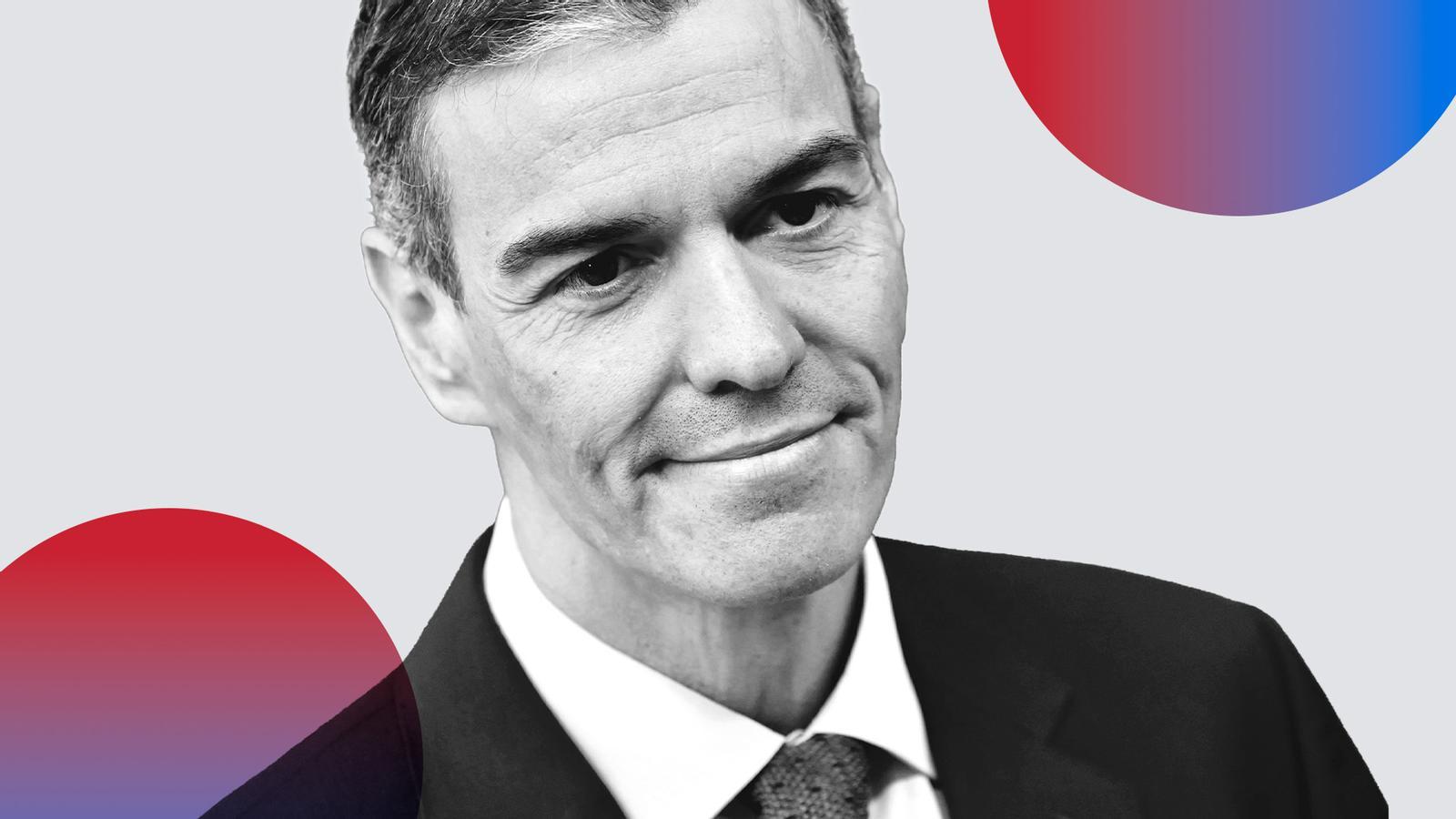

-
CAT -
CAST
MadridIt is difficult to create a profile of Pedro Sánchez when 99.7% of citizens, according to the CIS, know him. After governing Spain for eight years, everyone knows who he is and already has a formed opinion of him. But it is not only for this reason that it is complicated to profile the Spanish president, it is also because, beyond reviewing his biography, explained forwards and backwards, there is a Pedro Sánchez for every era. Not for nothing do most of the consulted PSOE sources who have followed his trajectory speak of him as the most pragmatic being on Earth. There is a Pedro Sánchez in 2018, when he comes to power through the first successful vote of no confidence in the democracy; there is a Pedro Sánchez in 2019, when he tries to make a pact with Albert Rivera and ends up embracing Pablo Iglesias; and another from 2023 onwards, when he allies himself with Carles Puigdemont for his investiture. A human chameleon that adapts to the colors of the environment to survive the passage of time.
This pragmatism should not be confused with an aversion to risk. On the contrary. Sánchez is a born gambler, and the more difficult the game, the greater his bet and the greater his final success usually is. A combination of luck and virtue that may end this November 29 if the polls are confirmed and the PP and Vox sweep him out of the Moncloa.
But let's start from the beginning. Pedro Sánchez was born on February 29, 1972, in Madrid; on that day, the newspapers of the time reported on the visit of the British Foreign Secretary, Sir Alec Douglas-Home, to Gibraltar in a context of maximum diplomatic tension with the Franco regime over the closure of the 'Verja' (the fence). "Gibraltar will not be resolved in two days," the English minister eloquently said, and he could not have been more right. The final agreement with the United Kingdom regarding the Rock – with Brexit in between – was reached in 2026 at the hands of Sánchez himself, an example of risky decisions that, while assuming they will bring criticism, he knows will go down in history. Place here pardons, amnesty, or the pacification of Catalonia. Because he wants to go down in history.

Sánchez grew up in the Tetuán district of Madrid and went to the public high school Ramiro de Maeztu. It is a traditionally working-class area that now combines great diversity and is booming due to its proximity to the financial axis of the Paseo de la Castellana. To escape the image of a killer, which he has earned over time, in this campaign the PSOE has wanted to show his more human side. He explained how he and his wife, Begoña Gómez, met—who has been in the eye of the hurricane throughout his term—and the suffering of his family due to the hatred he awakens, especially in Madrid. “My daughters have had to leave a venue because people were shouting ‘Pedro Sánchez son of a bitch’,” he confessed.
His grandparents did not know how to read or write—one of them went into exile in Germany during the dictatorship, also looking for opportunities—and his parents had him very, very young, “by accident,” he said in the interview with Jordi Wild. A part of his personal biography that he wanted to show to exemplify social mobility. He brought up English, which Alberto Núñez Feijóo does not know how to speak. “I keep studying. I didn’t learn it in the cradle. My English was from school, in that EGB system where languages were not taken care of as they are now. That is why I strive to improve it,” he told Lecturas, to make it clear that if he moves with ease in this language, it is not because of social class but because of “effort”.
In any case, Sánchez does have international background before becoming president from having practiced it. In 1995 he graduated in economics at a center attached to the Complutense University of Madrid and later studied a master's degree in economics in Brussels, was an advisor to the European Parliament, and a member of the cabinet of the United Nations High Representative in Bosnia and Herzegovina, Carlos Westendorp. His political commitment to the PSOE materialized already during his university years, when he began to be a militant, already within the always difficult Madrid socialist federation.
“His field is the international arena, he moves like a fish in water,” assures a socialist leader who has also spent time in the European Parliament, and who is not surprised that in this term one of Sánchez's main achievements has been to be recognized as a leader of the left on the world stage. The fact is that if there is a new element in Sánchez's profile compared to that of the 2023 elections, besides making his passion for mountain biking visible – in his youth he played basketball –, it is that he is now a benchmark for left-wing parties in other European countries. He has achieved this by being the only European leader to have stood up to Donald Trump or by spearheading the denunciation of the genocide in Gaza. In fact, if you speak to any left-wing leader from outside the State, they consider Spain the last socialist Gaul and envy having such leadership. Internally, the perception is different: for the right he is a “traitor” and for the lefts that are not the PSOE a “lesser evil”.
The resistance
Sánchez's biography is filled with epic elements. If there is one mistake his adversaries cannot make, it is to underestimate him. Before running for general secretary in 2014, Sánchez grew up in the Madrid PSOE in the shadow of Pepe Blanco and hand in hand with minister Óscar López and Antonio Hernando. He was not the favorite, but he was the most ambitious, as would be demonstrated later. “He has always carried a certain complex that he was not valued for all that he was capable of doing,” opines a leader of the old guard, who recognizes his great resilience.
The party killed Sánchez in 2016 and he resigned as a deputy to maintain the “no means no” stance on Mariano Rajoy's investiture. He started over from scratch to win over the socialist militancy in 2017. “When they kicked him out, he had very good professional offers, but the guy said no. It could have changed his life, they were big companies... for me, that is the definition of the character, who is willing to do whatever it takes to achieve his objectives,” relates a source. However, there he chose bad travel companions –José Luis Ábalos, Santos Cerdán and Koldo García– that have blown up like a boomerang in this term. “Ábalos has hurt me a lot,” he himself has confessed.
In fact, the last three years have been some of the toughest he has spent in politics. Already at the end of an agonizing term, on October 5 he decided to risk it all again with all the polls against him to repeat the 2023 long shot. With one difference: three years ago he was dragging his feet in the electoral campaign and now Pedro Sánchez, as stated by a member of his closest team, “is stronger than ever.” On Sunday we will know if we are facing the last gasps of Sanchismo or a new metamorphosis of the leader.
