The danger of Sánchez and Illa's strategy against the far right
The direct confrontation against Vox and Aliança can be counterproductive and benefit them electorally

-
CAT -
CAST
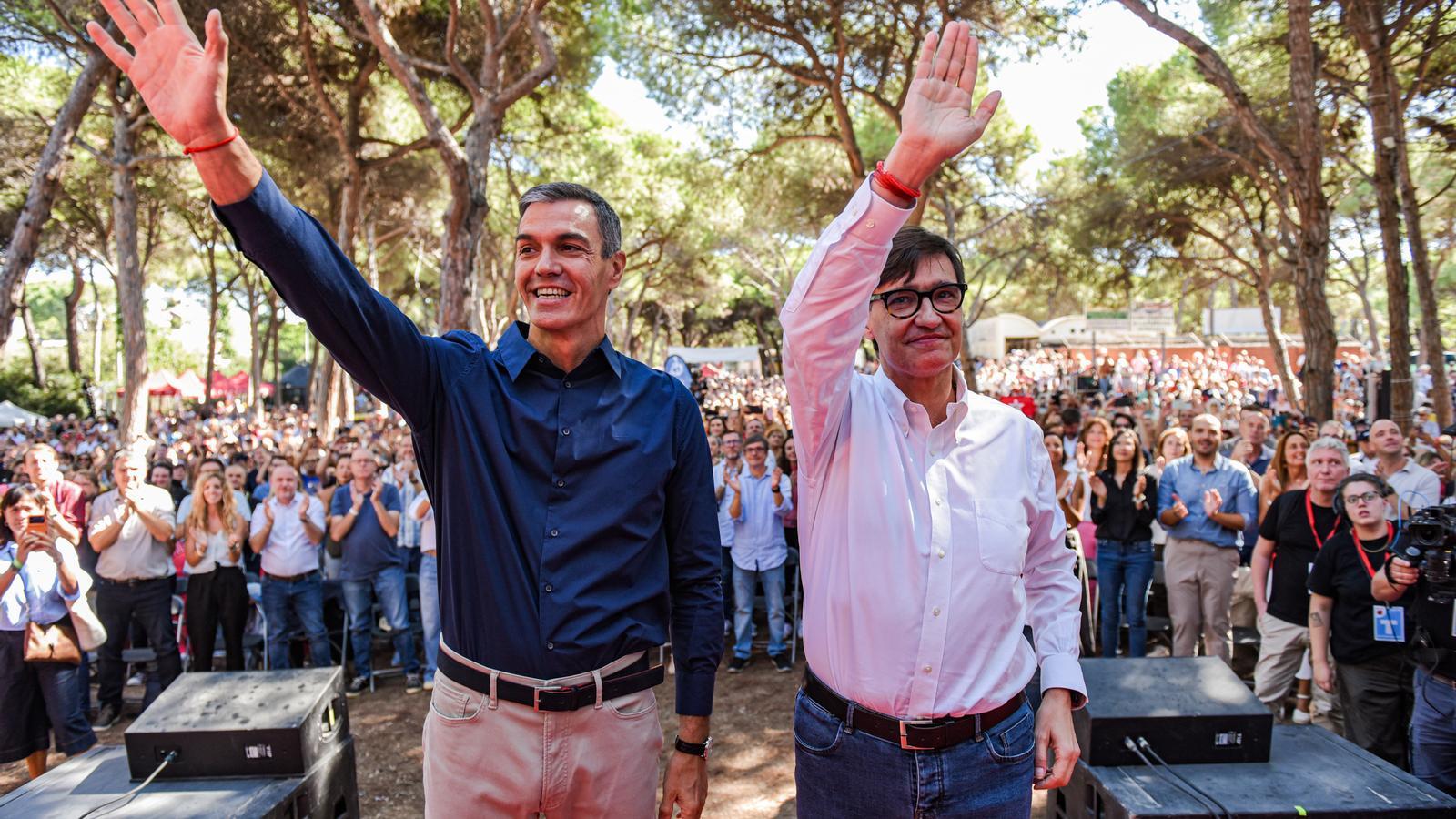
BarcelonaThere is no infallible manual for fighting the far right and, despite the different recipes applied, it continues to grow almost everywhere. As in medicine, and just as the package inserts themselves warn, each case is different and the remedies have a point of unpredictability depending on the context. However, the political scientists consulted by ARA agree that the strategy of Pedro Sánchez and Salvador Illa of constantly confronting the far right and self-appointing themselves as the only alternative to Vox and Aliança Catalana can have serious side effects, both for their own political health and for democracy in general.
The PSOE and the PSC repeat like a mantra that in the upcoming Spanish elections there are only two possible options to choose from: Pedro Sánchez or the far right. They ignore the nuances and put the PP and Vox in the same bag, in addition to constantly warning of the risks that a landing of the far right in Moncloa could cause. One of the socialist leaders who is exploiting this approach the most is the president of the Generalitat at the national level and especially against Aliança Catalana. He maintains a tough tone against Sílvia Orriols and often clashes – and publicizes it on social media – with the mayor of Ripoll's party, which now only has two deputies in Parliament, but which polls predict a great rise for. A strategy, that of directly confronting the far right, which other progressive leaders also carry out, such as the candidate of Esquerra, Gabriel Rufián, and that of Front Ampli, Ada Colau, in the upcoming Spanish elections.
The professor of Political Science at the UB Xavier Torrens explains that the message of fear is not new in politics and that it is common for leaders to seek to gain voters by warning of what could happen if another party comes to or remains in power. In fact, the expert recalls that the PSOE had already opted for this strategy before the birth of Vox, then directed against the PP, but warns that the “problem” is when it is applied against the far right, because these formations live off “confrontation” and “polarization”, mainly on social media. "A snowball effect is created that feeds them and ends up benefiting them," points out the author of the book Salvar Catalunya (Pòrtic).
Torrens asserts that "at first it may seem that it is a strategy that works when it comes to mobilizing voters," but that in the long term it is "counterproductive." "People might be activated the first time [they are alerted to the arrival of the far-right], but no longer the second, third, or fourth," adds the political scientist. In this sense, the researcher from the think tank European CEPS Sophia Russack notes that "it is not enough" to criticize and "show opposition" to the far-right, but that "it is necessary to propose and defend one's own measures." Thus, the expert considers that the best strategy for progressive forces, even if they "are very weak and losing power," is to regain the initiative and "not act reactively" to the far-right.
On the other hand, Torrens describes the idea that the growth of the far-right only affects the PP and Junts as "erroneous," and that it may benefit left-wing parties because it weakens the political rivals of the traditional right. The expert points out that, especially in cases of such meteoric growth as that of Orriols' party, these formations draw from voters of all forces, including the PSC. Torrens cites the example that when Orriols won in Ripoll, it was partly thanks to the fact that it ate into the traditionally socialist electorate, even in areas of the city that are predominantly Spanish-speaking.
From Mitterrand to Lula
One of the clearest cases in this regard, pointed out by the director of the European research center Future Policy Lab, Javier Carbonell, is that of the former president of France, François Mitterrand. The socialist leader went so far as to change the electoral law to favor Jean-Marie Le Pen and divide the right. Mitterrand facilitated the extreme right's ability to obtain representation in the National Assembly and, despite this, lost the legislative elections to the traditional right. Shortly after, when Jacques Chirac arrived at the Élysée, he returned to the previous electoral regulations. This is a historical case that sources within the PSC itself cite as a counterexample of what should be done to fight against the extreme right.
In contrast, the example to follow that political scientists suggest is that of the strategy of Lula da Silva, who has just won the elections in Brazil against the extreme right. The leader of the Workers' Party ordered his ranks to avoid direct confrontation with the extreme right on social media, even if they considered the comments to be inappropriate or fake news. The goal was to avoid giving them any more exposure, and instead, to boost channels that are not subject to the algorithms of X, Facebook, or TikTok. A strategy that Sánchez's team has already taken note of and has even contacted social-democratic deputy André Janones to advise them for the upcoming Spanish elections, as reported by the Brazilian media Metrópolis.
Thus, Carbonell qualifies as "key" in the Brazilian elections that Janones launched a WhatsApp channel in favor of Lula, which has been highly successful and has surpassed ten million followers. The expert highlights that with this digital strategy, the leader of the Workers' Party managed to "increase control" over the campaign's media agenda and avoided ceding this power to the extreme right. "He won in large part by having avoided the confrontation and polarization that benefits the extreme right," concludes Torrens.
