Aid to deal with the impacts of El Niño hangs by a thread at COP31
The Turkey summit is prolonged due to the lack of agreement on financing and on the end of fossil fuels

-
CAT -
CAST
El Niño could add 49 million more people to global hunger. The World Food Programme (WFP) expects to see the number of food-insecure people rise from 225 million to 274 million because of this phenomenon, exacerbated by the climate crisis. Its impacts—crop failures, droughts, floods, and extreme temperatures—will be especially poignant in 45 countries, mainly in Central America and Africa. And that is why these countries are among those that have spoken out the loudest during the UN climate summit in Antalya (Turkey), which was already in overtime this Saturday and could extend beyond the usual duration due to a lack of agreement.
Positions remain very deadlocked, especially on the point referring to fossil fuels. Many countries—including those of the European Union and the Pacific states—are calling for the inclusion of a global "roadmap" in the summit's final agreement to phase out oil, gas, and coal. But oil-producing countries, led by Saudi Arabia, and others like India, are opposed.
In more than 30 years of annual climate summits, it has only been possible once to include the mention of "fossil fuels" in an official text, and, paradoxically, it was in Dubai (United Arab Emirates), in the final agreement of COP28 in 2023. There, governments committed to a transition to move away from fossil fuels. However, since then, it has not been possible to advance or concretize this commitment, to the point that the mention of the subject has disappeared from the final agreements of subsequent summits. Brazil did not achieve it either at last year's summit, COP30, but since then, it has been pushing negotiations to try to agree on a global "roadmap" toward the progressive end of fossil fuels.
Now, the inclusion or not of this roadmap within the binding commitments of COP31 keeps the negotiation deadlocked. More than 60 countries are in favor, from Panama to the entire EU, many of which, such as France or Germany, have already presented their own roadmaps. Spain has also taken advantage of the Turkey summit to announce its plan: to increase electricity from renewables to 100% by 2040 and to completely phase out oil, gas, and coal from the total energy system, including industry, by 2050. A plan, however, that will depend on the government that emerges from the November 29 elections.
The eternal conflict of financing
But this is not the only sticking point. There is another one that is stalled and is especially relevant to be able to deal with the impacts of El Niño: the funding that rich states must provide for the adaptation of the poorest and most vulnerable countries to increasingly severe and frequent climate impacts. Last year, in Brazil, it was agreed to triple this aid, but it remains to be specified how it will be done. Leaving it in the hands of each government does not work, as demonstrated by a Carbon Brief report, which warned that the financial commitments that have reached the Turkey summit are 70% lower than those of previous summits.
In the latest draft agreement of COP31, the 120 billion that appeared in the first draft had disappeared and there were no details on how the goal of tripling the aid would be achieved. “An attempt is being made to take a step forward on this point,” explained IDDRI analyst Anna Pérez to ARA, who admitted that this summit comes “at a very complicated moment in international relations in which countries have no desire to cooperate.” According to Pérez, the announcement made by the leaders of the United States, China, and Russia from Beijing of an agreement to boost oil refining, while COP31 was underway, has also affected the mood of the negotiators.
“We are very concerned about the lack of progress on this point [that of funding], because we have seen during these two weeks a major blockage in funding,” also warned Chiara Martinelli, director of Climate Action Network (CAN) in Europe, who also denounced the lack of transparency in the negotiations that were underway in these last hours.
“Everything that happens in these negotiations has a direct impact on whether we will be able to respond to significant phenomena like El Niño. It is possible that there will be a food crisis in Central America; 70,000 households have already lost their corn crops,” warned Mateo Adarve Zuluaga, from Oxfam, from Turkey. “While the world faces a ”super-El Niño” that intensifies climate disasters and inequality, this is not the time for empty words or false solutions,” said Michelle Higelin, executive director of ActionAid Australia, who demanded that her country, as co-president of the summit together with Turkey and as “one of the world's leading exporters of fossil fuels,” push the negotiations to “leave fossil fuels behind.”
The victory of the oil states that have managed to include the promotion of carbon capture in the final agreement is also not at all pleasing, a technology that is not yet fully developed but that the fossil fuel industry wants to use in extraction facilities to avoid having to reduce production. “The only objective of this point in the agreement is to be able to continue producing oil,” denounced Romain Ioualalen, from the NGO Oil Change International.
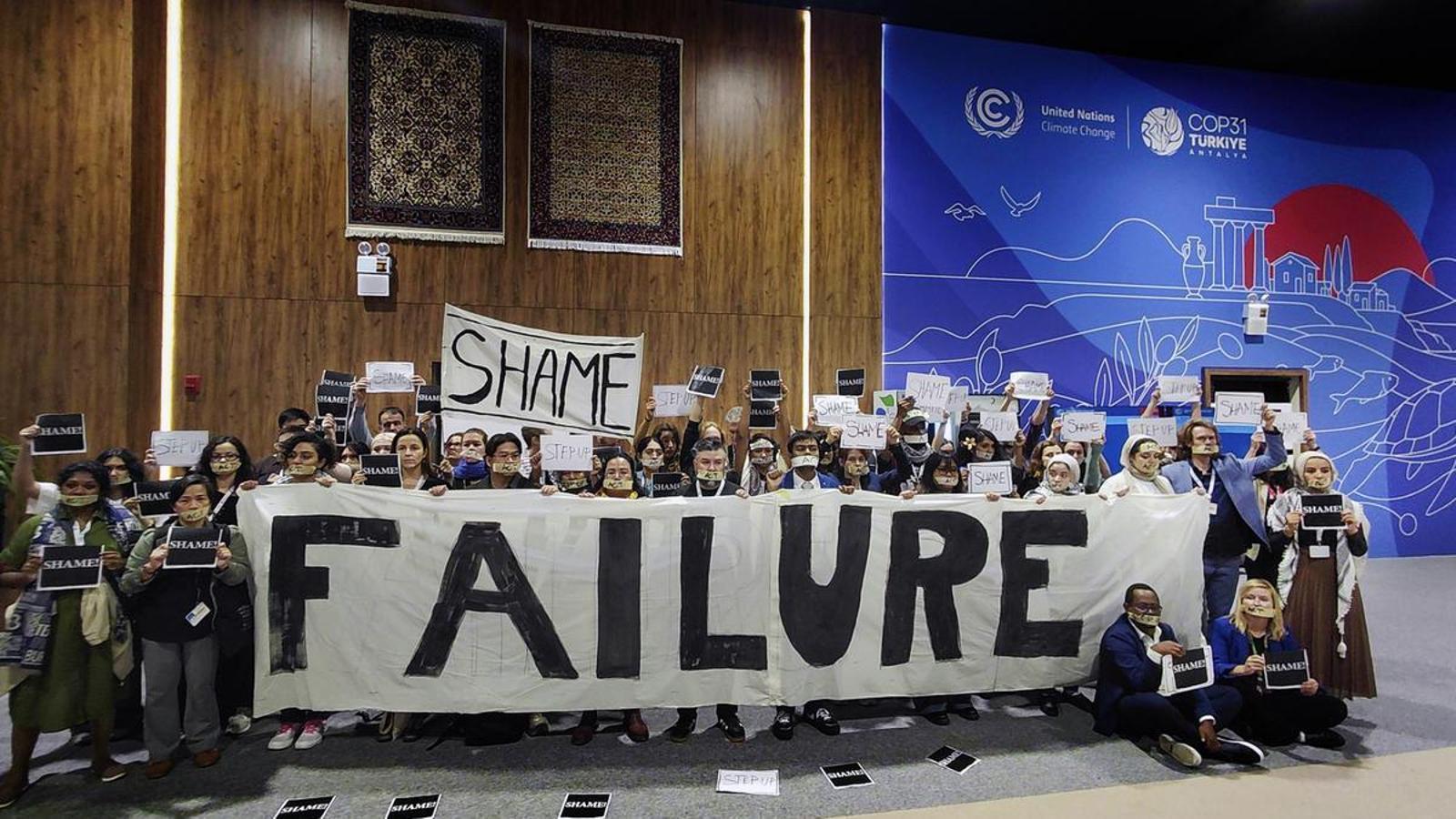
What does seem certain to appear in the final agreement is the commitment to raise the global electrification rate to 35% by 2035, although it remains to be seen whether it is specified that this electricity must be from renewable energies, as many governments and observers demand. Turkey's star proposal was a very feasible pragmatic measure intended not to leave the summit empty-handed, but if it ends up being the only success, it will not be able to prevent this summit from being labeled a failure.
