Sánchez versus Feijóo: The vertical video battle
The Spanish Prime Minister stands out on TikTok with a humanization strategy while the PP leader gets bogged down in party propaganda
-
CAT -
CAST
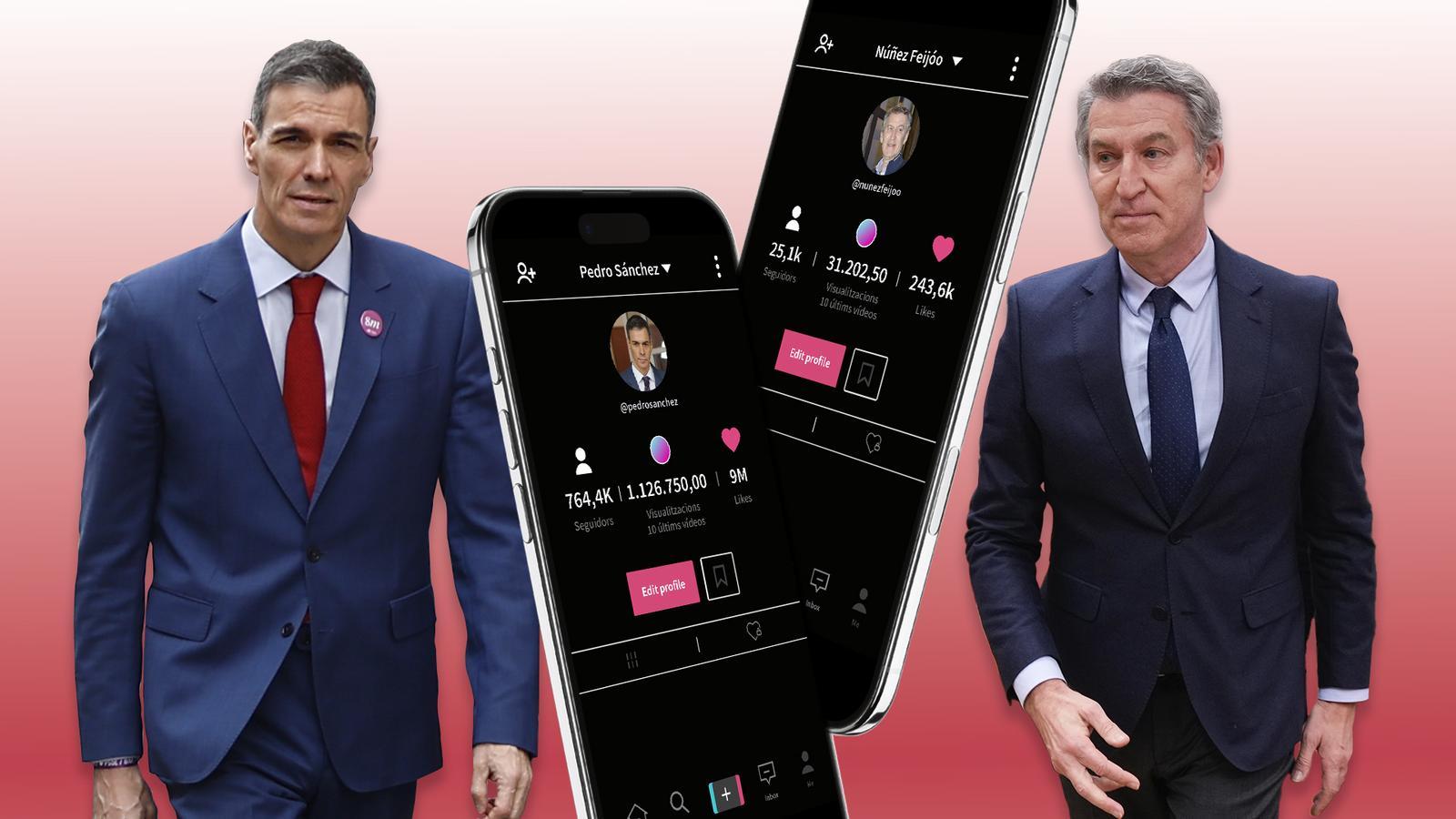
BarcelonaIn the war for the digital narrative, the tug-of-war between the Spanish government and the PP has moved to the vertical format. The two main Spanish politicians opened accounts on TikTok almost simultaneously, although the impact they have is quite different. Alberto Núñez Feijóo was the first to land there in September 2025, just two days before the Spanish prime minister, Pedro Sánchez, did. It is the socialist leader, however, who has gotten the most out of it: Sánchez already has 764,400 followers and over nine million likes. The most striking data from the comparison is that the total number of followers of the popular leader is approximately equivalent to the volume of new users that the Spanish prime minister gains in just one week. A gap that becomes even more evident in the impact of the content: Sánchez's last ten videos have an average of 1.1 million views, thirty-six times more than Feijóo's 31,200.
Sánchez's success is no accident. In conversation with ARA, Xavier Tomàs, a political communication consultant, highlights that the president "reserves between 2 and 5 moments a week to record" specific content for social media. A consistency that, moreover, allows his content to transcend the platform and generate a "rebound effect" in traditional media, says the expert, as happened with the video of the cap with the slogan Make Science Great Again. On the other hand, Feijóo maintains a much more limited pace and has not managed to decipher TikTok's language, warns Tomàs, who indicates that "it's no use making a video a day if the language is unmotivating, too slow, and captures little attention." On the contrary, the expert points out, Sánchez combines "quantity and quality" in his approach, a fact that could allow him to overtake Santiago Abascal (currently with 988,900 followers) as the most followed politician on the platform before the end of the summer.
Lluís Pastor, professor of communication at the UOC, in conversation with ARA delves into the visual identity of this comparison. While Feijóo's profile picture is informal, its content is "a propaganda tool of the PP" where slogans and catchphrases launched from Génova dominate. Pastor points out an inconsistency: "The personal Feijóo is absolutely blurred because they have understood TikTok as another party propaganda tool". Instead, he explains, Sánchez uses an institutional photo with a jacket and tie to say "I am your president on any platform", but, once inside, he shows "more human dimensions", showing the books he reads or the places he travels.
The abyss between "likes" and polls
This digital hegemony, however, clashes with an electoral reality: outside the CIS, polls are going in the opposite direction. Xavier Tomàs points out that, despite the growth in followers, the real use of social media to attract new voters is still scarce. "Having a million followers can be leveraged in more ways than just making videos," he states, and suggests that, for example, all rallies and speeches could be broadcast live to connect with this audience.
A step forward in this direction is the commitment to direct participation, highlights Tomàs. This week, for the first time in Spanish politics, Sánchez has opened and answered a Q&A session exclusively on social media, a common format in Europe but unprecedented in Spain. Nevertheless, Tomàs questions the lack of a "data capture" strategy to mobilize voters as elections approach. Currently, leaders limit themselves to asking for a "like" when they could be converting that million followers into an active database for the campaign, remarks the expert.
The Catalan mirror: the case of Salvador Illa
In the Catalan sphere, the dynamic is repeated with nuances. While the former president of the Generalitat, Carles Puigdemont, now the head of the main opposition party, maintains a historical lead in followers due to his trajectory, the current president of the Generalitat, Salvador Illa, faces widespread unfamiliarity among younger generations. Tomàs argues that "it would be strange for young people to know him" if specific campaigns from the presidency are not promoted targeting this group. Illa has tried to reverse this situation; this very Wednesday, he invited to the Palau de la Generalitat the boy who, in a viral survey at the Saló de l'Ensenyament, mistook him for "Salvador Dalí". Although these gestures can generate virality and "add up," states Tomàs, the structural reality is that in Catalonia there are a million young people whom institutional political communication still does not know how to reach effectively.
