The pact of Vox and PP to end the left on 11-29
Unlike the 2023 elections, Feijóo and Abascal avoid attacking each other, aware that they are condemned to understand each other
-
CAT -
CAST
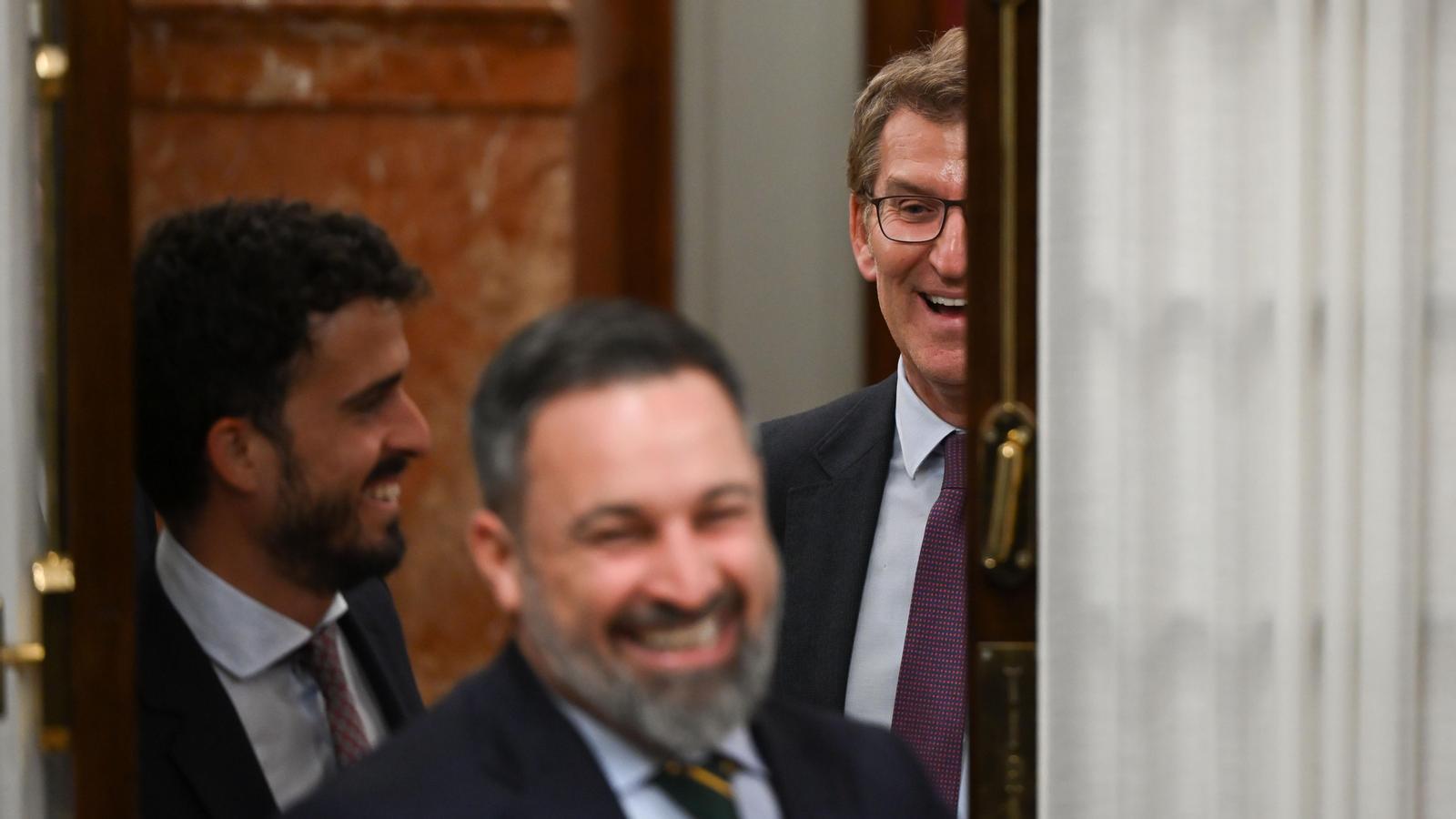
MadridThe same faces, but a different interaction. Alberto Núñez Feijóo and Santiago Abascal are repeating as candidates for the right-wing bloc in the November 29 elections, but, unlike the previous elections three and a half years ago, the strategy of the PP and Vox on how to relate to each other has transformed. They have gone from the mistrust and crossed attacks of 2023 to a kind of non-aggression pact between the two parties, which have assumed that, for now, they are doomed to understand each other if they do not want to find themselves relegated to the opposition again. It is an assumption they no longer hide and which the right-wing media celebrates, urging Feijóo and Abascal not to repeat the mistakes—they are reproached for having been overconfident and harming themselves by fighting each other—that allowed Pedro Sánchez to continue governing to this day.
"Vox is not our enemy. It is not our adversary. Sánchez's policies and his partners are. When one gets priorities confused, in the end, one gets lost. I will not get confused. Political change in my country is above the PP and the PP candidate," stated Feijóo last week in an interview on Federico Jiménez Losantos' program on esRadio. He repeated it this Tuesday on Carlos Herrera's program on COPE. In Génova, they openly admit that the scenario is to make a pact with Vox after the elections and are even exploring an alliance to run for the Senate with the far-right. At the same time, they shy away from the premature triumphalism exhibited in the previous state electoral event and now opt for caution as well as a radical distancing from the PSOE accompanied by a clear approach to the far-right.

Also from Vox, they have changed the belligerent tone towards Feijóo from 2023 for a speech that claims they have high-mindedness in the face of the priority objective of joining forces to unseat the Spanish president. The PP is no longer "the cowardly right", at least in public, and the attacks are directed almost exclusively at the PSOE. "Sánchez is capable of anything to destroy Spain, but we are also capable of anything to save it. I send a message of tranquility, responsibility and commitment", said Abascal in response to the pact between the PSOE and the Broad Front to form a joint list in the upper house. The president of Vox has not only defended allying without complexes with the populars in the Senate –they are even negotiating some alliance in Congress, renouncing to run in some constituencies– but also avoiding the "spectacle" of fratricidal war of the left. The discrepancies in the negotiation with the PP, he maintains, must be kept in the private sphere.
It is key to understand these positions to remember the alliances between the PP and Vox that have been closed in recent months in four autonomous regions. After the regional electoral cycle, which began in Extremadura on December 21st and ended in Andalusia on May 17th, the marriage between the two formations has become an incontestable reality. Abascal's party now governs in coalition in four autonomous regions. Faced with this bet by the extreme right to return to the PP's regional executives after having abandoned them en masse in the summer of 2024, Vox's strategy of confrontation and attack on the PP has been modulated, since it now shares government responsibilities with them. If they manage to add up on November 29th, it would be foreseeable that they would repeat the same formula at Moncloa. This Friday on Cadena SER, Feijóo did not hide it, an attitude that contrasts with the one he had when he arrived at the presidency of the PP, in 2022.
Progressive assimilation
In 2023, Feijóo was still trying to maintain a certain distance from Vox and avoided openly aligning himself with them, even calling on the PSOE to let the most-voted list govern. An approach that was harshly criticized by Abascal, who warned him that this was not the way to combat Sanchismo. The Popular Party leader harshly criticized Sánchez for governing even though the PP won more seats, but now Feijóo is opening the door to doing so himself in the event that the reverse happens on November 29th.
In parallel, the Populars have been progressively hardening their discourse on immigration, security, or housing and have moved to direct and indiscriminate clashes with the Spanish government using the battering rams of corruption or the crisis in Ceuta. This programmatic hardening of the PP is also accompanied by a tougher tone in the interventions of Feijóo and other leaders, as well as with the strategy on social media, where they do not hesitate to use AI in a crude way to attack the PSOE.
The names that have taken the baton of this campaign and the profiles of the heads of the lists are also significant of this change. If in 2023 Feijóo tasked profiles from the moderate wing of the party—such as Cuca Gamarra and Elías Bendodo—with handling it, now the PP leader has given the campaign leadership to Miguel Tellado, a tough profile, and has entrusted the program to Alma Ezcurra, one of the first popular voices to deploy the theory of a possible electoral fraud with the amnesty law.
The choice of Xavier García Albiol as number 1 for Barcelona and Cayetana Álvarez de Toledo as number 2 for Madrid are also clear messages of a commitment to forcefulness. It remains to be seen, however, if between now and 29-N this non-aggression with Vox is maintained in the face of polls that predict a growth of a far-right that has already managed to unseat other traditional right-wing parties in the European Union.
