Obama supports El-Sayed in Michigan: "You can breathe an air of change"
The former US president goes into campaign mode to give the final push to the key candidates for Congress
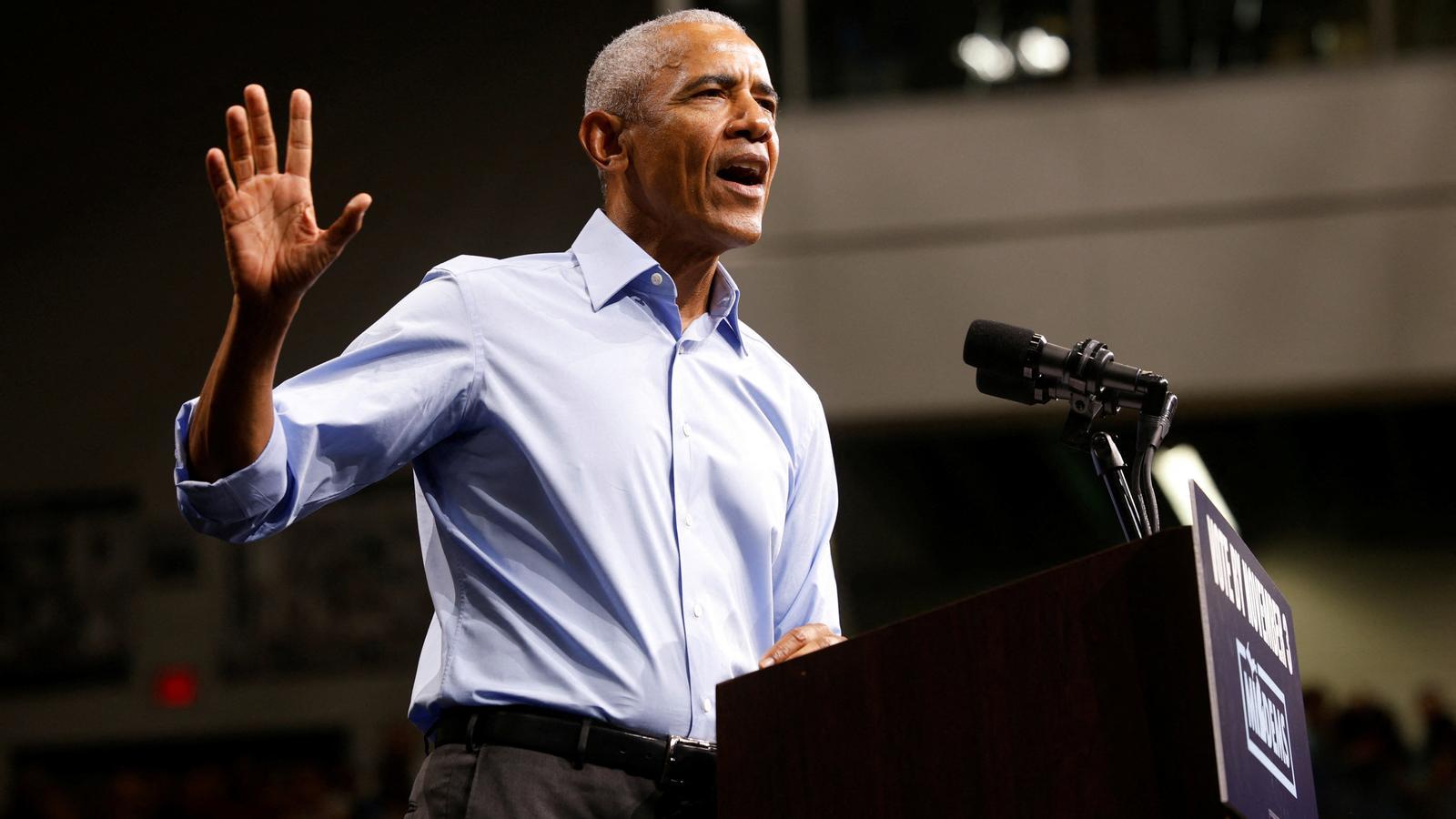

WashingtonThe Democrats are at that sweet spot where everything can still happen and there is almost no room for disappointment. With polls inflating hopes of even gaining control of the Senate, former President Barack Obama has gone into campaign mode to provide the final push for one of the faces of the moment: the Democratic candidate for the Senate for Michigan, Abdul El-Sayed. The appearance of one of the party's heavyweights with the progressive candidate in Detroit confirms the moment of change the party is experiencing, both externally and internally. As Obama has proclaimed, «change is in the air».
As a counterpoint to this idea that something different is happening in these elections, El-Sayed has had the public repeat a statement that resonates with the reality of many American households: «It shouldn't be so hard». The 41-year-old candidate, who aspires to become the first Muslim senator in the country's history, has reminded attendees that it shouldn't be so hard to fill the fridge, put gas in the car, pay the rent, or go to the doctor. «This campaign has never been about what we are fighting against, but about what we are fighting for», the Democrat stressed.
With the lesson learned from the 2024 defeat—when calls to vote against Trump were not enough to mobilize the electorate—El-Sayed has strived to build a campaign that promises a new horizon. «Listen, it's not even about fighting against Donald Trump. It's about fighting for that family on the west side who can't afford to buy food because of this damn war in Iran», the Democrat emphasized in one of the phrases that best defines his campaign strategy.
Like other Democratic candidates in these legislative elections, El-Sayed responds to the concerns of a society in which six out of ten Americans believe that there is currently too much economic inequality, according to a recent survey by the Pew Research Center. These same data also show that, compared to 2019, there is less and less tolerance towards this situation: the percentage of Americans who believe that the economic system needs to be completely changed has gone from 14% to 24%.
For this reason, this Saturday evening Obama supported a candidate with a speech much further to the left than what is usually heard within the Democratic ranks. "Donald Trump is simply the worst symptom of the disease that our politics suffers from. The disease is the system that allows billionaires, large corporations, and lobby groups to buy and sell politicians to manipulate the rules of the game against us. That is why we pay more for everything we have to buy and earn less for the work we do," El-Sayed remarked.
In his own way, El-Sayed has also coined his own "America First," in which the United States returns to putting its citizens at the center. It is not Trump's isolationist "America First," but it does propose a new way of addressing the growing unrest among the population. With the rising cost of living and the loss of purchasing power, many voters want to feel that money will be invested within the country. In fact, this idea of putting an end to overseas military campaigns has also been one of the great flanks with which El-Sayed has supported his rejection of the genocide in Gaza and the need to cut economic and military aid to Israel.
The winds of change are not only felt in the campaign speech, but also in the narrative that El-Sayed himself embodies as the son of Egyptian immigrants. The Democrat explained that, when he was small and growing up with "an eleven-letter name," he would never have considered dedicating himself to politics, "until in 2008 I saw a man named Barack Hussein Obama run for the presidency."
Although in the past El-Sayed has marked political distances from Obama, this Saturday evening he claimed the parallels between their trajectories. "It was the first time I saw someone who looked even slightly like me in politics," he recalled. Both are children of African immigrant parents and share the experience of having grown up with a name that made them feel different. If Obama's arrival at the White House proved that racial barriers were not insurmountable, El-Sayed now aspires to expand the limits of who can represent Americans from the Senate, while at the same time demanding a change in the ideas and priorities of the Democratic Party.
