Sánchez, determined to stay if he loses

MadridYou can imagine that, by now, rumors and speculation are swirling within the PSOE about what will happen if they lose the election. What will happen if they win also causes some, because it is not very likely that the socialists will be able to easily rebuild the alliances of 2023. However, this would have a consolation prize in the event that Sánchez manages to make his party the most voted. Also in this case, it would have to be decided what to do regarding the leadership of the organization. In the worst-case scenario, that is, if the PSOE is the second political force in terms of number of deputies and has no possibility of reaching an agreement, what would be the prospects for the continuity of the socialist secretary-general? Naturally, there may be circumstances – for example, if the party ends up above or below one hundred deputies – that modify the plans for the immediate future. But at this moment, Sánchez's circle assures that his decision, if he loses, is to remain at the head of the opposition to play hard against the new government.
The PSOE in no way thinks that it could have a disastrous result that recalls past experiences, in which a change of leadership had to be improvised. Prudence consists of saying that there will only be an alteration of plans if unexpected situations occur that could strongly diminish confidence in the party and its credibility. The socialists believe that the PP has activated all resources to try to achieve some kind of surprise derived from the ongoing judicial actions. In these circles, it is added that options would have to be rethought if there are revelations about issues that the organization is currently completely unaware of. What they initially rule out is that there could be initiatives similar to those that for more than two years were promoted by Judge Juan Carlos Peinado against Begoña Gómez, Sánchez's wife.
Courts tend not to make decisions with a possible electoral impact when an election has already been called and is underway. Zapatero's daughters—to mention a fact already foreseen—are summoned to testify at the National Court regarding the relationship of their company with the activities and payments received by the former head of government, but after the election date, not before. Both must give testimony on November 30 as defendants, so that they can appear with their lawyer. From the outset, the risk they face is that the judge in charge of the case, José Luis Calama, will take precautionary measures. Zapatero, in any case, has long been ruled out from intervening in this election campaign.
On the other hand, the PSOE is very calm regarding the possible appearance of candidates with aspirations to lead the party if the results of the upcoming November 29th are ostensibly poor. Even with this hypothesis, the reading of the scenario is that an obligatory response is needed without fuss. Regarding this point, it is important to remember that, although these upcoming elections are the most transcendental on the calendar, next year there will be new elections at the municipal and regional level. Throughout the legislature, local and regional socialist leaders have been asking for the general elections to be held first, and they have already achieved it. The first blow from the wear and tear of the government will not be received by the socialist mayors or presidents of autonomous communities – those of Catalonia, Asturias, Castilla-La Mancha, and Navarre – but by Sánchez himself. In any case, the party says that this new call will keep people with aspirations busy trying to get by, and not on tearing the party apart.
Meanwhile, the PP is trying to take advantage of the tailwind and has forgotten, as expected, its theories about the fact that the country should be governed by the most-voted party. It is obvious that, even if it were the leading force, the PSOE will not govern if it cannot close deals that allow it. That is why Feijóo —who had so requested priority for the PP when forming a government as the most-voted force in 2023— has already said that now it is not about the alternation of power, but about removing Sánchez. Once again it is clear that speeches are adapted to conveniences. It is quite significant, on the other hand, that the popular leader did not want to meet with the Argentine president, Javier Milei, and that Vox is starting to use censorship, as in the case that has led to preventing a theatrical show about the figure of Federico García Lorca.
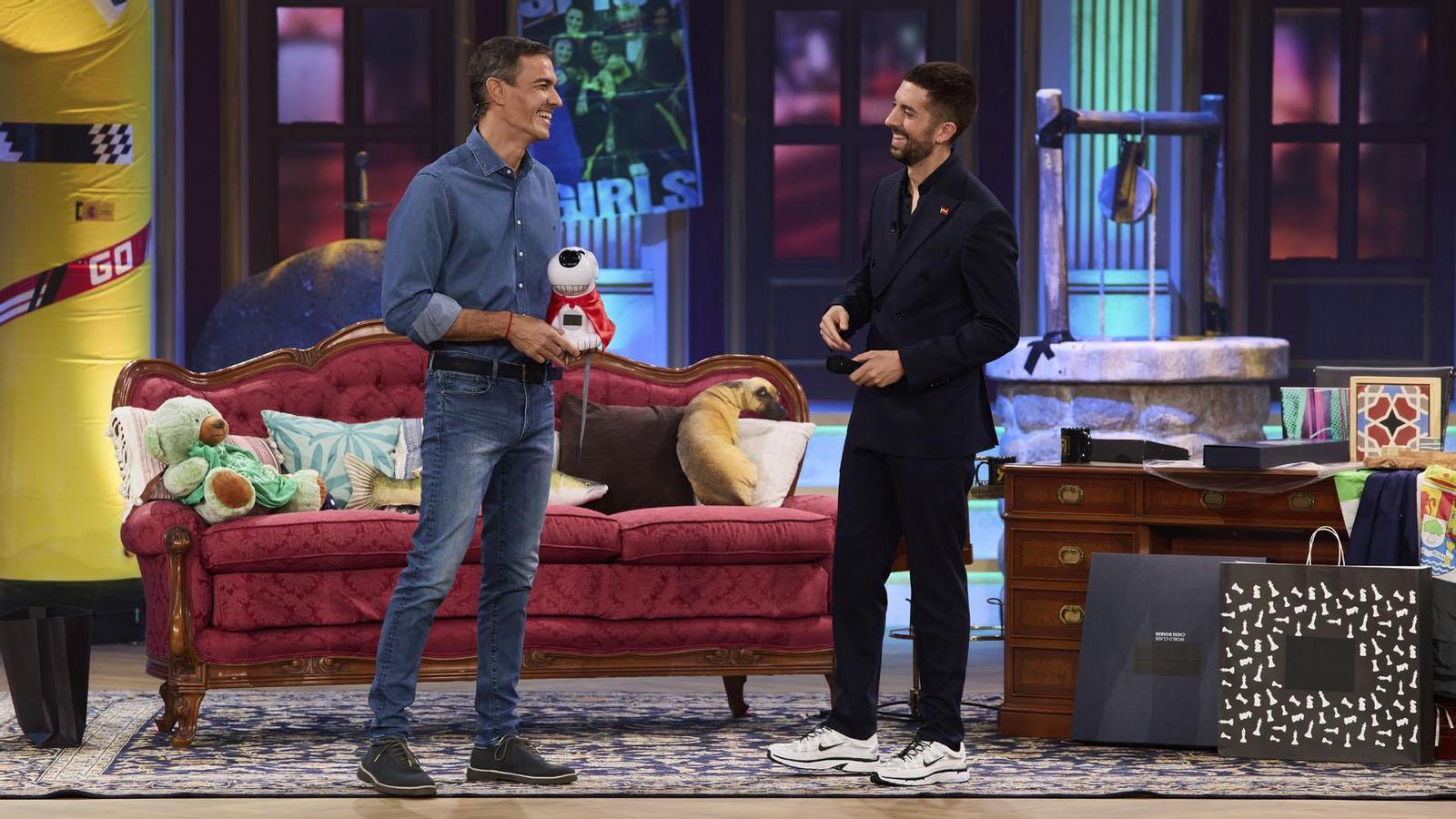
In parallel, this electoral pre-campaign is starting to accumulate images with a certain impact, the kind that will mark the memory of this stage for a long time. In this sense, it is curious to what extent audiovisual material easily imposes itself on any attempt to delve a little deeper into the generation of political stimuli. The most repeated photos are those of the declaration and the kiss from Sánchez to his wife, the hug between Ayuso and Milei, and the socialist leader on the programLa revuelta, in an electoral race that began with another impactful image: that of Maricarmen Abascal ill and her eviction on a stretcher. The appeal to feelings is a constant at this moment.
Hardly anyone asks anymore what the parties' electoral programs say, as they don't even bother to prepare summaries or leaflets to fill mailboxes, like in years past. In part, this lack of interest is probably due to the fact that few people believe that commitments serve any purpose other than to be broken. It is not even bad faith. Making promises is a way of wasting time because it is difficult to be sure about the effective strength that will be held starting next year in the Spanish parliamentary chamber. So far, only the pension increase based on the inflation index is committed. Apart from the PSOE, the PP also says it will respect it. On the other hand, it is logical not to waste time on old communication resources when it is more practical to monitor social media and have a team that functions in the creation of messages and counter-messages. What remains to be closed is the question of the debates between the candidates. The PP only accepts one face-to-face debate, and other lower-impact debates with more candidates. One more reason to doubt their confidence.
