Catalonia rows against the current to stop a PP and Vox government
The campaign ends with calls to dispute the useful vote of the PSC by ERC, Junts and the Broad Front
-
CAT -
CAST
BarcelonaAs happened in the last general elections, Catalonia will once again play a key role this November 29th. However, if in 2023 the four Catalan constituencies were decisive for Pedro Sánchez to continue at the Moncloa, this time the result in Catalonia may go against the grain compared to the rest of the State, but be futile to prevent the PP and Vox from taking the reins of the Spanish government. The socialists continue to lead the polls in Catalonia and have conducted a conservative campaign to try to retain the useful vote that is contested with ERC and the Broad Front, but also with Junts. A strategy that the PSC wants to serve to contain the rise of the PP and Vox that the demoscopy also predicts for it in Catalonia, especially the extreme right. But beyond the influence of Catalonia's result on the State, this November 29th will also serve to visualize how the battles in a Catalan key that have also been fought during this campaign are resolved.
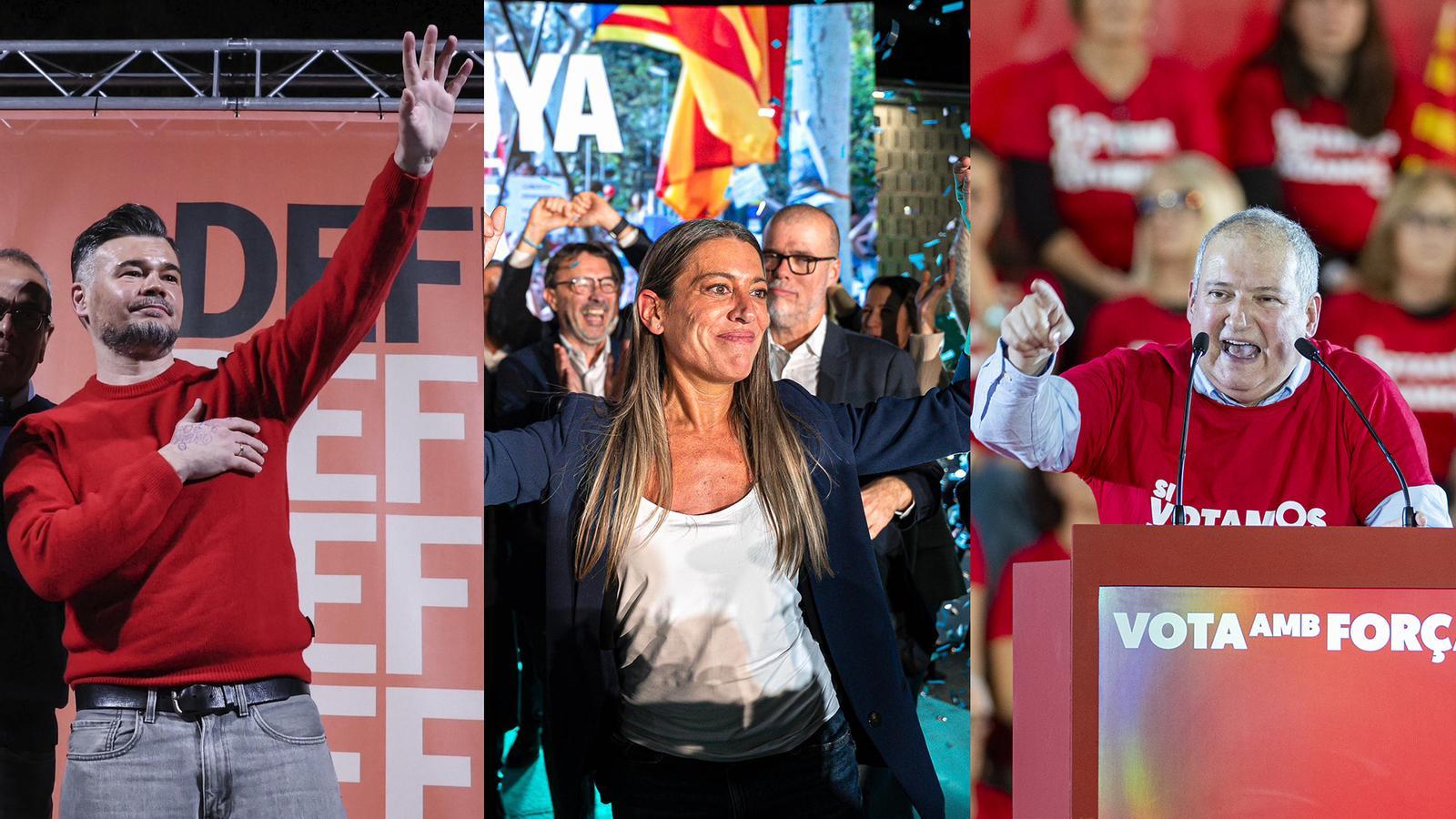
In the last debate of the campaign that was held this Friday on Catalunya Ràdio, the PSC's strategy was visualized: presenting itself as the useful vote to stop the PP and Vox, but not straying from the script so as not to make any mistakes. “There are many ballots, but there are only two options: Pedro Sánchez or Alberto Núñez Feijóo and Santiago Abascal,” defended the president of the Generalitat, Salvador Illa, at the PSC's last campaign rally from the Paloma party hall in Barcelona. This has been the campaign of their candidate, Jordi Hereu, who has had a rather discreet profile to try to leave all the ground to Pedro Sánchez –who has visited Catalonia only once in this campaign–. Despite having the polls against them throughout the State, the socialists have tried to convey that there is still a game and that Catalonia is the one that must lead the comeback. Hereu, to close the campaign, has opted to harden the tone against Junts and has assured that the PSC “is not the Catalan minority, but the Catalan majority”.
The PSC is fighting for the useful vote, mainly, with ERC. And the republicans have decided to jump on the bandwagon of their candidate, Gabriel Rufián, who has skyrocketed their expectations for this November 29th. The party has played with the fan phenomenon of Rufián and since the beginning of the campaign, when it detected the appeal of their candidate among the youngest audience, it has handed out posters and t-shirts at every rally. Oriol Junqueras was betting this Friday on achieving between 13 and 14 seats if in Lleida, Tarragona and Girona "people vote well". Esquerra, in this sense, has tried to dispute the useful vote with the PSC by making an appeal to "disenchanted" Catalanist socialists. "He does not deserve your vote," Rufián stated this Friday in the last two campaign acts in L'Hospitalet de Llobregat and Sant Andreu de la Barca, two socialist strongholds –although in Sant Andreu the republicans hold the mayoralty–. "Whatever happens, it has been an honor," he concluded. Rufián took the opportunity to thank the support that Ernest Maragall expressed this Friday.
Sumar, the partner with whom the PSOE has shared a coalition government in the State until now, also wants to pressure the socialists. Ernest Urtasun has assumed the weight of the Catalan campaign –Ada Colau is the presidential candidate for the State despite being number one for Barcelona– to try to present itself as the force that drives "brave left-wing policies" in the State. The goal is to avoid the flight of votes towards the socialists that all polls remark could climb up to 20%, but also towards ERC. The coalition, in fact, does not have good forecasts for November 29th, but rather the demoscopy predicts a decline for it —in Catalonia it could be left with three or four deputies.
The pro-independence battle
Junts also does not have good electoral prospects. The candidacy led by Miriam Nogueras has dedicated its main messages to avoiding leaks towards the PSC due to the useful vote and to positioning itself "in the middle" between the Spanish right-wing and left-wing blocs. The convergent gene, with Artur Mas and Jordi Pujol, has had a strong presence over these past two weeks, although in the final campaign event in Barcelona, the party also brought out the former President of the Parliament, Laura Borràs. However, it has been difficult for Junts to enter a campaign that was born polarized. Nonetheless, the party has played with the figure of Carles Puigdemont to try to set the agenda with a controversial interview in El Mundo in which the former President of the Generalitat attacked Pedro Sánchez, and a few days later announcing his return for December 12th, once the Supreme Court had definitively amnestied him. This Friday, Puigdemont closed the campaign by calling for "not wasting the vote" by voting for Alhora, and Nogueras defended that Junts should be "decisive" in achieving the fiscal agreement.
This electoral race has also served to visualize the eternal battle within the independence movement. Junts and ERC have once again thrown barbs at each other, which have been personified between Miriam Nogueras and Gabriel Rufián. Here, past struggles have surfaced because Carles Puigdemont's party has attacked the republicans' negotiating strategy, rescuing the "in exchange for nothing," and Rufián has spent the rallies lashing back – "It is a national disgrace" – and reminding them that it was ERC who negotiated the pardons.
The Spanish right is also growing in Catalonia
The PP has the polls in its favor to reach the Moncloa and the result in Catalonia could be key. Alberto Núñez Feijóo chose Xavier García Albiol to try to stop the leakage of votes to Vox and the PP's campaign has reversed the party's downward trend, which has taken advantage of the errors of the far-right formation. However, the Catalan populars have run a campaign in tow of the national one to give prominence to Feijóo, who began the campaign in Badalona and returned this last Friday of the campaign to Hospitalet –in the afternoon Albiol closed the campaign in Lleida to try to obtain a seat in this province that right now is difficult–. The national leader has left the speech on security and immigration in Albiol's hands. Vox, for its part, trusts that the rise predicted by the polls will give a boost to the result for the whole of the State. The far-right formation has not held any closing campaign event in Catalonia.
