Gabriel Rufián reveals the origin of his idyll with Podemos: “You are my people”
The leader of Esquerra shares a stage in Madrid with Irene Montero, who claims herself as the subversive left
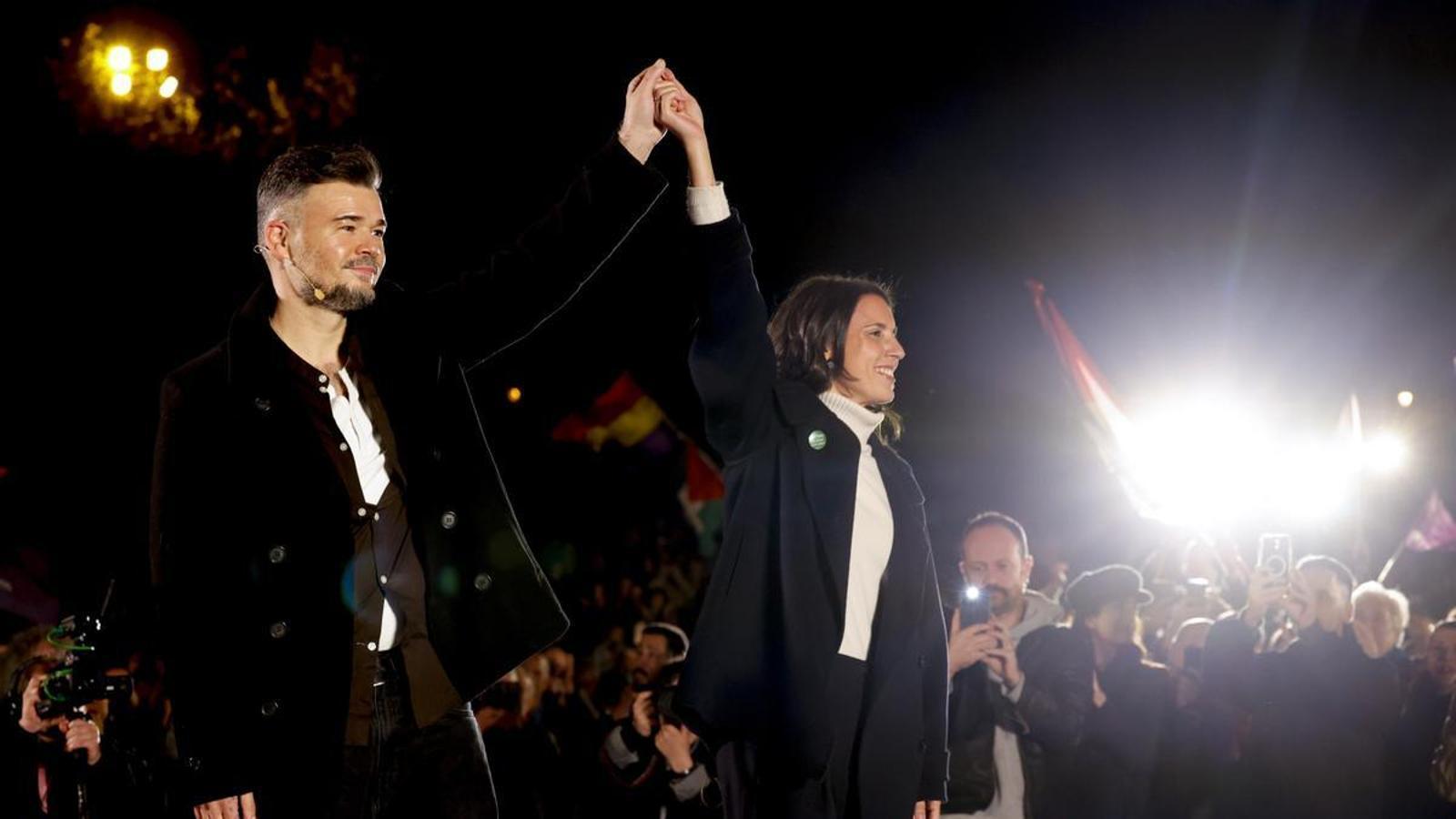

MadridGabriel Rufián and Irene Montero wait inside a tent at the Tierno Galván park amphitheater in Madrid to go out and perform. Hundreds of people surround the circular stage and wait for them with their phones in hand to get the best video. “Rufián, Rufián,” is heard among the younger sector, who, upon seeing him, approach him to ask for a photo and an autograph. Despite being the head of the Esquerra list and acting as the “opening act” for the event, Gabriel Rufián gets the biggest ovation. The audience applauds when they hear him cite the executed former president Lluís Companys —“I am Catalan, but I want things to go well in Madrid”— and does so even more enthusiastically when Rufián explains the origin of this idyll with Podemos. “I am an independentist and a progressive, but I am savagely anti-fascist,” he proclaimed, and pointed at Junts as he usually does: “If you are neutral, you are just another fascist.”
The Esquerra leader referred to a “bad stage” of his political career, approximately two years ago, according to sources close to him, to explain how his bond with the purple party began. Podemos invited him to an event at a theater in Madrid. “At that moment, I was not used to being applauded, to being received with affection. I thought I would sit down to listen to the good people of Podemos like just one more person. But when I arrived, you all stood up and applauded me like no one ever had. That day I thought: these are my people too, I don’t care about your origin or your surname.”
The episode moved the audience that was listening to him, about 3,500 people according to the organization, with flags of Palestine, tricolors, or LGTBIQ+. Rufián encouraged voting for Podemos against Sumar and the PSOE, as he presented it as the left that does not let itself be dominated by the socialists. “Yesterday the left was overwhelmed,” declared Rufián in allusion to the face-to-face debate between Pedro Sánchez and Alberto Nuñez Feijóo, “if it had been Irene Montero, that would not have happened.” For the Esquerra leader, a party is needed that “subjugates” the PSOE and does not act as a sidekick, with a veiled dart against Sumar.
Rufián has lashed out at his left-wing competitors. “A woman had to die” for the PSOE to react on housing, he lamented, in reference to the eviction and death of Maricarmen Abascal. He gave another example: Guillem Agulló. The Council of Ministers officially recognized him last week as a victim of far-right terrorism. “33 years had to pass” since the murder of the young man from the Valencian Country, he recalled, to explain that the Socialists, if they are not conditioned, in his opinion, by a subversive left, do not implement brave policies.
In this way, Rufián and Montero have created the context to criticize one of their main rivals at the polls: Broad Front. “This wasn't about replacing Yolanda Díaz,” he lamented, joining the usual jabs from Podemos against Sumar for staying within the executive and not pressuring the PSOE enough. Despite claiming the unity of the left, both Rufián and Montero have thus asserted themselves against Ada Colau's candidacy. For example, they lamented that the alliance between Podemos and Esquerra caused a lot of noise and they were accused of breaking unity, while the pact between Sumar and Més Madrid was taken for granted.
The “anti-fascist” alliance
The common thread of the event was the “anti-fascist” front in the face of the rise of the PP and Vox. In fact, Rufián dedicated a good part of his speech to explaining the reasons for his pact with Irene Montero. Despite claiming to be an independentist and speaking of Catalonia as his country, he argued that the policies of the PP and Vox will not stop at the Ebro and that for this reason there is a “historical responsibility” for the Spanish and sovereignist left to go and vote en masse on November 29th.
The head of the Esquerra list and Montero split the roles of Podemos' electoral slogan, “peace, home, and work”. While Rufián dedicated himself mainly to talking about social policies, the Podemos member chose to claim herself as a pacifist, against the investment in weaponry that the Spanish government is making, and even questioned the sending of weapons to Ukraine to fight against Russia's invasion. “No to NATO”, was proclaimed from the audience.
But what Montero did not lack was the final call for mobilization. “We need one last push”, she admitted. The fact is that the purple party does not have its representation in Madrid guaranteed, according to the polls, nor does Irene Montero's seat. The paradox is that, if participation increases significantly, it will be more difficult for the “purples” to enter Congress from the Spanish capital: as it is a constituency where many seats (37) are distributed, achieving one requires many more votes than in smaller districts. “Yes we can”, concluded Irene Montero.
