Bolaños disconnects Morocco from the massive entry of immigrants: "There is no evidence"
The minister attributes the events of July 30 to a "distortion" on social networks of the Supreme Court's ruling

-
CAT -
CAST
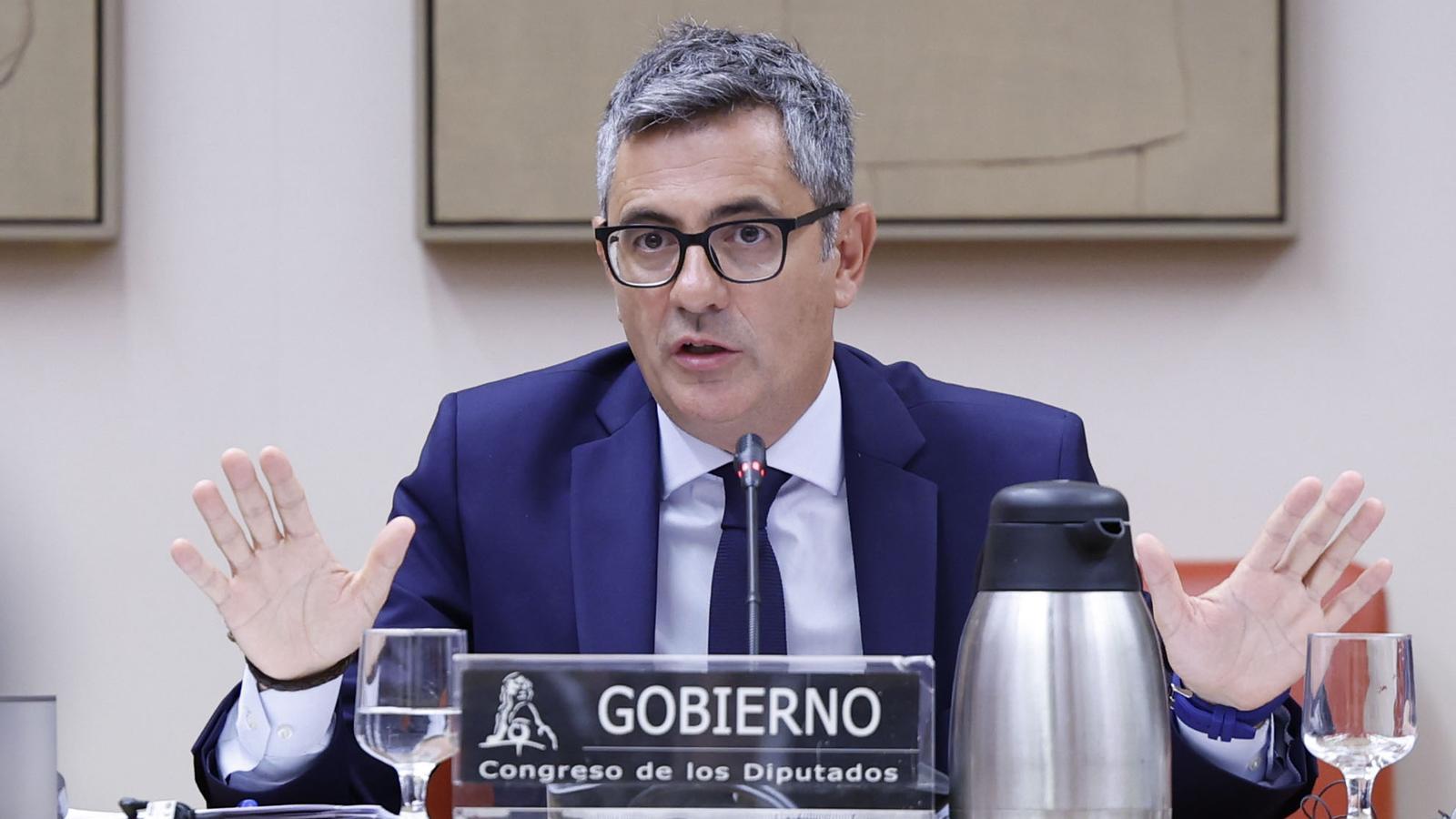
MadridIf there has been an issue that has focused the Spanish government's appearance this Thursday on the Ceuta crisis, it has been the role of Morocco. After the clash within the executive due to the information transmitted by the CNI, the Minister of Justice, Félix Bolaños, appeared before the Joint Committee on National Security in Congress, with the aim of accounting for the management following the massive entry of more than 70,000 immigrants on July 30 into the autonomous city. What happened? According to Bolaños, it occurred due to the "distortion" of a Supreme Court ruling that rejected hot returns in case of entering by swimming, as it considered that in these cases an administrative process and an individualized evaluation should be opened before an immediate return. The minister has dissociated Morocco from the events:
Bolaños thus defended the Alawite country:

Minister Bolaños explained in the appearance what he considers happened on July 30. He said that, from the Supreme Court's ruling on July 8 regarding pushbacks at the border, two fake news were generated that spread like wildfire on social media. On the one hand, it was spread that the border was open, and on the other, that if you swam into Spain, you could not be sent back. In the opinion of the Minister of Justice, this led to unprecedented migratory pressure on Ceuta, which is always in the sights of national security. However, Bolaños did not clarify who he believes generated this wave. At this point, he did make it clear that the Spanish government did not have "prior or precise information about the magnitude" of the entry, supporting the version of the Minister of the Interior, Fernando Grande-Marlaska, and not that of Margarita Robles, according to whom the executive did not have enough intelligence information to take extraordinary measures.
Bolaños has defended that, once the crisis began, the State reacted by "reinforcing" services in the autonomous city –in the case of Justice, the civil servants dependent on the ministry and also the Prosecutor's Office– and increasing information exchange between ministries. However, he pointed out that if the judicial power has not been reinforced, it is because he is waiting for the formal request from the CGPJ. This is a way of assuring, contrary to what the opposition says, that the Spanish government mobilized from minute one. "Pedro Sánchez has been on the phone the whole time," he stated. To return to normality, he guaranteed that all necessary resources will be allocated to Ceuta, and he highlighted the "coordination" that will occur as a result of the creation of the single command led by Torres.
The objective is to progressively return all immigrants, but respecting the law, which requires analyzing each case individually for asylum seekers and minors, the ministers remarked, who also wanted to emphasize that Morocco has shown itself to be willing to "collaborate". In this regard, Bolaños has asked for "solidarity" from the rest of the autonomous communities, most of them governed by the PP, to host these minors, at least temporarily. Torres has warned that it is false that everyone can be returned immediately and recalled that there have been convictions for prevarication by both PP and PSOE leaders in Ceuta for not following the law.In any case, Bolaños and Torres have highlighted that "90%" of the people who entered Ceuta irregularly on July 30 returned the same day, which – they argued – is also the product of "diplomatic work" with Morocco. Thus, Bolaños has wanted to ask for "calm" and "confidence" from the citizens of Ceuta, increasingly tense. "We will return to normality," he promised, and he downplayed the insecurity denounced by the opposition. He admitted that there has been a 4.2% increase in crimes in Ceuta, but he believes that the figures do not align with the situation depicted by the right. In turn, Torres has called for non-violence, denouncing that it cannot be that Ceuta workers from the Red Cross feel "threatened" for giving food to immigrants.
"Morocco is not a reliable partner"
The explanations have not satisfied the groups. For Esquerra deputy Francesc-Marc Álvaro, the Spanish government's reaction has been "slow" and "improvable" and, in the case of Pedro Sánchez, "absent." A thesis that was also shared by the PNB and Junts, who have once again called for the transfer of immigration powers to the Generalitat. In Álvaro's opinion, the situation in Ceuta is a "social and political bomb" and quick action is needed, as well as demanding explanations about what lies behind the massive wave of immigrants beyond the "distortion" of the Supreme Court's ruling. Morocco? Other international actors? Or who? "What reliability does the corrupt monarchy of Morocco deserve?" asked the republican deputy, stressing that there is "consensus in the chamber, except for the PSOE, that it is not a reliable partner." Jon Iñarritu, deputy for EH Bildu, has called the executive "suckers" for its attitude towards the Alawite country: "You don't need to be Pericles to see the lack of collaboration. It's evident." "Will the Spanish government stand up to the Moroccan monarchy and return to the sensible position that Western Sahara cannot be occupied?" added, in turn, Sumar deputy Enric Morera.
But the doubts have not only come from the left, but also from the right. PP deputy Cuca Gamarra has described what happened on July 30 as an "invasion" and has blamed Morocco. "It was not self-management by individuals mobilized by TikTok. We should not worry about the mobile phones of Moroccans. What should worry us are other motives," she said, implying that Morocco was the one that infected Margarita Robles and Pedro Sánchez's devices with Pegasus and is now blackmailing them. "What do you owe Morocco?" continued Pepa Millán, spokesperson for Vox, and expressed her conviction that the monarchy launched its population against Spain to violate the territorial integrity of the State. "It was an act of war," she even said. Bolaños concluded the appearance emphatically and asked for a "rectification" from the right: "You have no proof"
The former president of the Spanish government, José María Aznar, traveled to Ceuta this Thursday and met with the head of the Ceuta executive, Juan Jesús Vivas. "National sovereignty must be restored," he demanded, recalling that "territorial integrity has been violated" and that the "State's primary obligation is to restore order, security, and normality, which have been so notoriously violated for a month now."
While the Minister of Justice, Félix Bolaños, was appearing, the Minister of Health, Mónica García, was also appearing. The minister denied that the immigrants in Ceuta carry diseases, and admitted that it is the conditions that people find themselves in, overcrowding, that favor the appearance of pathologies. "Tuberculosis, scabies, and chickenpox exist in Spain. The overcrowding conditions are what condition migrants to get sick," she stated. At the same time, she added that she considers the risk of transmission to the Ceuta population to be low, because differentiated assistance circuits have been established.In this regard, she once again ruled out an "indiscriminate" confinement of immigrants due to a lack of "epidemiological justification". She provided data: three cases of tuberculosis, three of chickenpox, and about sixty of gastroenteritis have been identified. The vaccination campaign will begin next week.
