The Spanish government seeks to calm Ceuta by promising more resources to speed up returns
Discard using the city's sports centers after the local government's rejection

-
CAT -
CAST
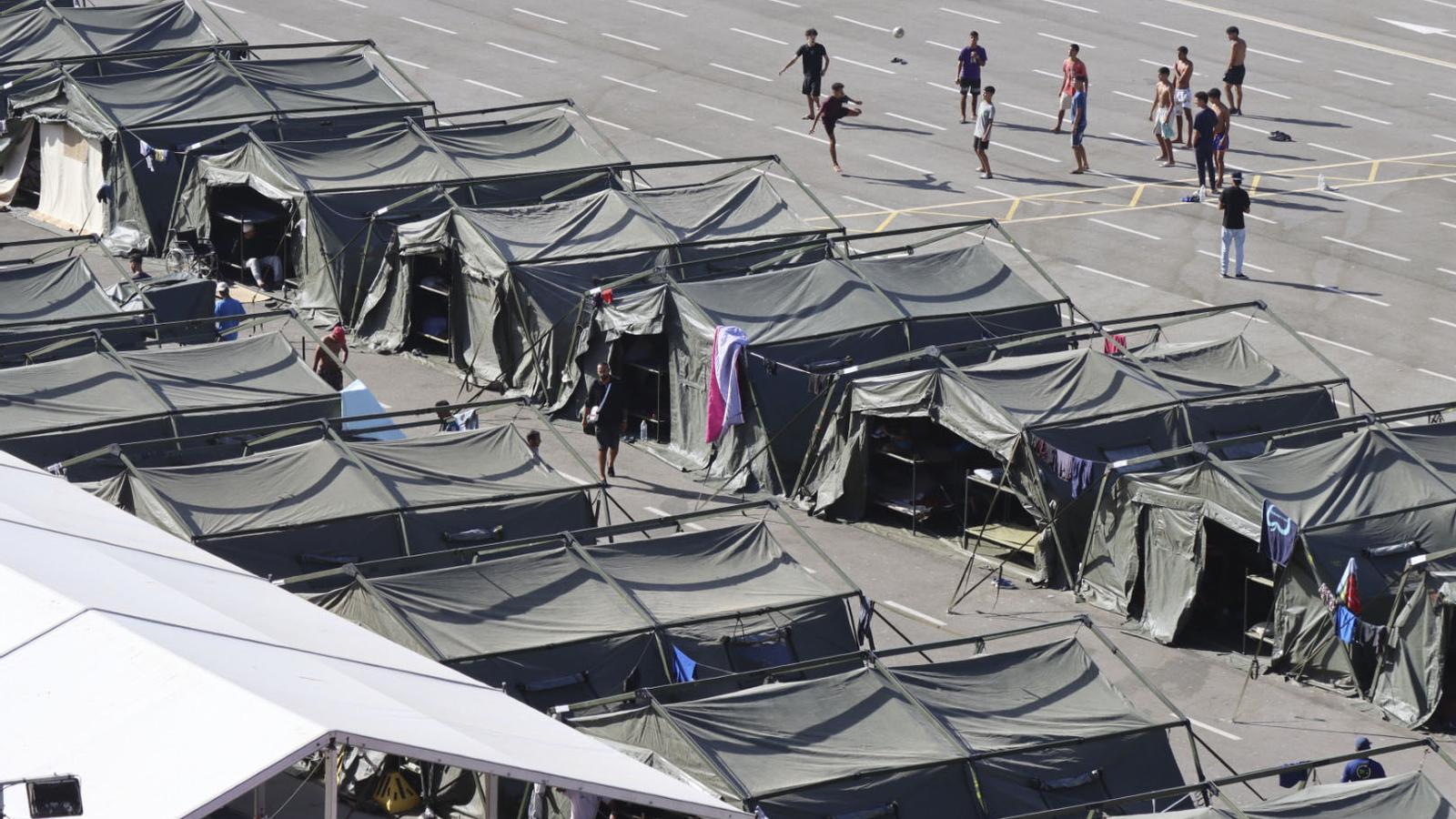
MadridThe Spanish government and the government of Ceuta continue to search for spaces to temporarily house the immigrant individuals who entered the autonomous city on July 30 and 31 and who are still living on the streets. The intention is that, once they are "contained" in temporary spaces, they can be registered and "returned" to their country of origin in accordance with the law, said the Minister of Territorial Policy, Ángel Víctor Torres, at a press conference this Wednesday. Torres also promised more resources to expedite procedures and facilitate returns. It should be noted that the law requires individualized files to be made and cases to be studied one by one.
"This is the plan [...]: to register them so they can return as soon as possible," the minister reiterated. The government of Ceuta has once again called this Wednesday for an "immediate" return of all immigrant individuals who remain in the city. Torres insisted that it must be done "within the margins of the law" and recalled that there are politicians convicted for returning minors outside the law in 2021. In Ceuta, in addition to minors, there are also asylum seekers.
With this message, the Spanish government, which has always placed return as a priority, seeks to calm the spirits of the government of Ceuta, which feared that the enabled spaces would become a precedent and would not be temporary.
"The priority is that they return, and if they return, camps are not needed – said the president of Ceuta, Juan Jesús Vivas (PP), hours before –. When legal frameworks are irresolvable [referring to the prohibition of the express return of people, especially minors], means must be put in place to resolve the problem. More immigration officials, police officers, interpreters, judges, prosecutors, more of everything are needed to speed up the procedures".. Now, the Spanish government has promised reinforcements.
But the message from the Spanish executive also seeks to calm the spirits of the city of Ceuta, where tension among residents grows by the moment. In fact, Torres has been met with a demonstration against the management of Pedro Sánchez's government. "Ceuta defends itself, Ceuta is not sold," shouted the demonstrators as they waved Spanish flags. The minister has called for "coexistence." "Violence leads nowhere," he said.
Which spaces?
This Wednesday, the first meeting between the Spanish government and the government of Ceuta was held after approving the declaration of "exceptional situation" in the city and appointing a single command led by Ángel Víctor Torres. Pedro Sánchez will preside over the second meeting this Friday remotely from Moncloa.
The Spanish executive has approved a royal decree to enable all sports centers in Ceuta as temporary reception spaces. Also other facilities and organizations that depend on the autonomous city, in addition to facilities owned by up to 11 different ministries, as detailed in the decree published this Wednesday in the Official State Bulletin (BOE). In total, 2,000 new positions are planned to be created.
Of all the spaces considered, the government of Ceuta has rejected the idea of sports complexes, which the ministry has accepted. "[The spaces considered] are susceptible to being used, but we do not want to harm coexistence or normality," said the Minister of Territorial Policy just after meeting with the president of Ceuta. Torres acknowledged that they are continuing to look for spaces and revealed that the public schools where 350 girls had been temporarily housed have already been vacated and relocated. The new locations will be added to those already made available, where around 2,000 immigrants have been housed so far.
The government of Ceuta assures that it sent a list with different locations to house people. "The area near [the border] of El Tarajal and other areas far from the residential nucleus. These camps must be in areas where they do not affect neighbors," stated Vivas. In fact, the decree foresees that the spaces will be designated "by consensus" and that the list of facilities from the Spanish government is "modifiable and flexible," as the local government's criteria will be taken into account.
Finally, the government of Ceuta has formally requested the Spanish government to assume responsibility for unaccompanied immigrant minors, which is currently the responsibility of the autonomous and, in this case, local administration. A request that the minister has completely dismissed.
Contradictory figures
Meanwhile, the juggling of figures continues. The Spanish government has not provided any official figures on the number of immigrants who remain in the city since they arrived almost a month ago. Nor how many live on the streets. Furthermore, returns to Morocco continue to be sporadic. Regarding unaccompanied minors, after the first vice-president and Minister of Economy, Carlos Cuerpo, announced that approximately 2,900 minors had already been registered with the Spanish authorities, the Minister of Territorial Policy has lowered the number of registered individuals to 1,410. "There are still minors on the streets," said Ángel Víctor Torres, who acknowledged that they do not have a definitive number of minors.
This Thursday, the debate precisely returns to the issue of unaccompanied immigrant minors in Ceuta. The Ministry of Youth and Childhood and the autonomous communities are meeting to address the situation, although the only official item on the agenda is the approval of an extraordinary 25 million euros to strengthen Ceuta's resources. The PP vetoed, in a previous meeting, addressing the situation of the children, but the ministry intends to propose solutions.
The departments in charge of Vox after pacts with the Popular Party (Aragon, Castile and León, and Extremadura) will not attend the meeting and have already warned that they will "challenge" any files they receive. The PP, meanwhile, is balancing between the pressure of the far-right and compliance with the law, which obliges them to accept the distribution. Be that as it may, sources from the Ministry of Youth and Childhood indicate that they are far from putting a figure on the table and, in fact, they want to prioritize the transfer to the Peninsula of the most vulnerable profiles, especially girls, but by reaching direct agreements with private entities. Competencies would remain in the hands of the autonomous city.
