Three electoral notes

Black Monday. I have seen that a Catalan digital media outlet has started a subscriber recruitment campaign with the motto “Dark times are coming.” That is to say, on Monday we will wake up with a PP-Vox majority and we must be well-informed to face the tsunami. It is the commercial embodiment of the worse, the better. I understand the sentiment expressed by the campaign very well because at Polònia we also had more fun when specimens like Rajoy, Zaplana, Acebes or Soraya were in charge. But beyond that, there is within the sovereignty movement a kind of morbid yearning for change. Many Catalans believe that under the yoke of PP and Vox, Catalonia will emerge as a bastion with its own profile, there will be a popular reaction like the one that drove the Process, while Spain will succumb to the ghosts that prevent it from being a normal democracy. And who knows if it will be true, but the collateral damage we will suffer will be great, and in Catalan society I detect enough division, fatigue and disillusionment not to trust in a reaction so vigorous that it could break the bank. Leaving aside that the monster that lurks for us is not only outside the walls; it is also among us, increasingly uninhibited.
Quarter-finals. The war for political hegemony is fought through successive battles, successes, and partial failures. As in the Champions League, the contenders must eliminate rivals to reach the grand final. In Spain, the final is already on November 29th, but in Catalonia, in terms of internal politics, we are still in the quarter-finals. On Sunday, we will decide whether ERC or the Broad Front keeps the space to the left of an increasingly centrist PSC. We will also see if ERC or Junts lead the independence bloc, at least in Madrid (in Catalonia, we must wait to see what role Puigdemont wants to play). Or if it is the PP or Vox that becomes the reference point for the Spanish right in Catalonia, a minority space, but one that provides decisive votes in Spain. In short, we will see who the main (or principal) aspirants to face the PSC in the grand final are, and under what conditions the Catalan socialists will face the next challenges. For the most self-centered Catalan analysts, the Spanish elections are –also– primaries for the Catalan and local contests. And it is true that trends are set, and that in each campaign, the contenders emerge doped or weakened by their electoral history. But we all know that the Catalan voter is promiscuous, which is a healthy thing because in every election we have different things at stake.
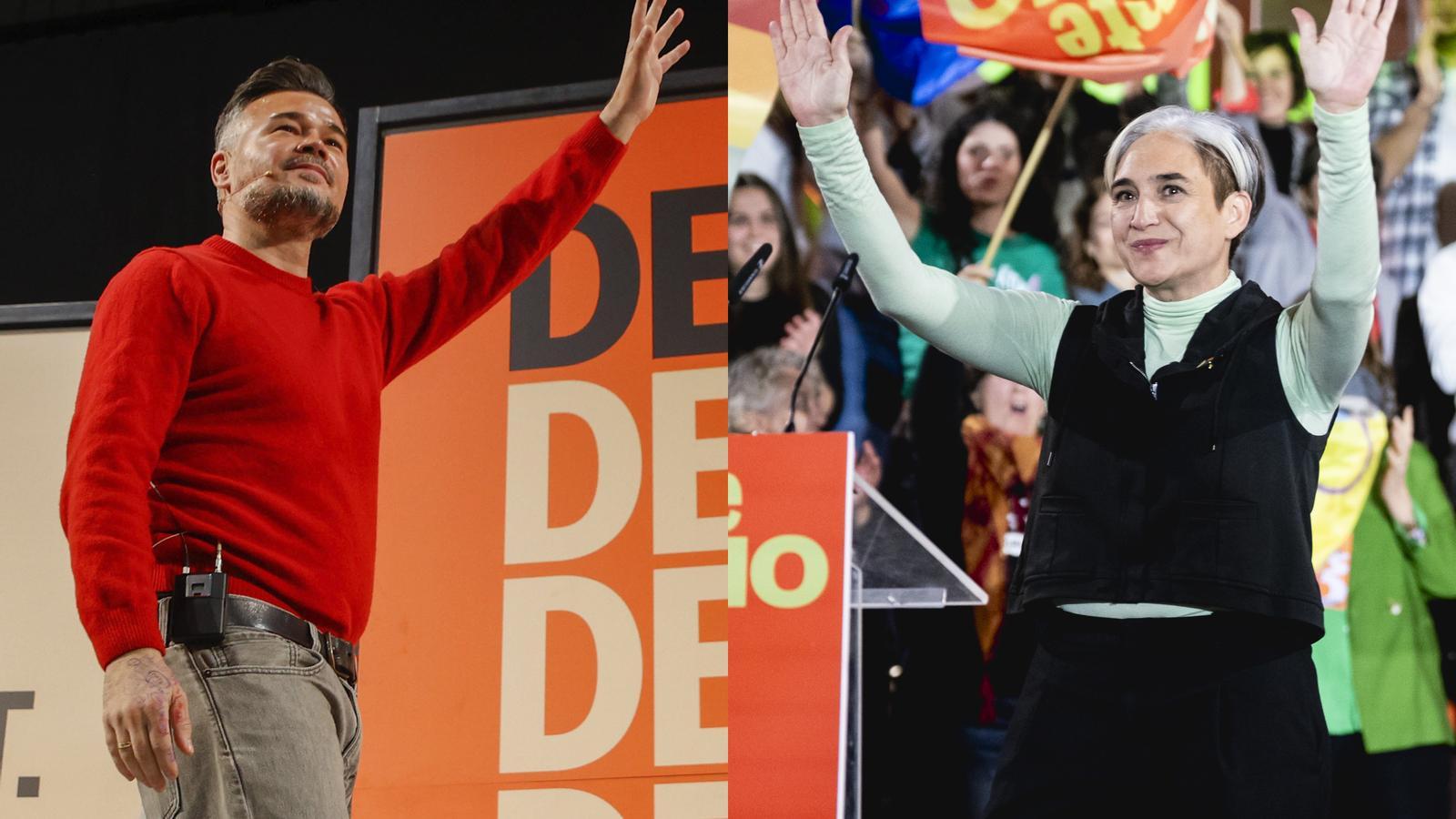
Rufián-Ada. Of these partial eliminations, the one I find sociologically most exciting is the one maintained by Gabriel Rufián and Ada Colau. Both have points in common (a certain taste for populism and narcissism, and a very Manichaean vision of political and social reality), and aspects that show their complexity and mirror the complexity of the country. Colau and Rufián are two imperfect Catalans, as we almost all are. She speaks Catalan better, but he defines himself as an indepe. He appeals to the pro-sovereignty left, while she wants a Front that, in addition to being broad, is not too distracted by territorial concerns. But it was not long ago that both seemed destined to coincide in a unitary operation. The most skeptical may think that what marks the trajectory of both are personal agendas. It would not be the first case, nor will it be the last.
The expected success of Rufián will put his party in front of an exciting but risky challenge: Complementing him with Junqueras, quoting Lluís Companys in Spanish, talking about independence (or just whispering it) to the masses of depoliticized young people who are queuing up to get the poster of the quintessential pop leader. For Colau, on the other hand, Sunday is all or nothing: Either she is the strong woman of a Sánchez government, or she has to start from zero. For her and for the Comuns.
