Elon Musk is annoyed by 'The Odyssey'

Elon Musk continues to be upset about Christopher Nolan's version of The Odyssey. For months, he and his supporters have been campaigning on social media to question the casting of the new blockbuster of the ancient epic, particularly the choice of black actress Lupita Nyong'o for the role of Helen of Troy and transgender actor Elliot Page as the warrior Sinó. Now that the film has been released, some conservatives have admitted that there is nothing particularly woke in Nolan's tale of sacrifice and male honor. He takes liberties with the original material, like any Hollywood version, but one of its main divergences is a more Christian than pagan moral framework, which should not offend most of the conservative sector.
However, Musk has not stopped complaining. On Tuesday, he promised that by the end of the year he will release a "historically accurate" version of "The Odyssey" created with artificial intelligence, and he published an absurdly cheesy clip made by his image generator Grok. In doing so, he inadvertently highlighted one of the reasons why Nolan's version is so powerful: because it represents human revolt in a world full of AI-generated junk.
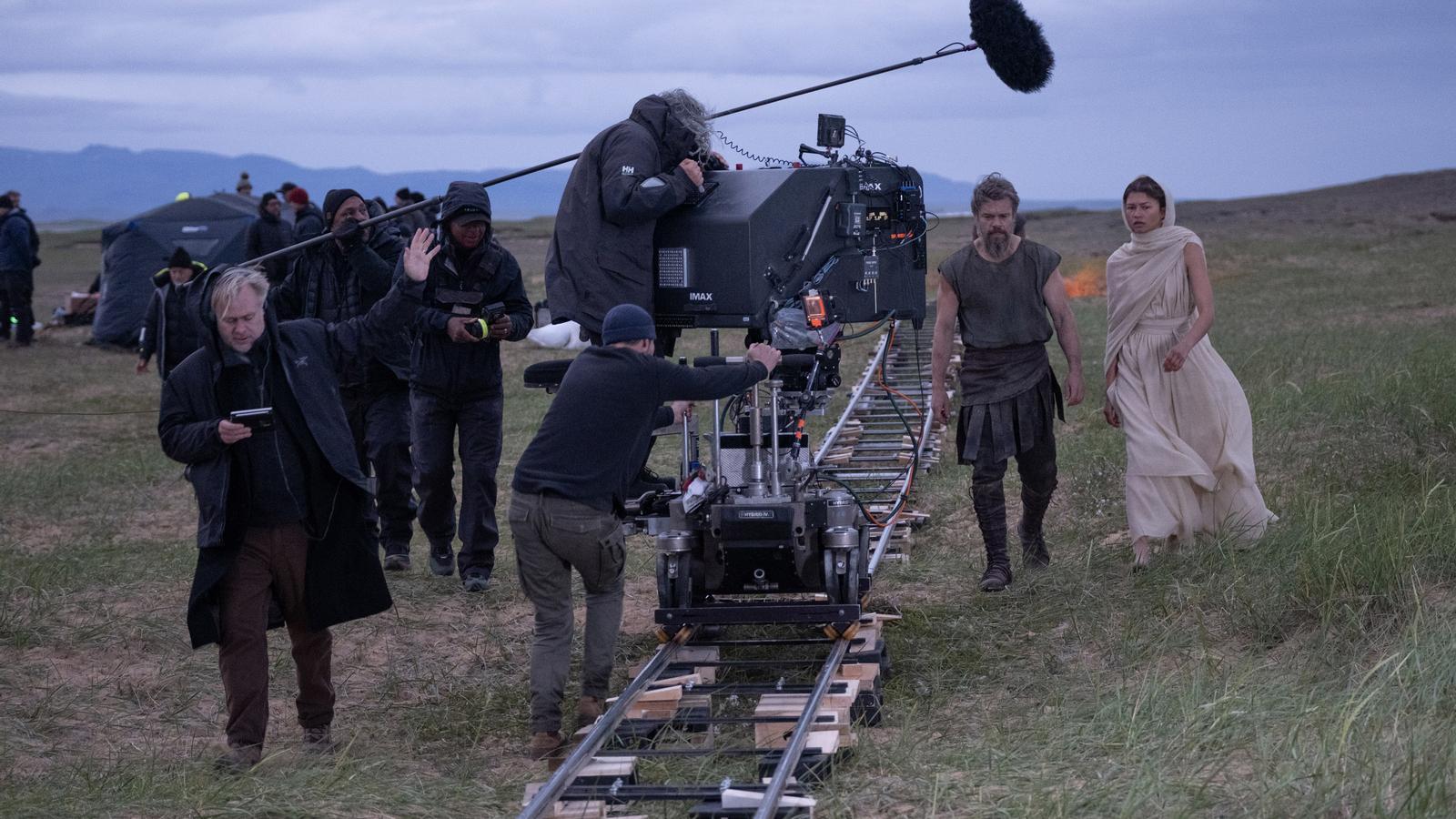
Despite its length, The Odyssey is surprisingly intimate in scale and restrained in its use of special effects. "We like to spend a lot of time in real places, in real locations, having things in front of the camera that are tangible," its cinematographer, Hoyte van Hoytema, told The New York Times. The cyclops Polyphemus was not an AI creation, but an 18-meter animated puppet. The sirens are small figures in the distance; Hades, a murky expanse. In The Telegraph, critic Robbie Collin described Nolan filming on a wooden ship in the midst of a real storm, creating the sense of tempestuousness that characterizes the film. Nolan knows how to build hyperreal fantasy kingdoms, as he did in Inception and Tenet, but this time he has prioritized the earthly over the grandiose and impressive.
Some of the polarizing narrative choices Nolan has made seem to stem from this approach. The film doesn't create an ancient, opulent dream world for viewers to get lost in. The gods are barely present, save for a thinly played Athena by Zendaya. "Nolan's version, unlike Homer's, is a completely disenchanted story, stripped of all the supernatural stuff, save for a couple of witches," protested right-wing influencer Matt Walsh, who unfavorably compares the film to Gladiator, Lord of the Rings, and Mel Gibson's Apocalypto. The film's stakes seem more psychological than mythical.
This is precisely what draws viewers in, and has made The Odyssey not just a hit but a cultural phenomenon, with some people flying to see it in 70-millimeter IMAX. (As The New York Post reported, the only Manhattan theater playing the film in that format has tickets sold out through Aug. 19.) There may seem to be a contradiction between the absence of visual spectacle and its success as spectacle. But AI has made visual spectacle seem cheap. Viewers crave visceral experiences.
One of the few pleasant surprises of 2026 is that people are returning to the movies. During the pandemic, there were many predictions that movie theaters would not survive, replaced by the conveniences offered by on-demand video platforms. While the most pessimistic forecasts proved exaggerated, in recent years the downward trend has continued. American box office sales were lower in 2024 than in 2023, and continued to disappoint in 2025. This year, however, will be the best in terms of ticket sales since 2019. Young people, eager for communal experiences, have flocked to cinemas; according to a Fandango study, Gen Z is the demographic that frequents them the most today.
What's striking, however, is not just that people are returning to cinemas, but the kind of films they're watching. Recent films that feel artificial, like Supergirl, the live-action Moana and Star Wars: The Mandalorian and Grogu have flopped. In contrast, low-budget horror films Obsession and Backrooms, which rely on creepy premises rather than otherworldly visuals, have been huge hits. “The 2026 audience is sending a clear message to filmmakers: we want films to look real, and for you to sweat while you make them,” James Hibberd wrote in The Hollywood Reporter.
No greater defender of analog, artisanal filmmaking exists than Nolan, who doesn’t even own a smartphone. Speaking to Collin of The Telegraph, he celebrated young people’s rejection of AI. “In my entire lifetime, I have never seen a rejection of a supposedly foundational technology that is so rapid and widespread,” Nolan stated. As a result, he said, “after years of heading toward heavily virtual environments, we’re seeing a renewed interest in more tactile and real forms of storytelling.”
It is this ethos, rather than multiracial casting, that makes The Odyssey a rejoinder to Musk’s ideology, with its video-game-derived perceptions of greatness and its conviction that algorithms can create art. He is probably right to detest it. He is wrong to think his machines could ever produce anything like it.
Copyright The New York Times
