7 reasons to read the Odyssey
The new Catalan translation, by Pau Sabaté, claims the strength and validity of the classic, which tells the adventures of Odysseus and the longed-for return to Ithaca

-
CAT -
CAST
Barcelona"Sing to me, Muse, of the man of many wiles who wandered far and wide, / after he sacked the holy city of Troy." This is how the new Catalan version of the begins.
A foundational and enigmatic text
"Homer is the great child poet. The world is born and Homer sings it. It is the bird of that dawn". These words by Victor Weber in the first chapter of his essay William Shakespeare (1864) serve to illustrate the foundational element of the Odyssey. Composed and recited orally since the 9th century BC and fixed in writing during the 8th century BC, it is one of the first epic poems in the Western literary canon. Divided into 24 cantos and comprising more than 12,000 hexameters, it has been praised by writers as diverse as Dante Alighieri, Ernest Hemingway, James Joyce –who offered a very personal reinterpretation of Ulysses–, Mercè Rodoreda, Jorge Luis Borges and Margaret Atwood. "Whether the Odyssey is Homer's work or not adds a mist of mystery that seems secondary to me. What is important is that we have two great poems attributed to this name", comments Roger Aluja.
In the essay The Scar of Ulysses, included in Mimesis (1946) and recently recovered by Acantilado in Spanish, Erich Auerbach (1892-1957) praised "the joy of sensory existence that becomes present" when reading the Odyssey: "We don't care if it's a legend, if it's all lies –he adds–. Homer does not need to insist on the historical truth of his narrative, his reality is solid enough. Homer seduces us, traps us in the reality he tells and that is enough for him. In that real world, which exists in itself, and to which as readers we have been brought as if by magic, there is nothing else. The Homeric poems hide nothing, they contain no teaching or secret second meaning".
Resonates in the past of any reader
Classics can be fascinating on a personal level – and end up in the drawer of “unforgettable” books – or blend into the collective unconscious, as Italo Calvino recalled in Italo Calvino in Why Read the Classics (1981; in Catalan at Edicions 62). Childhood readings are so important, for Calvino, that he recommends returning to them at least once in life. “As we grow older we change and the encounter with the texts is totally different,” he writes: every rereading of a classic is, in reality, a reading as initiatory and surprising as the first.
The love for the Odyssey by Pau Sabaté and Roger Aluja began in adolescence and has been transforming. "The first time I read it I was 15 years old – Sabaté recalls. At home we had the second translation by Carles Riba [published between 1947 and 1948]. It amazed me. When you overcome the barrier of the splendid language it uses, it becomes very seductive and interesting." Homer influenced Sabaté in his decision to study Greek and, later, classical philology at the University of Barcelona (UB). In 2019 he inaugurated the lavish Bernat Metge Universal collection with his translation of the translation of the Iliad, and six years later he repeats with the Odyssey. His editor, Roger Aluja, was also captivated by the same book as Sabaté when he was in high school. "My research project consisted of comparing several versions of the sixth canto – he explains. Riba's, which was the first I read, but also the one in prose by Joan Alberich [La Magrana, 1998], and a couple or three in Spanish." When he was studying classical philology at the UB, Aluja coincided in the classroom with the Hellenist Jaume Pòrtulas: “He is one of the world's leading specialists in Homeric poetry. Professor Pòrtulas ended up supervising my doctoral thesis, which is an aesthetic commentary on the eleventh canto of the Odyssey”.

It goes beyond being an adventure book
"TheOdyssey" is a travel book, without travel – assures Dolors Miquel in the epilogue of the new edition of the Bernat Metge Universal–. A story that a shepherd or a peasant would tell by a fire or on a summer evening. Or someone from distant lands. It would seem that the author is telling us that the only great and possible journey is that of the logos, that the most penetrating Odyssey" of all is that of the imagination."
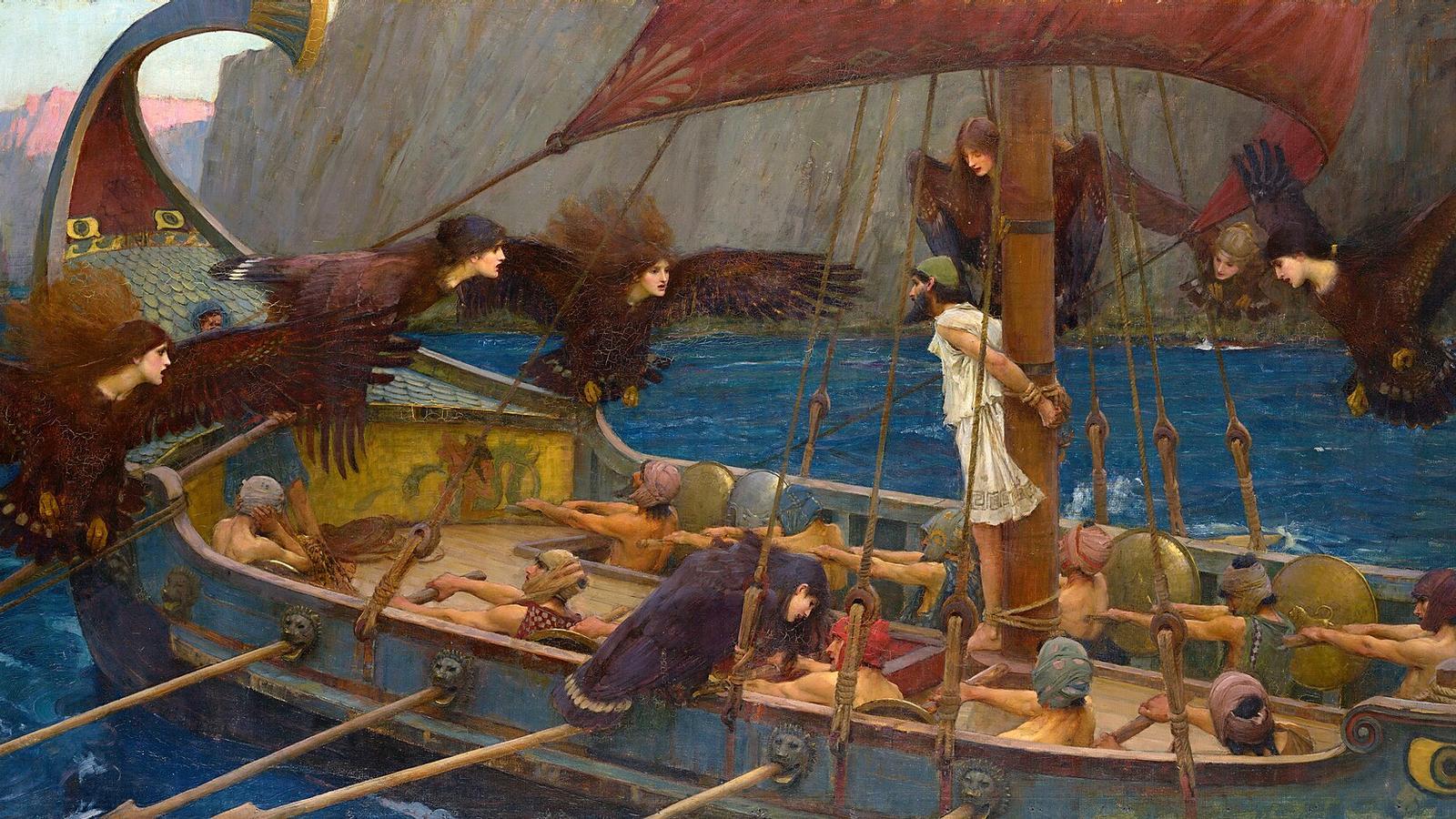
It is Odysseus himself who, transformed within the work into an aede – a term that designated Greek rhapsode poets –, is responsible for narrating his adventures, among which are the deception of the cyclops Polyphemus, the song of the Sirens – who have the head of a woman and the body of a bird –, the sacrifice of the Sun's cattle, and his relationships with Nausicaa, Circe, and Calypso. "Although Calypso offers him immortality if he stays with her on the island where she lives, Odysseus prefers to return to Ithaca to reunite with Penelope and his son Telemachus – says Sabaté –. Initially, the most striking and attractive part of the Odyssey" is that of the adventures, but the cantos that take place in Ithaca are fundamental. For the adult reader, they may even be more interesting." In relation to highlighting the adventures in the epic poem, Carles Riba considered it, in the prologue to his second translation, an attempt to bring the classic "to the marketplace", and added: "To snatch the Odyssey" from the monopoly of more or less learned Hellenists, fine; but to deliver it to the insensitivity and banality of mere novel devourers [...] it is difficult to resign oneself to it".
Allows rediscovering a different hero
Odysseus represents "a different kind of heroism than that of Achilles, the great protagonist of the Iliad", says Aluja. He shares with Achilles skill on the battlefield, but unlike him "he does not renounce other war tactics, such as ambushes, camouflage, or the use of the bow, which for warriors of strength is the weapon of cowards".
"Odysseus is a master of dissimulation and deception", comments Sabaté. The fact that he is a man "of great cunning" –according to Riba–, "of a thousand faces" –in Joan F. Mira's 2011 translation for Proa– or "very versatile" –in Sabaté's version– allows him to overcome all obstacles, human and divine, during the ten years that separate him from the end of the Trojan War and his arrival in Ithaca. "When he wakes up on the beach of Ithaca, Athena [or Athene], his protector, transforms him into a miserable beggar, so that he remains unnoticed by everyone, friends and enemies alike –writes Jaume Pòrtulas in the prologue to the latest reissue of the Odyssey translated by Carles Riba in the Bernat Metge Essencial in 2019–. Finally, once at home and among his own people, the man who had been [...] No one will manage to recover, thanks to a series of structured and successive recognitions, the various facets of his personal and social self. He thus returns to his full self. We could say that he rebuilds himself: he rebuilds himself as the father of Telemachus, as the husband of Penelope, as the son of Laertes, and also as the king of Ithaca".

The excellence of Catalan translations
There are three versions of the Odyssey by Carles Riba: between the first, published by Editorial Catalana in 1919, and the last, by Alpha – from the Col·lecció Bernat Metge – in 1953, more than three decades passed. "The mark he has left on contemporary Catalan literature has been important, although perhaps more among poets, translators, and other writers than among the general reader," admits Jaume Pòrtulas. When Joan F. Mira published his Odyssey in 2011 with Proa, he aimed "not to embellish the text, nor to try to improve it, nor to pretend to make it more poetic and more elevated". Like Riba and Sabaté, but unlike Joan Alberich's version, he translated it in verse. "Translating Homer in prose is perfectly respectable, but it can never be read, perceived, or felt like a translation in verse – Mira argued at the time–. Never, in any way. And translating Homer in verse means, if it is materially possible (in some languages it certainly is not), reproducing the hexameters of the original".
Pau Sabaté has wanted to follow "Riba's lead": "I have tried to capture the passion for genuineness. Riba is sometimes even colloquial. He also aspires to be very literal, to convey the strangeness of the original Greek text, which sometimes seems like an incantation. I have tried not to accentuate this point". The translator has avoided "modernizing the language of the Odyssey to the extreme". The reader interested in a solid prose version – based on the English adaptation by Samuel Butler, author of Erewhon, in 1900 – can turn to the recent edition by Blackie Books, which features the translation by Xavier Pàmies.
A poem full of women that announces patriarchy
As Dolors Miquel points out in her epilogue, the Dolors Miquel points out in her epilogue, the Odyssey opens and closes with the goddess Athena. Throughout the poem, women have "a more relevant role than in the Iliad", says Aluja. "Although Calypso wants to keep Odysseus on the island, she eventually lets him go, and it is Circe who explains all the obstacles he must overcome to reach Ithaca — she adds—. Penelope awaits him there, who has managed to postpone the decision to choose a suitor with the cunning of undoing at night what she weaves by day. Until the job is finished, she will not remarry". Miquel explains that beneath this female presence beats "the beginning of a phallocentric truth obsessed with hiding what is mysterious, what is feminine, uterine and unique". She recalls that Greek thought, appealing to the philosopher and psychoanalist Luce Irigaray, transmits a "world that man has constructed to supplant adherence to the maternal world, to assert himself against the mother, against participation in her world". In the Odyssey, "everything is directed towards the definitive establishment of this expanding civilizing ideology": patriarchy.
It will allow you to go to hell and back
Besides proposing a journey through various Greek islands and allowing the reader to learn about their fauna, the Odyssey is a poem rich in mentions of trees and plants. "The names of animals and plants are always a thorny issue when translating ancient literature –comments Pau Sabaté–. The flora and fauna of the eastern Mediterranean, although not radically different from ours, do not entirely correspond to that of the western shores either. A second problem is that the temporal distance and the limited nature of the sources have made certain denominations confusing". Rack his brains, Sabaté has concluded that the "double thicket" under which Ulysses takes refuge on the island of the Phaeacians is formed by a part of olive tree and another which, instead of being broom or aladern, must be wild olive. "An aladern and an olive tree growing together do not quite make a double thicket –he adds–. The usual cultivation technique for olive trees was to graft them onto wild olive trees to make them fruit faster".
One of the riskiest adventures presented by the epic poem is the journey to Hades, the name by which hell was known in ancient Greece. "Odysseus goes there twice. The first is explained in the eleventh canto, and among the most memorable passages is the reunion with Achilles, the hero of the Iliad", recalls the translator. Achilles laments having had to pay the toll of death to achieve glory among the living: "Do not try to console me for death, Odysseus, do not comfort me! / I would much rather earn a living on earth / hiring myself out to a man without inheritance or much to live on / than be the king of all the dead, of the perished". Odysseus learns his lesson and ends up returning home.
