The nights of the flaming containers
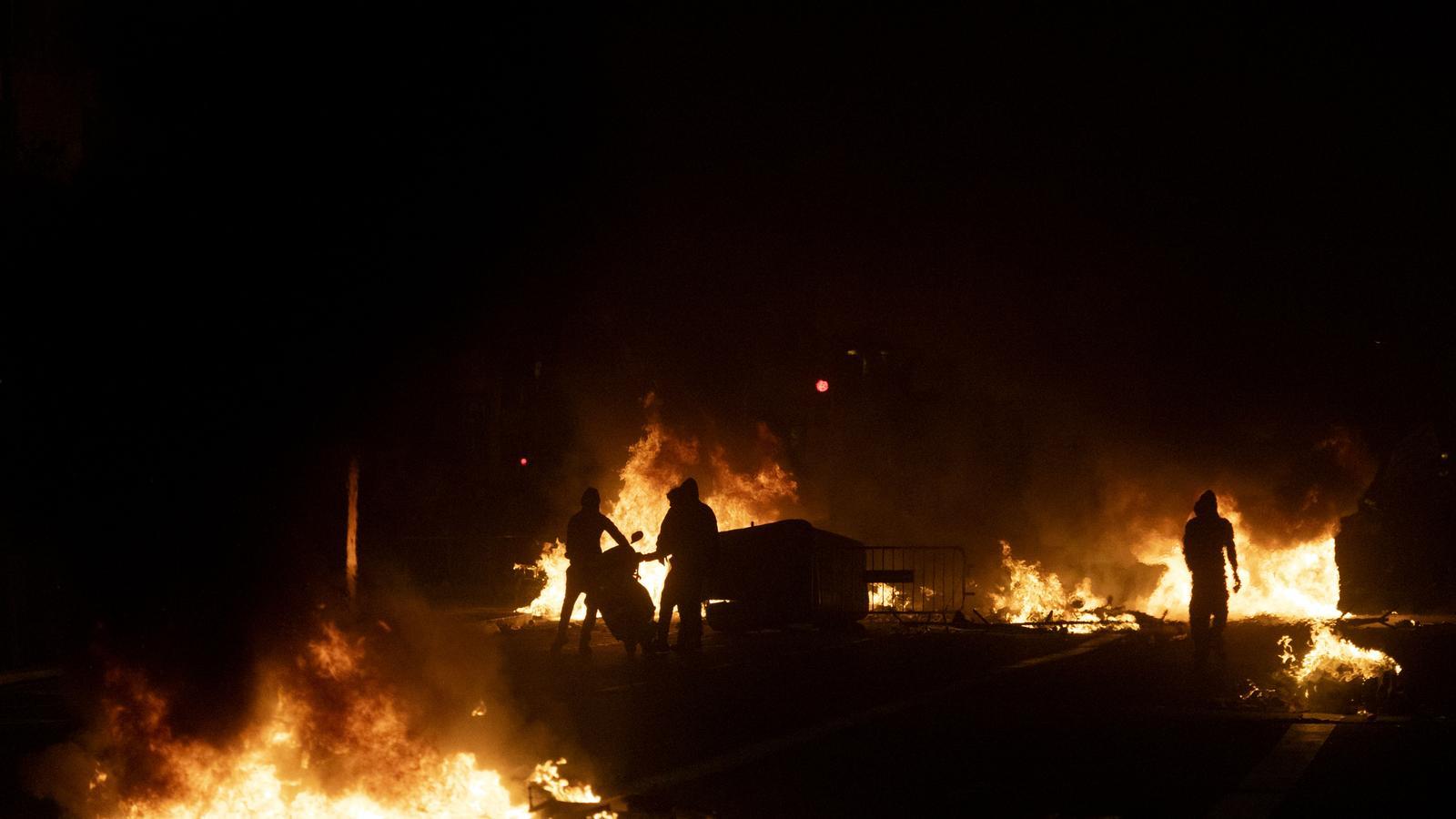

I did not like the night of flaming dumpsters in Urquinaona on October 18, 2019, and I have not liked the one on November 11 on the Ronda de Sant Antoni, the beloved neighborhood of my childhood, where I have seen, with joy, how the neighborhood mobilized to save from the fire the plane trees that give it character. The burning – and the combat pyrotechnics – do no favor either to Barcelona or to the good causes with which the burning is associated.
Barcelona has an image that has been a source, in the words of the Consell de Cent in the 15th century, of “profit and fame” or, of the City Council in the time of the 1888 Universal Exposition, of “prosperity and renown”. It must be taken care of. It is quite true that Paris also suffers from riots, but, for reasons that do not need to be explained, its resilience is much higher than ours. They do not suit Barcelona. They do harm.
Regarding the causes, it is necessary to differentiate between Urquinaona and Sant Antoni. That of Urquinaona, fully legitimate, was to combat the repression of the independence movement, and it enjoyed support that went far beyond strict independence supporters. But we could have spared ourselves the flames. It would have been better if the memory of this movement had been exclusively that of the great peaceful and exemplary demonstrations, without papers on the street and without fire epilogues.
I understand that in the disturbances of the last month we must differentiate those of October 24th, the day of the Blocus looting, from those of November 11th, the day of the general strike for housing. In the Blocus phenomenon, I cannot help but see, as a key, a globalization of networks that offers possibilities to the enemies of the EU. It would be surprising—and an implausible sign of incompetence—that in the context of the war in Ukraine, such an accessible and profitable channel for destabilization would not be used.
In contrast, on November 11th, the uproar was caused by what are usually called anarchist and anti-system groups. They did not exceed 500 people, but on the eve of a general election, they may have harmed the aspirations of the general strike organizers. Especially if they do not distance themselves from them.
I am writing this article because it surprised me that, when asked about her reaction to the burning of dumpsters and other violent actions, the representative of the Tenants' Union replied “it’s not our business.” The question was evidently an invitation to condemn the behavior of the arsonists. Not doing so is a serious mistake. In this, I agree with Councilor Parlon. The cause of the Tenants' Union is one of the most worthy we can imagine. One may agree more or less with the specific measures they propose to alleviate the suffering caused by the lack of housing, but personally I must say that, given the drama of housing, I prefer to live in a country where social awareness has generated a Tenants' Union than one where this is not the case. But associating oneself, even if by omission, with the flames has no benefit for the cause; it can only subtract support from it. Great protest movements around very basic needs have always defended themselves better through non-violence. And what is more basic than housing?
For the cause of the Tenants' Union, the timing is also quite unfortunate. With elections two weeks away, large mobilizations can have disproportionate electoral effects, whether positive or negative. They will be negative if the average voter's perception is one of disorder, a fact I observed in my youth following two experiences lived from a distance. One, the French May of '68, a very broad movement with "imagination to power" as its star slogan. But which ended in June with an overwhelming victory (354 seats out of 487) in the elections called by General De Gaulle, president of the republic. The other, the 1972 US presidential elections, the focus of the efforts of the anti-Vietnam War movement – with episodes of great tension like the Democratic convention in Chicago – but which ended in November with the election of Richard Nixon, a Republican, and the defeat of the movement.
Both in the French May and the American summer, the central core of the mobilizations was reasonable, but the peripheral disorders weighed on the voters. Today, among us, the central core of November 11th is also reasonable, but Blocus and Sant Antoni may weigh on the voter. My unsolicited advice to the Tenants' Union: make it all easier for yourselves by clearly distancing yourselves from the night of the flames.
