Jokes bring water

-
CAT -
CAST
According to an ancestral Catalan saying, “les bromes porten aigua” (clouds bring water). It is semantically interesting because it plays with the two meanings of the word broma: the meteorological one, which is equivalent to fog/clouds, and the jocular one, in the sense that they can make one cry or, more broadly, be unpleasant or have negative consequences. Let us see how we apply the proverb to two emails I have received, both referring to a newspaper from the same day.
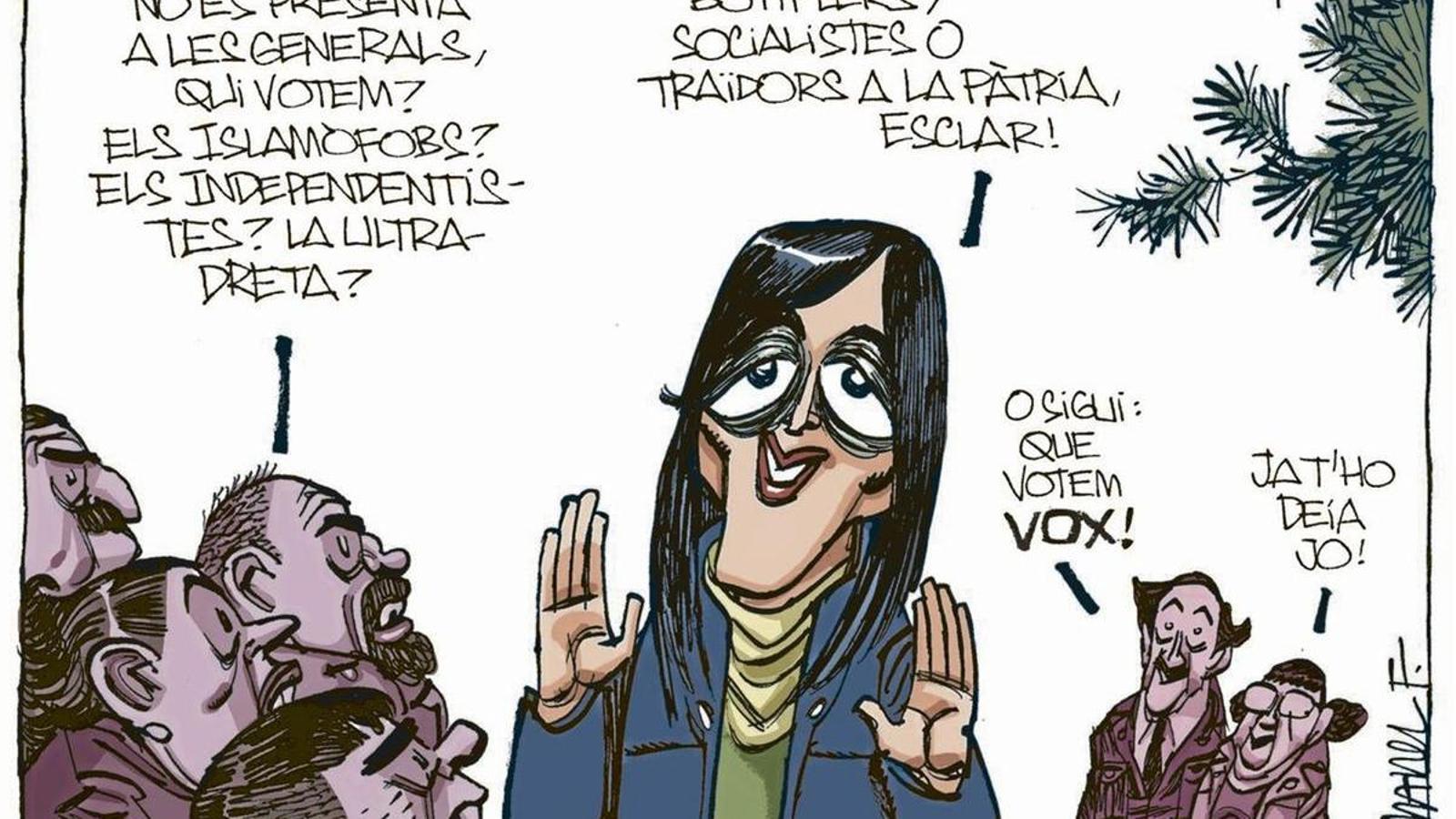
Reader Marta Pujol writes to me: “I have doubts about whether I have really grasped the meaning of Manel F.'s cartoon on page 4 of today's newspaper, October 11th. At first, I felt indignant and insulted because it seemed to me that Islamophobes, the far-right, and pro-independence supporters are all being lumped into the same bag. I confess to being a pro-independence supporter, but I am very far from aligning myself with the theses of AC, PP, and Vox, and in no case would I give them my vote. I repeat, perhaps I have misinterpreted the joke; in any case, I would appreciate a clarification from the cartoonist.”
For his part, subscriber Jaume Molsosa refers to a comic strip by Elva Lombardia on page 23 of the Ara Diumenge of the same day, the 11th. He says: “It shows a woman slamming a man’s head into the toilet bowl while shouting an insult. It is a scene of violence that, shown in reverse (a man slamming a woman’s head into the toilet), would certainly raise the angry protest of some observer. This, violence exercised by a woman against a man, even if it is a joke, is a resource that is becoming more and more frequent in audiovisual media. I think we need to reflect on it”.

As graphic humor is a matter of opinion journalism that is very well protected by freedom of expression, I understand that this Ombudsman can exonerate the authors. I have, however, asked Manel Fontdevila if he would like to have his say, given that the reader is asking him for a clarification. He, very kindly, has replied:
“In general, I don’t like explaining the meaning of jokes, because that is the way for them to lose any shred of humor they might have. I don’t really know what to answer the reader. I understand that the characters who ask whether to vote for an independentist, an Islamophobe, or the far-right to Sílvia Orriols are Aliança Catalana voters, and they ask it precisely because the party has decided not to run in the general elections. And AC, in my opinion, does put independentism, Islamophobia, and—even without openly acknowledging it—the far-right in the same bag. If the reader is not an AC follower, then the joke is not about her and, therefore, she should not worry. The fact that the independentists of AC are Islamophobic does not in any way mean that all independentists are.
Maybe I didn't explain myself well enough with the joke –he continues– and I am sorry if there are more people who have felt confused. In my defense, I want to say that I have been making jokes for many years, at ARA and in other places, and I have never played the card of considering the independence movement a racist or supremacist movement, even though it is a quite common argument in certain environments. I believe in the right to self-determination of peoples and the independence movement is, therefore, a completely legitimate movement.
A different matter is that –concludes Fontdevila–, in recent years, within the independence movement there are openly racist people, a regrettable trend that horrifies me but that I also cannot pretend does not exist. The idea behind these jokes is to denounce it, in fact”.
Graphic humor, it has been said, is a parcel of opinion journalism, and as such is constitutionally protected. And I would say that it is doubly so, because it handles two languages, the verbal and the visual, and, to top it all off, in a humorous code beyond realism that allows for the game of pushing boundaries. The European Court of Human Rights (ECHR) stated in a 1976 resolution that freedom of expression also protects ideas that 'offend, shock or disturb the State or any sector of the population'. The same body, in a 2007 proceeding, considered that 'satire is a form of artistic expression and social commentary which, by its inherent characteristics of exaggeration and distortion of reality, naturally aims to provoke and agitate'.
Graphic humor has a long and rich tradition in our country; I refer to the studies of Doctor Josep Maria Casasús, master and colleague at ARA, author of Periodismo irónico (2000), and I note the monograph Revistes d’humor a Catalunya, 1972-1992, by Joaquim Roglan, published by the Journalists' Association. If we zoom in on the Transition, the magazine Por Favor was seized on five occasions, and Hermano Lobo twice. For the annals of the newspaper library, I must not fail to mention the benchmark magazine L’Esquella de la Torratxa, which between 1872 and 1939 hosted in its controversial and polemical pages such excellent creators as Pere Calders, Antoni Clavé, Juan Gris, Joan G. Junceda, Apel·les Mestres, Isidre Nonell, Ricard Opisso, Picasso, Tísner (Avel·lí Artis-Gener)... With a long string of judicial proceedings, censorship, and fines.
The illustrious guild of cartoonists –a word accepted by the IEC– has seen it all and, with its pushing of freedom of expression to its very limits, has not only suffered administrative and criminal repression, but has also endured attacks such as those on El Papus, one dead and seventeen injured, in 1977, and that of Charlie Hebdo, twelve dead and eleven injured, in 2015. Sometimes, the reader's defense must appeal to their understanding of being one by elevation, defending freedom of expression in its most exposed areas, where the water of jokes can become a storm of sad current events.
It will not be me now who corrects either Fontdevila or Lombardia, who in the comic we are discussing makes precisely a reflection on their craft, but I understand and appreciate the comments from Marta Pujol and Jaume Molsosa, which should make us reflect from their very affable tone, and the Ombudsman must give public voice to their comments and must take care both to ensure not to put all the colors of independence—and in general of every political idea of broad spectrum—in the same bag, as well as to observe with respect any kind of gender sensitivity. The recently presented (May 19th) Guide to Inclusive Journalism. Intersectional gender perspective in the construction of media messages, promoted by the Institute of Women, attached to the Ministry of Equality, will be useful in debates on the subject. Lucía Quiroga, author of the text, referred during the presentation to the “reversibility rule”, a very interesting second chapter, with incisions on humor, which raises “a simple exercise that proposes asking oneself if a topic, a headline or an approach would be equally valid if the subject of the information were a man. If by reversing the gender the formulation turns out to be ridiculous or inappropriate, the issue is also inappropriate if the subject is a woman”.
POST SCRIPTUM. The rigorous topicality of the time change makes me hasten to record the criticism of reader Lluís Felipe Lorenzo García regarding last Wednesday's headline “Winter time returns, with one more hour of sleep”, which “surely excludes more than a million Catalans from all the Catalan Countries who will work during the night”. He is absolutely right and it will have to be seen if, as the reader also points out, those who work will be paid for the extra hour; I know for a fact that there are some who do not get paid for it.
The Reader's Ombudsman takes note of doubts, suggestions, criticisms, and complaints regarding the newspaper's content in its digital and print editions, and ensures that the treatment of information is in accordance with ethical codes.
To contact the Reader's Ombudsman you can send an email to eldefensor@ara.cat or record a message of no more than one minute to the WhatsApp number 653784787. In all cases, identification with full name and ID number is required.
