They say that without chips there is no paradise
Barcelona Supercomputing Center: a cathedral full of supercomputers

-
CAT -
CAST
"Eoooo! Eoooo!", I say out loud to see if it echoes. And it certainly does! "I used to teach computer science in this chapel", says Sergi Girona, who studied for his degree – and doctorate – in computer science at the Universitat Politècnica de Catalunya (UPC). Luckily, the professor had a microphone (but the naughtiest students would sometimes sabotage his lesson: they’d make a radio station’s voice audible instead of his).
Sergi Girona is the Operations Director of the Barcelona Supercomputing Center - National Supercomputing Centre (BSC-CNS). No, Sergi does not belong to the Girona family, a lineage that settled to "spend their summers" in this area of Barcelona’s Pedralbes neighbourhood. One of its members, Manuel Girona – banker, mayor of Barcelona, promoter of the Urgell canal... and much more – commissioned architect Josep Oriol Mestres in 1860 to design a large country house for "him" to enjoy cooler summers than in the still-walled city. It is Torre Girona, which is now part of the UPC’s facilities.
The chapel where I am now, annexed to Torre Girona, was designed later, in 1949, by architect Joaquim Lloret, known primarily for designing Clínica Barraquer and the large residential building El Rancho Grande, on Barcelona’s Via Augusta, among many other works.
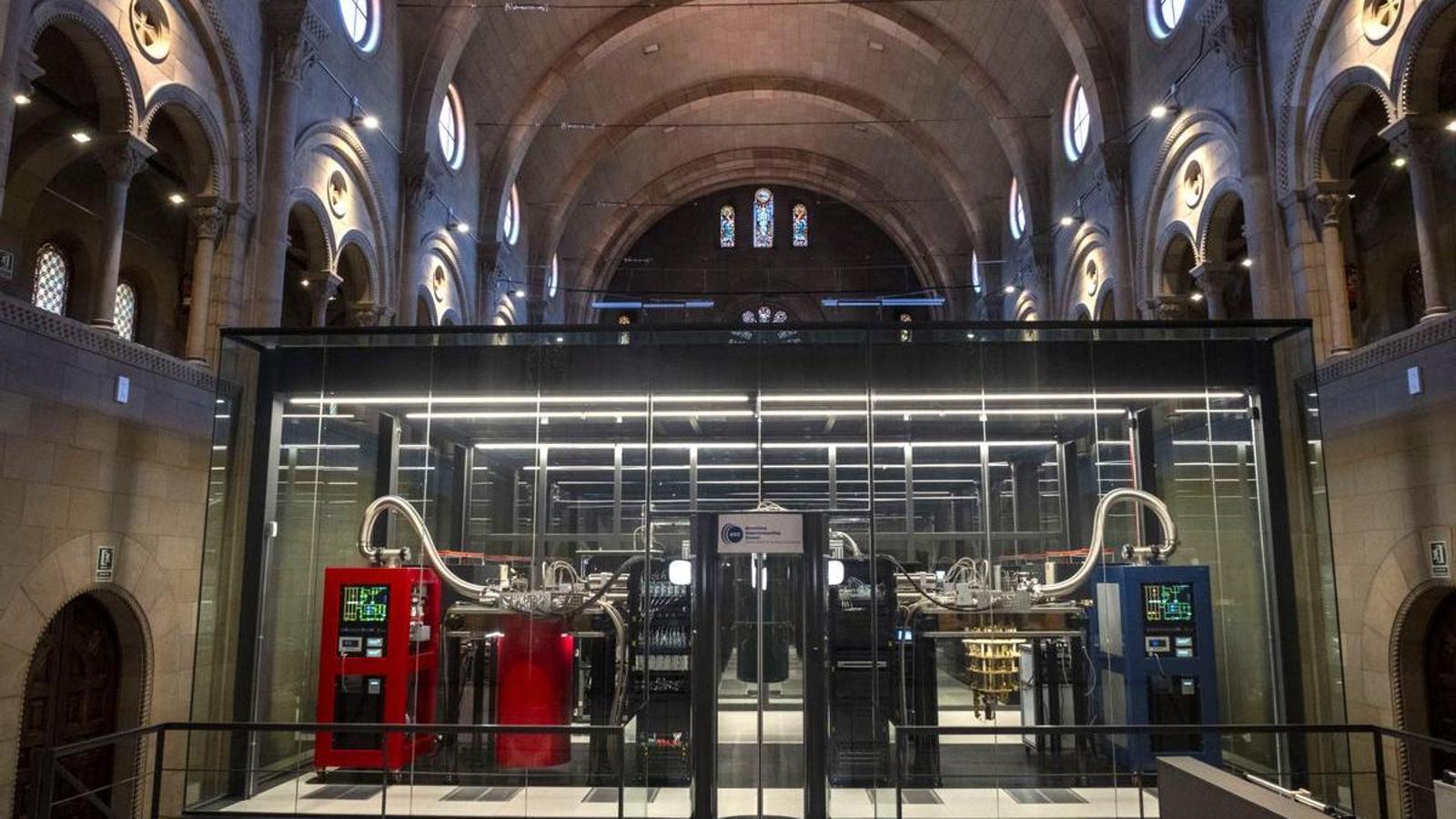
Inside this chapel were the first versions of the MareNostrum supercomputer, up to MareNostrum 4, which until a few years ago was extremely powerful. But as we know, in the world of technology, everything ages quickly. For highly complex computational challenges, it would now take too long to process information. That is why there is now, in a new area, MareNostrum 5. In the chapel, quantum computers have been installed, designed to solve problems that are unachievable for classical supercomputing.
"In 2004, when we installed MareNostrum 1, which was the most powerful supercomputer in Europe and fourth in the world, we needed a tall building, partly so it could be cooled by air", Sergi tells me. "And since this chapel was empty – and deconsecrated – it seemed like a good place for the supercomputer". In 2017, it was designated by vote, convened by DataCenter Dynamics, as the most beautiful data centre in the world.
Today, with too many empty churches, it is normal for some to have new uses, even if they are daring. In different parts of the world, some have become a bookstore, a skate park, a climbing wall, a nightclub, a luxury hotel, a car and motorcycle repair shop...
The quantum computers in this chapel are protected by a huge glass case, which allows temperature control inside. I am in a futuristic, novel-like setting. It appears in "Origin", by Dan Brown. I try, unsuccessfully, to find in this temple any sign that it has been a place of Catholic celebrations, while Sergi explains to me that it was prepared as a lyrical concert hall, and a false ceiling was built to improve its acoustics. But they have removed it. The initiative that has not prospered: there are no concerts.
On the other hand, the BSC is a very profitable investment, and with social use. It is a public center that serves professionals, from here and abroad, in fields as diverse as astronomy, biomedicine, physics, engineering, chemistry, earth sciences... And I'm leaving out many.
Next to the chapel there is a stone sculpture of a kneeling man, which may look like it was made many years ago. Like the chapel, which at first glance might seem Romanesque if you are not told anything. I notice the date of the sculpture: 2020! The year of the terrible pandemic. It is dedicated to Mateo Valero, the soul of this successful project and director of the BSC, who often repeats this phrase: "Without chips, there is no paradise". Agreed, technology is an indispensable tool to solve a good part of the world's problems, to advance towards sustainability, for research and well-being... But I think happiness does not depend only on all this.
"We promote open science: there is a committee of experts that evaluates projects every six months. Of every three, we select one, the best one. The others do not enter, we discard them". Yes, it is a good selection system. Even if all three are very good...
We are in front of MareNostrum 5, in an area of the Barcelona Supercomputing Center where there is a large expanse of computers, with lights that turn on and off. "The ceiling here is much lower than in the church," I observe aloud. "Yes, the cooling systems have improved a lot and do not need so much space," Sergi tells me.
Supercomputers like MareNostrum 5 not only perform mathematical calculations, but also create hypercomplex simulations. For example, in the field of climate, they simulate models of global climate change evolution. And in medicine, they develop "digital twins" to test drugs and treatments. If I have leukemia, they make a digital duplicate of me and run tests.
One of the things these supercomputers make possible is to do a great zoom, see everything much, much closer. "Why was Dr. Ramón y Cajal good? Well, because he had good microscopes," says Sergi.
It's late morning. A few researchers from other countries are already having lunch. That's why we walk without having to dodge many people in the corridors. But at other times this center is quite busy. It has grown enormously. It has gone from having 80 employees at the beginning to the current 1,400. One might think that so many computers don't require much staff. So, if computers do the work, why is more and more people needed? To think, manage problems... And foresee the future.
Objective: reduce Europe's technological dependence"We aim to develop and use European technology. We are going back a bit, but it is our bet," emphasizes Sergi Girona, director of operations at the Barcelona Supercomputing Center - National Supercomputing Center (BSC-CNS). "We want to become technologically sovereign and not depend on the USA or Asia." This world-renowned center continues to innovate in science and technology in a rapidly changing world.

