"Pain, pain for me alone": the intimate story of one of Lorca's last loves
The journalist Víctor Fernández recovers the unpublished notebooks of the 'ABC' critic Juan Ramírez de Lucas
-
CAT -
CAST
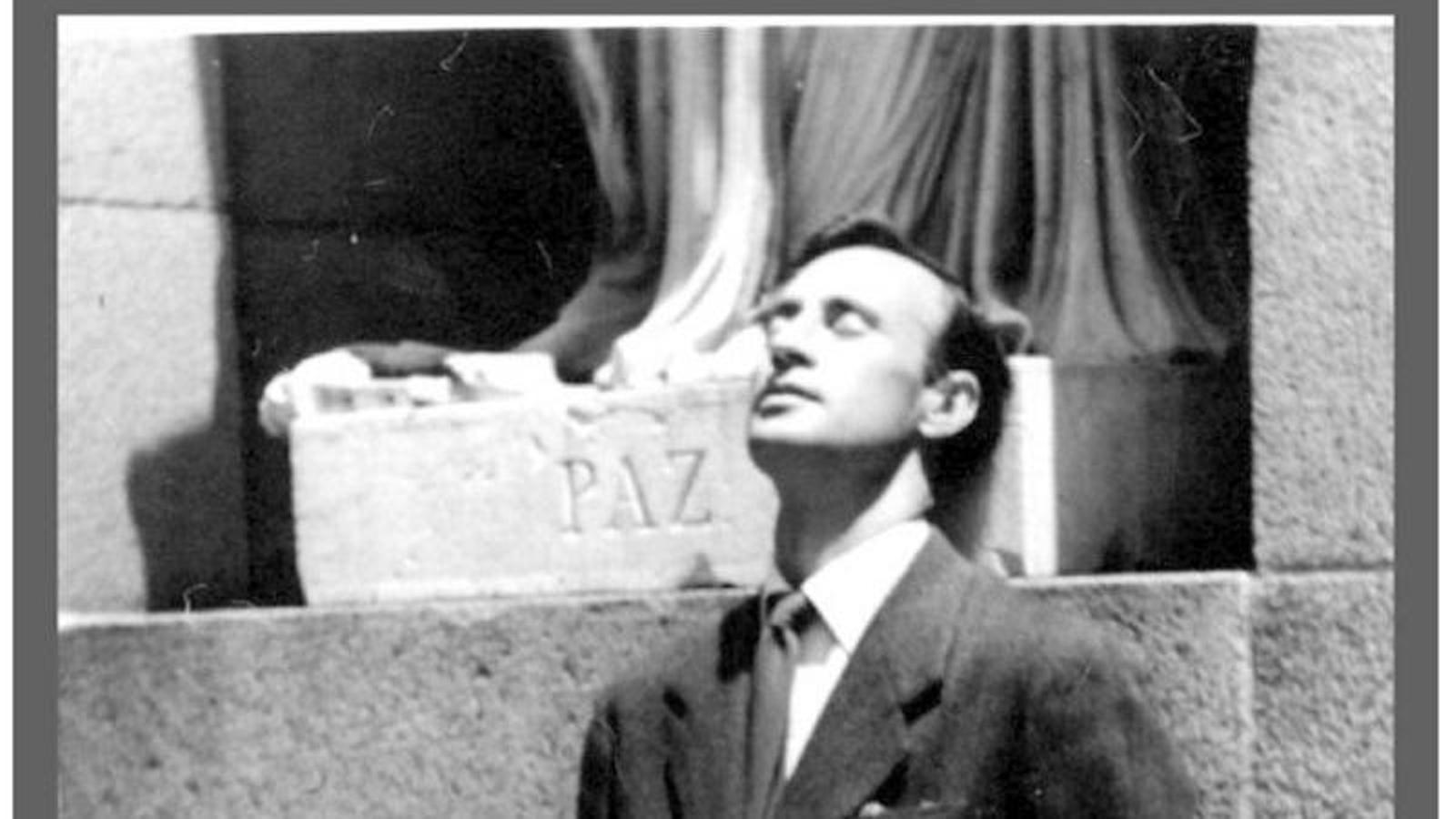
Barcelona“Aquel lindo de cintura / rubio galán sin sombrero, / sembró por mi noche obscura / su amarillo jazminero. / Tanto me quiere y le quiero, que mis ojos se llevó. / ¡No lo puedo mirar yo!”. These are lines from a poem that Federico García Lorca wrote on the back of a receipt from the academy where the “rubio galán” was studying. Lorca loved deeply, and was loved, and it is difficult to specify who his last love was. But what is certain, according to journalist and biographer Víctor Fernández, is that that blond man from Albacete was Juan Ramírez de Lucas (Albacete 1917-Madrid, 2010), and that the poet and that nineteen-year-old young man shared an intense love story during the last months of Lorca's life, just before he was assassinated at the Víznar ravine.
After many years of research, Fernández has recovered the manuscripts, letters, drawings, and poems that Ramírez de Lucas left behind, and talks about them in Juan Ramírez de Lucas. Recuerdos. Breve historia de un amor (Seix Barral), a book made with the Hispanist Christopher Maurer. During the conversation with ARA, Fernández receives a message on his mobile phone from an archivist in Granada asking if an unpublished manuscript signed by the poet could be authentic. Lorca, to whom he has dedicated many years, continues to haunt the researcher.
“What this book does is fulfill the last wish of Juan Ramírez de Lucas, who did not want anyone to steal his story,” asserts Fernández. Before his death, there had already been some leaks: the first to cite the name of Ramírez de Lucas in relation to Lorca was Ian Gibson, following the papers of researcher Agustín Penón, to whom the actress Pura Ucelay had explained that Lorca had noticed that boy during a theatrical rehearsal. But Ramírez de Lucas always refused to speak about it publicly. “Even in 1984 or 1985, when Luis María Anson, then director of ABC, where Ramírez de Lucas worked as an art critic, offered to buy the papers from him to publish them, he flatly refused,” says Fernández.
“Ramírez de Lucas was an extremely reserved man who never openly lived his homosexuality; in fact, he had a partner who knew nothing about his relationship with the poet. When he died, he left a box with the written notebooks to a sister of his who was a nun, with the wish that they would see the light of day once he was no longer there,” says Fernández. But the road to publication was quite complicated. Ramírez de Lucas had many siblings, and nephews, and the whole family had to be in agreement. Finally, the papers were deposited with a notary, and, following the documentary La luz quebrada (2024), by Manuel Menchón—where Fernández and Maurer served as advisors—the heirs authorized the Seix Barral edition.
Volunteer of the Blue Division
Juan Ramírez de Lucas transferred to the manuscript everything he could not express out loud. He explains that it was not love at first sight: “Physically, Federico was not attractive; a somewhat disproportionate head, a stocky and even flabby body, a peculiar and heavy way of walking did not make him what one could call a handsome man. His attractiveness lay in his mind, in his prodigious intelligence, in his overflowing and irresistible charm”.
In his story, there are some contradictions that are hard to understand through the eyes of today: how is it possible that the last love of Lorca, murdered by the fascists, ended up writing with enthusiasm about the Falange –stating in the summer of 1936 that he had found a political ideal there– and enlisted as a volunteer in the Blue Division? Precisely, Ramírez de Lucas is also the recipient of one of the last letters that Lorca wrote before dying.
“Berlanga also went to the Blue Division, and he was not exactly a right-wing man. It was a way to clean up his resume, to start from scratch”, says Fernández. Ramírez de Lucas came from the intellectual and theatrical environment of the Republic, and he carried with him a terribly violent relationship with a very conservative father who, upon discovering that he was a friend of Lorca, wanted to beat him. According to the biographer, the enlistment was an escape.
After the war, he pursued a career as an art critic at ABC and La Gaceta Ilustrada. He never married and always carried the grief for who was his first great love. “I could not even cry, nor show myself before other relatives who would have shared my anguished pain. Pain, pain for me alone,” wrote Ramírez de Lucas. He also imagined having been able to share the tragic final moments of Lorca before he was murdered by the fascists: “Or the same bullets would have passed through us both, uniting us, also, in death.” To this was added a feeling of guilt: he felt responsible for Lorca having taken that train to Granada, where they killed him. Lorca had asked him to accompany him on the tour of Mexico with Margarida Xirgu, but Ramírez de Lucas was a minor and, therefore, needed parental authorization, which his father categorically denied him. “In 1977, when the art critic traveled to Granada to write a report and managed to get the García Lorca family to open the doors of the Huerta de San Vicente to him for the first time, he spoke with them and photographed them without ever revealing to them who he had been in Federico’s life,” explains Fernández.
The unpublished letter
When they met in Madrid, Ramírez de Lucas was a 19-year-old teenager who had just arrived from a provincial city like Albacete: “For him, joining that amateur theater company and meeting Lorca was like arriving in New York or Hollywood,” says Fernández. At the time, the poet was 37 years old and was living the sweetest moment of his career. That autumn he was to premiere La casa de Bernarda Alba and Doña Rosita la soltera, he had just delivered Poeta en Nueva York to the publisher, and the Romancero gitano was reaching its sixth edition.
Often, the late Lorca has been portrayed as a sad man dominated by the premonition of death, but Ramírez de Lucas's notebooks reveal the opposite. “Here you see a lively, enthusiastic person who is eager to do things and who is enjoying love,” highlights Fernández. “Lorca acted as a mentor to Ramírez de Lucas: he gave him books, and he made him the first reader of La casa de Bernarda Alba,” he adds.
For Fernández, the piece that serves as a certificate of authenticity for this whole story is an unpublished letter that the journalist has located at the Residencia de Estudiantes in Madrid. It was written by Ramírez de Lucas in August 1937 to the musicologist Adolfo Salazar, a confidant of the poet. Desperate a year after the crime, the young man asked about the fate of the manuscript of La casa de Bernarda Alba and celebrated that the book Poeta en Nueva York had been saved. “That letter had not been read by anyone until now, and it proves that everything he explains he lived through firsthand by his side,” concludes Fernández.

