The decisive hour of Felipe VI
Pressured by the government, the king faces the most difficult speech after nine months of silence
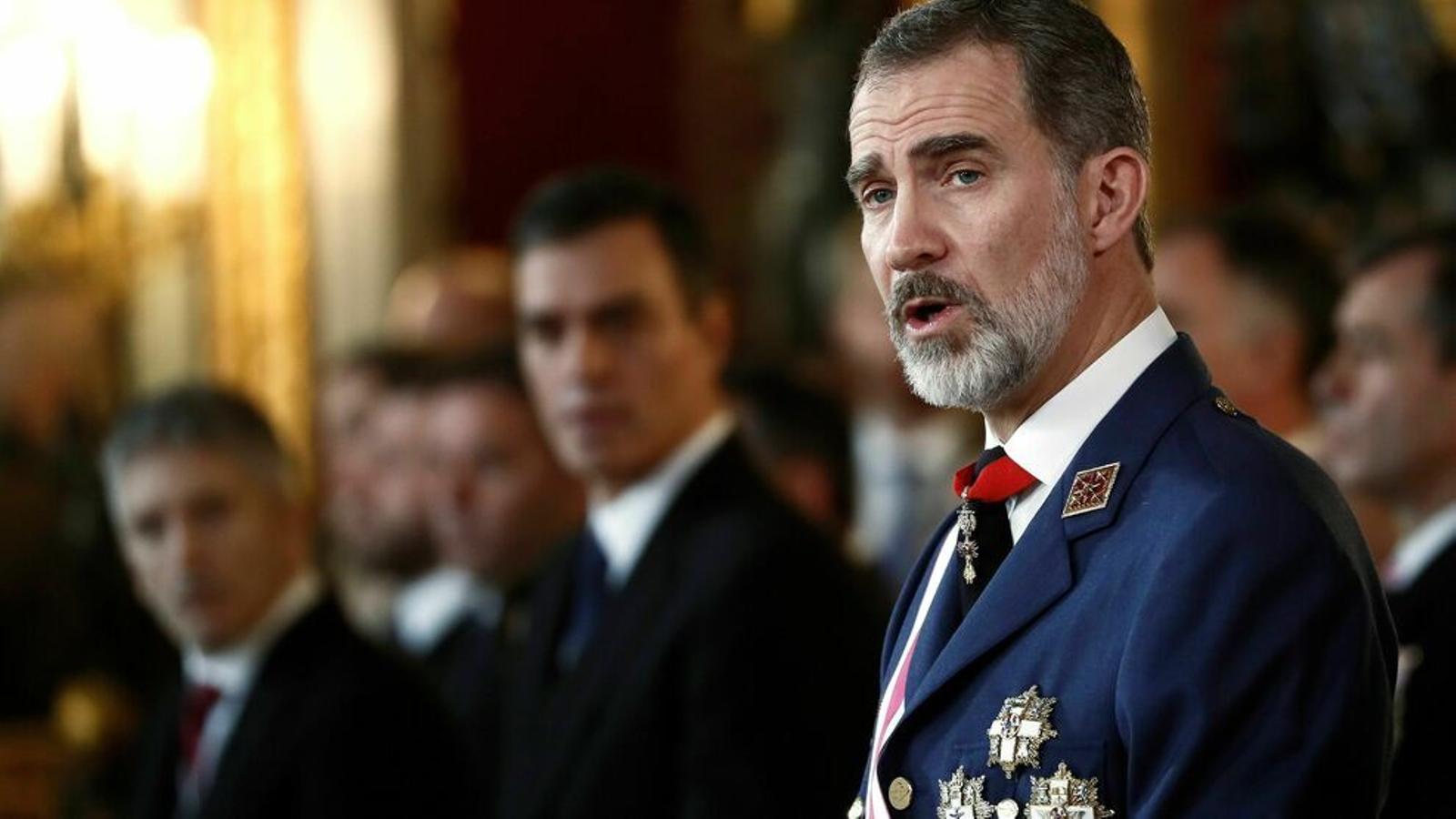
MadridIf we place a magnifying glass on the eight televised Christmas messages of Felipe VI since he was proclaimed King of Spain, only in one, the first Christmas speech, does the name of his father appear: Juan Carlos I. And it does so aseptically: he does not even thank him for the previous reign. After six years as head of state, the word corruption has also been dethroned to the 185th position in the ranking of the most used words in his messages, according to an analysis made by the ARA. He has used it only four times, twice the first year - in the midst of the controversy over the Nóos case - and twice more, without going into detail, in 2017 and 2018.
The Christmas messages are the king's most personal commentaries. If during the rest of the year all his words are written by the government in office, it is on this night that the monarch has the chance to talk about himself. This year in particular all the lights will be on at 9 pm in the Zarzuela. Felipe VI has been silent for nine months, when he sent a note disassociating himself from his father's legacy, on the same day that Spain applied the state of alarm.
La Moncloa is pressing for him to "rise to the occasion" and respond to the alleged corruption of the ex-king, as well as to the pressure from retired military personnel to maneuver against Pedro Sánchez, but the speech at this point is still unknown. La Zarzuela (his residence) maintains the hermeticism and even intends to not pass it on to the press in advance. Normally the speech was recorded, which lasts about ten minutes and in recent years has had a minimal audience in Catalonia - partly also because TV3 stopped broadcasting it -, the day after it was validated by the Spanish government, which has a duty to monitor the messages of Felipe VI. The vice-president, Carmen Calvo, remarked on Tuesday this is "normal" in a parliamentary monarchy.
Felipe VI is facing his most difficult speech. In the face of the scandals of the entire royal family, la Zarzuela decided to close itself up in 2015 after a first year of some transparency. Sánchez assures that the king must be interpreted more by his deeds than by his words, but his government partners, Unidas Podemos, have made a clear call for the monarch to condemn the "irregularities" of Juan Carlos I. The scandals of the emeritus - who has been on the run since August in the United Arab Emirates, from where he has acknowledged a fraud to the Treasury of 678,393 euros regarding the use of opaque credit cards by his family - have worn down an institution whose first mission is to preach by example.
The 'exemplarity' of the Crown
These are the duties that Felipe VI set himself in his proclamation in 2014, which was to serve to try to strengthen a worn-out Crown. In fact, all the King's Christmas messages have always been moralistic. The most repeated expression is "Spain", up to 74 times - his calls for "unity" have been continuous, while the word "dialogue" has only been repeated seven times and is in 77th position - but the bronze medal, with 39 repetitions, is for "we have a duty", closely followed by "I want", in 9th position, that is, to put duties on the Spanish people too.
The current king has broken with his father by giving up his inheritance, withdrawing his annual allowance and removing him from public life, but has not made any public messages of condemnation. He has also not responded to the letters he has received in recent days from retired military personnel with more than belligerent language. In this sense, we must also be attentive to the image he transmits on the 6th January, when Military Easter is usually celebrated in the Royal Palace. The Ministry of Defence has tried to play down the words of a group of "cadaverous octogenarians", but other sectors of the Spanish government are concerned that, fuelled by the triple right, these military men are pressing to reverse progressive measures. EH Bildu's leader, Arnaldo Otegi, pointed out this week in an interview with Público the possibility that the maneuver of the retired military will be used - like the 23-F coup d'état was - in order to try to legitimize a Crown in disrepute.
"La Zarzuela has in its hands the power to face the situation and turn its communication policy around in a forceful way. It has to start giving explanations, making a policy of the evidence and answering questions that Spaniards ask themselves, or else continue with its strategy, which consists of denying reality", the president of the Association of Political Communication (ACOP), Verónica Fumanal, reflects to Efe, who considers that the Crown is suffering "a historical reputation crisis". In turn, political scientist Ignacio Martín Granados believes that it would be a "mistake to avoid any direct reference" to the issue of the ex-king, and therefore recommends the King to act with "empathy".
These are duties that, for practical purposes, have been placed on him by all parties. Even the PP, which refuses to talk about the scandals of Juan Carlos I and remains unmoved in emphasizing the importance of his reign. The head of the opposition, Pablo Casado, predicted that the message of Felipe VI "will not disappoint". Ciudadanos have also pointed out that the monarch would have to give explanations for the ex-king's conduct, who at the last minute and, as explained by the ARA, after being hospitalized with covid-19, has given up returning to Spain for Christmas, where he has three investigations pending in the Public Prosecutor's Office.
