Ada Castells: "Who has it interested that literature becomes pure entertainment?"
In the novel 'The Anthropologist', the writer imagines a technified world where humans have lost the capacity to love
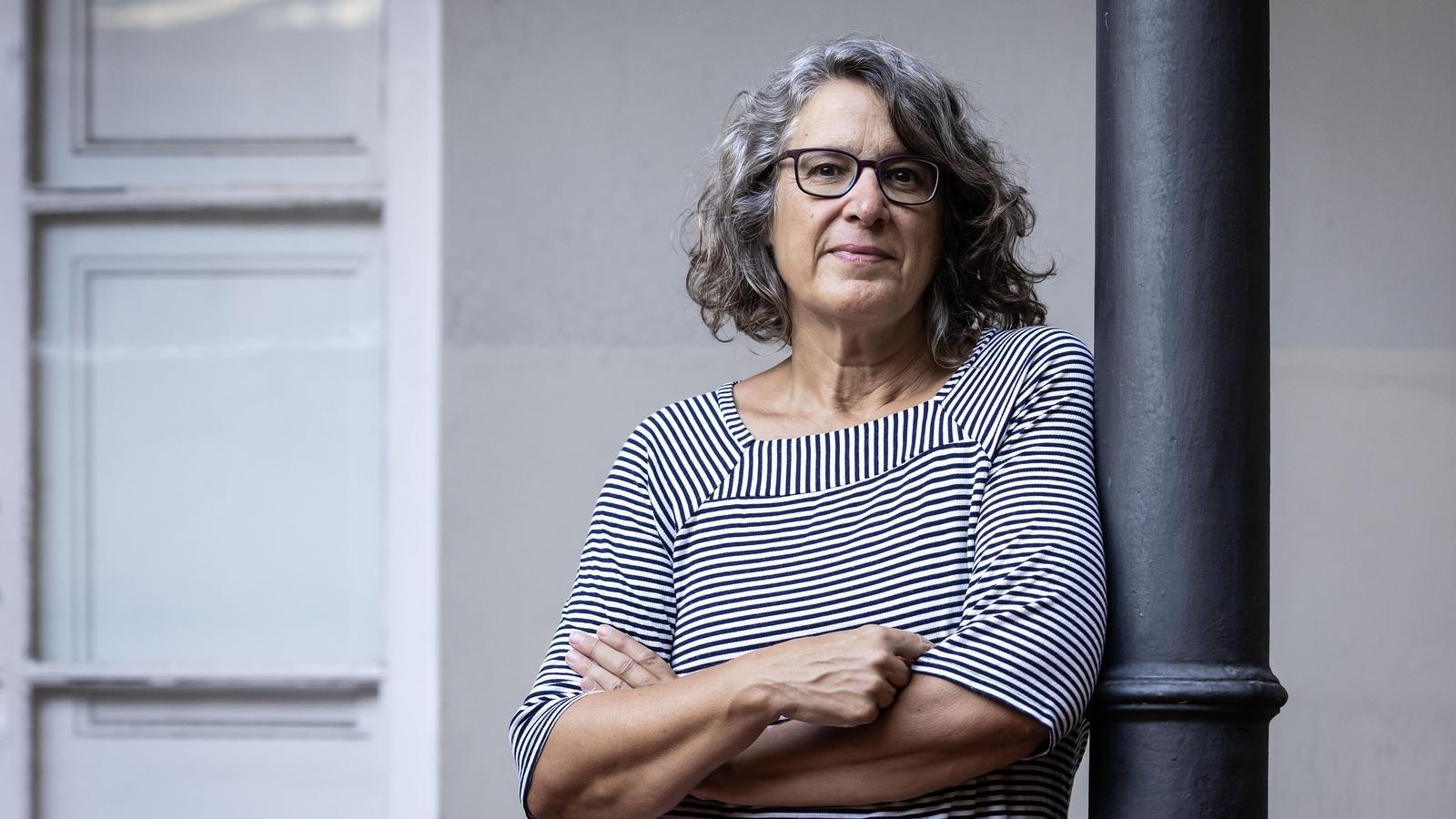
Barcelona"What would happen if we lost the ability to love one another, to help each other selflessly, to touch each other, to raise our children, to feel pity for others?", asks Ada Castells (Barcelona, 1968). The writer has imagined a technified world where machines do everything, even when it comes to giving birth: clamps hold the mother's body, and once the creature is expelled, she doesn't even touch it. Obviously, these are pregnancies where sex plays no role. The baby goes directly to a nursery zone, where machines will raise it. Sílvia, the protagonist of the novel The Anthropologist (Edicions 62), turns everything upside down when her daughter, Maria, is born: she decides to trick the machine and keep the girl. From there, all kinds of doubts and a rebellion arise.
"It is a society very much directed toward production, utility, and performance. They have little space, and everything is aimed at making it work, and it works. They have food, a place to sleep, a job, they feel useful –which is one of the components that we humans want to feel–, but, obviously, they are sad. There is a plague of sadness," says Castells. In fact, they are terrified of sadness, and to know how to combat it, they place a family from the ancient civilization in a laboratory and observe them. Sílvia is the anthropologist who watches them and takes notes. "I read anthropology reports and ethology books because I wanted her to really see them as a group of mammals and study their behavior," adds Castells.
Sílvia has grown up in a dehumanized world. "She analyzes her creature in a scientific way; she is an anthropologist who studies what this piece of meat that has come out of her entrails is, a being that does not speak, that is incontinent, that cries and understands nothing. This being creates rejection in her because it is irrational, not like them, but it is precisely the one that awakens in her the capacity to be human that she thought she didn't have," explains the author, who plays with science fiction to magnify things, but also so that it is all more fun. "I have used adventure, speculative literature, and reflection, and I have felt very free and had a lot of fun, but for me it was also a challenge not to fall into certain clichés and to bring it to my own terrain," she remarks.
The privileges of the richest
Those who live in this apocalyptic world, apparently, are descendants of a privileged class that could afford entry into a luxury shelter. "There is an increasingly extreme hierarchy, and the middle class is disappearing. If only 300 people were to survive on the planet, it wouldn't be us," admits Castells, who investigated and found the Survival Condo, shelters in the desert with all kinds of luxuries for those who can afford them and believe they must prepare for global collapse. "It is a fiction that they can survive, because humans are gregarious, we need bonds for survival. Thinking that only a few will be saved is absurd," opines Castells. "Can you imagine taking refuge with the worst of humanity? With Musk it would be horrific!", she adds.
One of the things that has been difficult for Castells is imagining a new scale of values. The society she imagines perfectly understands that at 40 years old people must die because there can only be 300 people. "We live worried about time, but we have more than we think," she says. In this polished and aseptic society there is neither intimacy nor freedom, but its inhabitants are not even aware of it. They do not have their own thoughts. There is always some little music or controlled landscapes that modulate your mood in a pleasant way. "I didn't want to make a world like that of 1984, I was thinking more of Huxley's Brave New World. Artificial intelligence is so kind, so compliant, it always agrees with you. That the oppressor is so kind is a very perverse thing, and it is what is happening to us. However, Sílvia, the anthropologist, what she does is plant the seed of revolt with her attitude," she affirms.
Castells does not believe that literature should be just entertainment: "I am increasingly clear that novels have a moral duty, something that is going out of fashion, but the question is: who has been interested in literature becoming pure entertainment? Literature has this capacity to make us reflect on what disturbs and worries us". And AI, the author opines, is a danger about which literature must be alert: "There is this new term, which is now used, of cognitive laziness. We have renounced imagining possible futures, a better world, or creating narratives that are not fatalistic," she laments.
