The invisible engineering of the street
How thermal comfort, advanced pavements and the segregation of public space determine the success of active mobility in Barcelona in the face of extreme temperatures
-
CAT -
CAST
When asphalt reaches extreme temperatures in summer or when autumn storms flood the roadway, sustainable mobility faces a challenge of infrastructure and habits. In an inhospitable street, without shade, or on a very wet and slippery street, pedestrians tend to reject walking and the use of bicycles and scooters tends to drop significantly, if not collapse.
In contrast to classic urban planning, focused on the fluidity of the car, urban architecture and its redesign are beginning to conceive public space in such a way that it is guaranteed that the journey on foot or through active mobility is environmentally sustainable and can be practiced throughout the year.
Part of the challenge for current smart cities is no longer installing futuristic screens but transforming the city into a protected infrastructure in a context of meteorological volatility, and adapting the environment by responding to both heatwaves and torrential rains, which are increasingly common, and to the cold.
To ensure that people choose to walk on hot or intensely cold days, urban planning needs precise data. Within the framework of the Climate Plan, the Shade Program focuses on evaluating the thermal comfort of shade structures (trees, pergolas, and bioclimatic covers) along pedestrian routes. Using sensors for temperature, humidity, wind, solar radiation, reflectance, and UVA/UVB radiation, the City Council calculates objective mathematical indices.
According to municipal sources, “these analyses have allowed for an objective assessment of the comfort conditions and solar protection obtained with the actions carried out within the city”. This metric makes it possible to know with scientific accuracy how many degrees of radiant temperature a shadow reduces and what real protection it provides against solar radiation on pedestrian journeys, and demonstrates that urban climate control ceases to be an ornamental issue to become an important design tool.
Tests of draining and reflective pavements
This protection is also sought on the surface where one walks or rolls. In the Les Corts district, the city has set up an open-air laboratory, an environment for real-world testing where materials are not tested in a closed enclosure, but on the streets, under the daily use of citizens and exposed to the threat of real rain and sun.
On the bike lane of Jordi Girona street, an experiment is being conducted with permeable and draining pavement of a linear typology. Designed as a sustainable drainage system (linear SUDS), this material features a porous matrix with high capacity to filter rainwater immediately from the surface and channel it into the subsoil. Instead of allowing water to accumulate and create a continuous and dangerous film, the pavement absorbs this water in real time, which eliminates the risk of aquaplaning and ensures the grip of the tire rubber.
Municipal sources detail that this material “would provide more safety on rainy days for users, thanks to the lamination and the improvement in the absorption of the amount of water it receives”, so that puddles are minimized and falls of cyclists and scooter riders are prevented during storms.
At a short distance, on Martí i Franquès street, the focus is on combating the urban heat island effect. Here, four types of reflective pavements are being evaluated with asphalt formulations with different levels of reflectance, which instead of absorbing and storing solar radiation like conventional asphalt, bounce light and heat back into the atmosphere to prevent the ground surface from overheating. Three cool pavements are also being tested to reduce the radiant temperature of the asphalt: one control, one with recycled glass, and another with industrial slag.
“In the current context of climate change, we must always look for ways to innovate and improve materials and solutions to adapt to the progressive rise in temperatures and intense rainfall. Conducting pilot tests allows us to see both the efficiency of the solutions and their maintenance cost,” explain representatives from the City Council.
For the moment, however, it is a pilot test without a defined schedule to convert it into a mandatory standard in ordinary public works tenders. “Once the data collection phase is finished, the solutions studied will be analyzed, and the results and conclusions will be shared to see the possibility and viability of scaling them up”. The problem is that without real cost data or mandatory deadlines, these innovations run the risk of remaining in a permanent trial state.
Sidewalks reserved for pedestrians and protected bike lanes on the road
Having a draining or cool pavement is not enough if the cyclist or pedestrian perceives insecurity when sharing the space. It is of little use to develop a state-of-the-art pavement (draining or cool) for a bike lane if this lane is poorly located or generates continuous conflict, as has happened for years, when many bike lanes in Barcelona were painted directly onto the sidewalk.
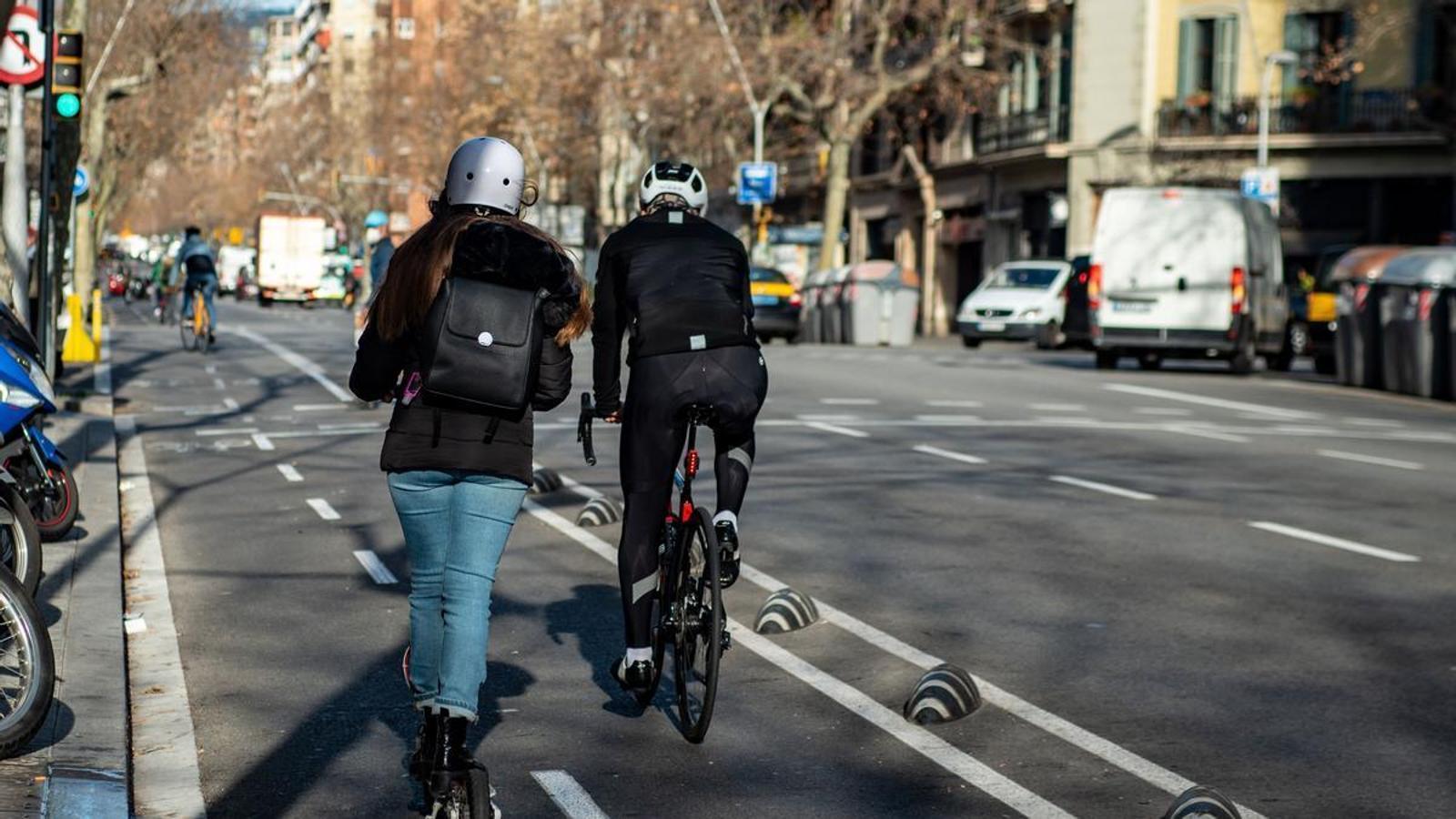
In this sense, the technical improvement of the ground leads naturally to redistributing who occupies each strip of the public thoroughfare for good coexistence. At the beginning of 2025, the latest modification to the pedestrian and vehicle traffic ordinance was approved, which definitively prohibits the circulation of bicycles and scooters on the sidewalk. The sidewalk is reserved for walking and the roadway (with adapted and protected pavement) for active mobility.
To carry out this separation, the City Council applies a strategy based on building bike lanes segregated on the road and isolated from motorized traffic with physical protection elements. The main objective is to preserve the sidewalks for pedestrians. In terms of cycling infrastructure, the City Council is working to improve it, so that bike lanes are segregated on the road. This includes removing bike lanes from the sidewalk and increasing the safety of pedestrians and cyclists with the construction of bike lanes separated from traffic by physical elements.
This segregation measure is materialized in urban transformation projects in areas such as Via Laietana, the Meridiana (in the section between Fabra i Puig and Felip II), the Diagonal (between Glòries and Verdaguer) and Pi i Margall, in addition to specific actions on the streets of Concepción Arenal, Escòcia and Travessera de les Corts.
The official deployment plan for this network sets a calendar for the tendering and execution of new segregated kilometers. Of the more than 57 kilometers of segregated lanes projected for this decade, the City Council details that “10 new kilometers have been completed and 1.6 are currently under construction”. The calendar expects to add 3.2 in 2027, before addressing the main phase of the project: the tendering of 43 additional kilometers distributed between 2027 and 2030.
In this way, the safety of the pedestrian and the cyclist stops depending on the good will of the users to rely on urban design.
Intelligent speed regulation on single-platform streets
If on large avenues the answer is separation with rigid elements, on single-platform streets (where there is no difference between sidewalk and roadway) regulation requires adaptive solutions.
In these spaces the pilot test of the European project Reallocate is inscribed, a research initiative funded by the European Union that analyzes how to manage the coexistence between pedestrians, bicycles, and scooters. In the Consell de Cent superblock, an environment with high citizen influx, “a screen shows warning messages aimed mainly at the drivers of bicycles, scooters, and other vehicles when a high intensity of pedestrian traffic is detected, with the objective of reinforcing the perception of safety and encouraging more prudent behaviors”. When the system detects a crowd of pedestrians, the dynamic alert warns micromobility vehicles to reduce their speed.
Thus, the fusion between thermal comfort in the air, the science of pavements under the asphalt, physical segregation on the road, and intelligent sensorization on unique platforms outlines a new city model. It is a smart city model that seeks to make the street an accessible, safe, and habitable space for pedestrians and micromobility users under any weather condition.
