Why does Europe not celebrate the Democratic victory?
Paris and Berlin warn that the administration remains intact and that, therefore, foreign policy too

-
CAT -
CAST
BrusselsEuropean capitals woke up this Wednesday with headlines about the Democratic wave in the United States Congress. Despite the euphoria and the hopes that this may have generated in some offices, the institutional statements have been rather lackluster and have opted for caution. A caution that shows that despite the electoral setback for the Republicans, no major changes in foreign policy are expected.
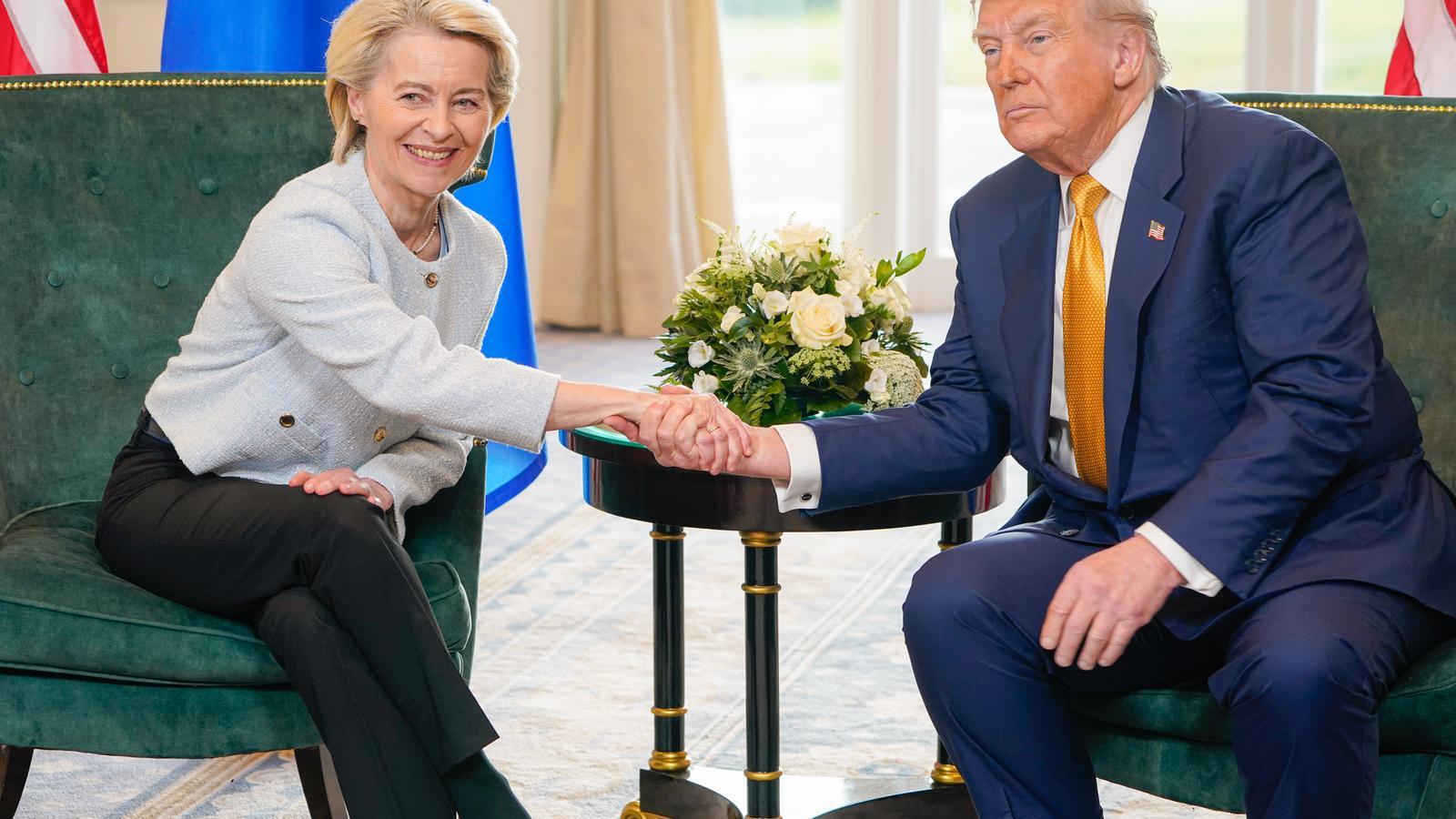
Paris and Berlin, the earliest to react, have provided a dose of reality with the realization that the midterm elections do not change the leadership of the White House and that, therefore, their interlocutor will remain the same: Donald Trump. The German Defense Minister, Boris Pistorius, congratulated the Democrats on a "historic victory," but noted that the American administration will remain intact. Thus, he made it clear that Berlin will continue to cooperate with confidence and will be in contact with both the Democrats and the Republicans.
The French Minister of Finance, Roland Lescure, evoked the same idea. He insisted that Trump remains in charge of foreign policy and warned that he is an "unpredictable" leader. In the view of the Finance minister, the Republican president has two options: "either he decides to rise above the battle," that is to say, he recognizes that changes are needed above all "regarding gas prices, which directly affect people," or he continues as is. "Frankly, this is something that we will have to watch in the coming days," he added.
Brussels, which remained silent until early afternoon, expressed itself with caution, limiting itself to saying that it hopes that the American chambers will continue "supporting Ukraine and pressuring Russia." "American voters have decided," said the head of European diplomacy, Kaja Kallas, who stressed that "Europe and the United States are stronger together."
Pedro Sánchez, hopeful
Immersed in the electoral pre-campaign, the Spanish president, Pedro Sánchez, is the only one who has clung to the Democratic victory to gain momentum. "It happened in Brazil. It has just happened in the USA. And soon it will happen in Spain," he wrote in a message on X, framing the results within a progressive political wave. The socialist leader said that American society has voted "against policies that only impoverish," against "climate change denial," and against the "privileges of the elites."
The most forceful message came from Tehran. Eight months after launching an offensive that has sent fuel prices soaring everywhere—including in the United States—, Iranian leaders have read in the election results a rejection of Trump's military campaign. "Out of conscience or cost of living, Americans have said no to war, and we support this message," wrote the speaker of the Iranian Parliament, Mohammad Bagher Ghalibaf, on X. Trump himself has acknowledged that the price of fuel negatively affected Republican results in the elections.
The president of South Africa, who has also been a punching bag for Trump—who has accused the country of persecuting white people—, has said that the results will mark the beginning of "a new era" in world relations. "The American people have spoken," said Cyril Ramaphosa. "I believe this will usher in a new era in global relations."
What can change in the world with a Democratic Congress?
The first two years of Trump's term have been marked by the disregard he has shown for the legislative chambers, both the Senate and Congress, despite having Republican majorities in them. With a few notable exceptions –such as the approval of the big, beautiful bill, budget votes, and the election of federal judges–, Trump has governed by decree, particularly in the realm of foreign policy. The controversial extraction of Venezuelan president Nicolás Maduro and the military campaign in Iran, for example, were not reached by consensus with the lower house. What makes one think, then, that this dynamic will change?
This is the warning that various analysts are giving in the main European newspapers: a Democratic Congress will not curb the erratic behavior of the American president on the international stage, just as a Republican Congress had no option to do so either. It could even do the opposite. "We must prepare ourselves not for more harmonious transatlantic relations, but for more acrimony and even more demands from Trump on Europe," warns Wolfgang Ischinger, a German diplomat and long-time president of the Munich Security Conference, in Politico.
"Donald Trump's approach to US foreign policy will likely not change –state analysts Célia Belin and Majda Ruge, from the think tank ECFR–. He will still be able to widely use his presidential power: to impose tariffs, order the withdrawal of troops, weaken the United States' long-standing alliances, and potentially launch military operations or close trade deals with foreign governments. His veto will block any significant Democratic legislation." Put another way, a president more cornered domestically may seek political victories abroad.
In the area where the Democratic presence in Congress could be most noted is in aid to Ukraine. Legislators will have more capacity to pressure the Trump administration to maintain military and economic support for Kyiv, to oversee the White House's decisions, and to approve new aid packages. But even so, the shipment of weaponry depends ultimately on the president, who can decide to block it if he wishes.
