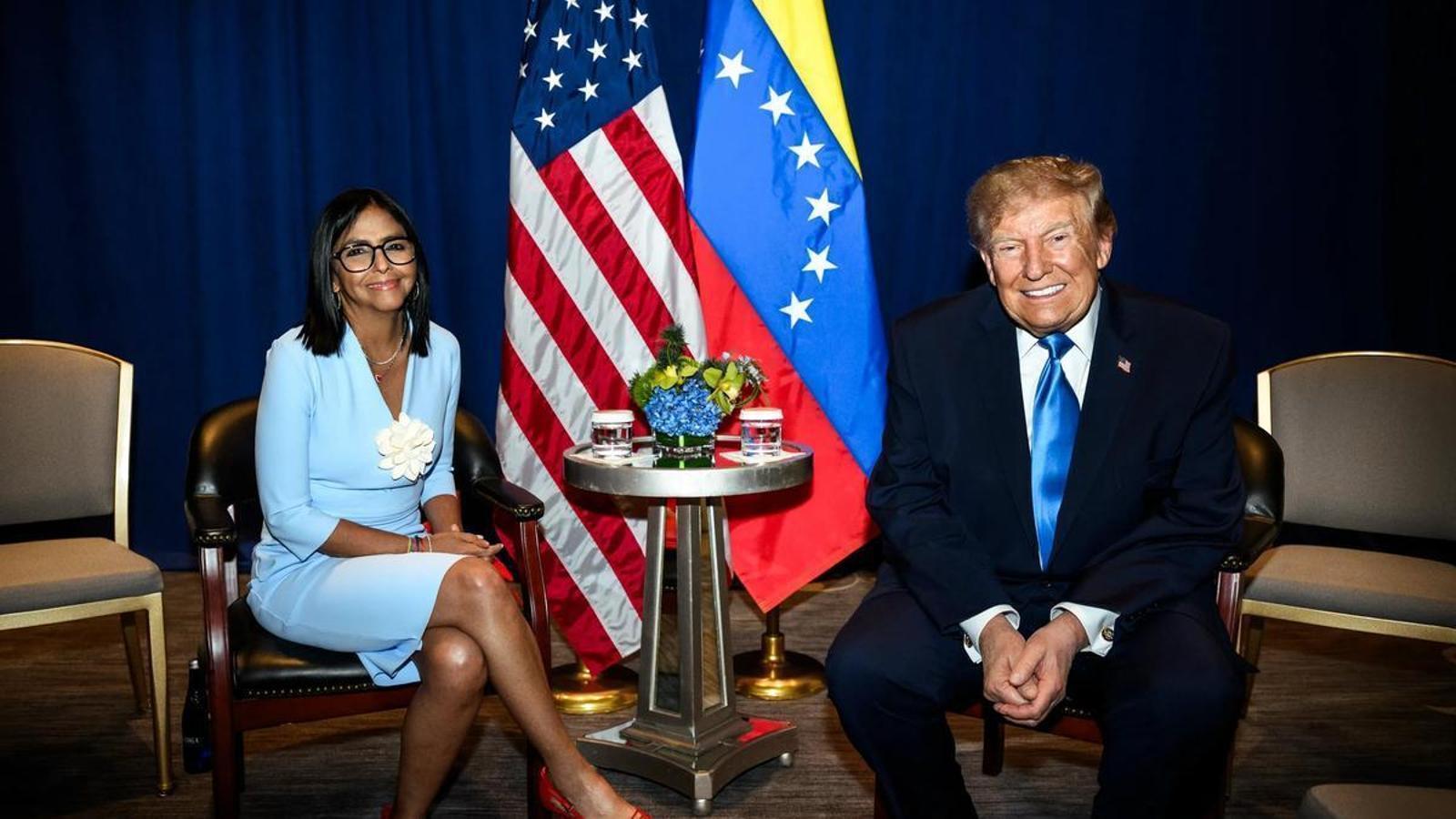
Trump meets with Delcy Rodríguez, who describes the meeting as "historic"
The interim president of Venezuela addresses with the North American leader bilateral cooperation in energy, mining and security, a few kilometers from where Maduro is detained
-
CAT -
CAST
BarcelonaNew York, the city where, 263 days later, Nicolás Maduro remains detained, is the setting in which Delcy Rodríguez and Donald Trump held a meeting this Tuesday on the sidelines of the UN General Assembly. It is the first encounter between a Venezuelan president and a US president in eleven years, and represents one more step –especially symbolic– in the resumption of relations between the two countries. The parade of leaders and officials from the Trump administration through Caracas has been a constant since Washington's military aggression in January, but it is the first time that the person primarily responsible for that operation has met directly with the person who forcibly opened the doors of Venezuela to him to plunder its natural resources.
The meeting took place within the framework of a reception hosted by Trump for foreign leaders participating in the UN high-level week. Rodríguez described the meeting as "historic" and stated that both sides addressed the strengthening of bilateral relations and cooperation in areas such as energy, mining, and security. The interim president also thanked Trump for his "support" for the process of Venezuela's reintegration into multilateral spaces.
The meeting was in a more informal format than the bilateral meetings Trump holds with representatives from France, the United Kingdom, or Japan. According to sources familiar with the preparations, the Venezuelan delegation addressed, in this and other meetings throughout the week, energy and debt-related issues, in which offsets from the United States would come into play, which suggests that Washington and Caracas could close new agreements.
The last time the tenants of the Miraflores Palace and the White House met face to face was in 2015. At that time, Nicolás Maduro and Barack Obama held a brief meeting in Panama, during the Summit of the Americas, at a time when Washington had redoubled sanctions against various Venezuelans and public workers in the country whom it accused of corruption, and had declared Venezuela a "national security threat" to the United States.
Delcy Rodríguez's attendance at the UN General Assembly also marks the first time in eight years that a Venezuelan president has voluntarily set foot on US territory. Upon arriving in the United States, Rodríguez was received at the airport by administration officials, among whom was John Barrett, the United States Chargé d'Affaires to Venezuela. During her first hours in New York, Maduro's successor met with representatives of the World Bank Group and the International Monetary Fund, in an agenda of meetings that a year ago was unthinkable for a Chavista leader.

UN Secretary-General António Guterres has received the Venezuelan leader at the United Nations headquarters in New York. We will have to wait until Wednesday evening (night in Catalonia) to hear what Delcy Rodríguez has to say to the representatives of the countries attending the General Assembly. That is when she will deliver her speech, in the same hall where this Tuesday Trump labeled Cuba a "failed state" and threatened to use military force in Latin America to "protect the national interests" of the United States. A statement that must have stirred up memories for the representatives of Venezuela of that night when the country experienced a near-cinematic military operation.
For the moment, in the General Assembly signature book, Rodríguez has called for strengthening multilateralism to ensure "world peace and stability," nothing further from the reality her country is living, dominated by the omnipresence of the United States and the absence of any significant response, beyond statements, from the rest of the world powers. Furthermore, during the first session this Tuesday, the Chavista leader held a brief conversation with Pedro Sánchez, whom she went to look for while he was sitting in his chair in the UN assembly hall. According to the Spanish government, Rodríguez asked Sánchez to continue talking about the situation in Venezuela. The Spanish leader replied that he is willing to do so and conveyed Spain's commitment to the future of the region.

The latest approaches
Before this Tuesday's meeting, the rapprochement between the United States and Venezuela has experienced two key moments in the last month. At the end of August Donald Trump announced an agreement with Caracas to acquire 65 billion barrels of Venezuelan oil, almost a quarter of the country's crude reserves. The pact directly awards the exploitation concession to the company North American Blue Energy Partners (NABEP), created in 2024 and owned by Alejandro Betancourt, a businessman who made his fortune by accumulating contracts with the Venezuelan administration during the governments of Hugo Chávez.
In exchange, the Pentagon acquires 35% of NABEP's shares and secures oil at cost price in a complicated moment for the sector following the United States' failure to reopen Hormuz and with the Bab el-Mandeb Strait, another key point of global oil trade located in the Red Sea, threatened by the Houthis of Yemen, allies of Iran.
Furthermore, last week the United States removed Venezuela from the list of states that, according to Washington, fail to comply with the fight against drug trafficking. It is an especially significant move after Trump initially justified the aggression against Venezuela as an operation against a "narcodictatorship." Back then, Washington accused Maduro of leading the Los Soles cartel –the existence of which has never been proven– and claimed that this alleged group of drug traffickers was integrated into the country's government structure. Once Maduro was captured and detained in New York, references to this alleged cartel were removed from the indictment against the deposed Venezuelan president.
